
Prabowo and PM Wong Meet: The Two Faces of Indonesia-Singapore Economic Relations
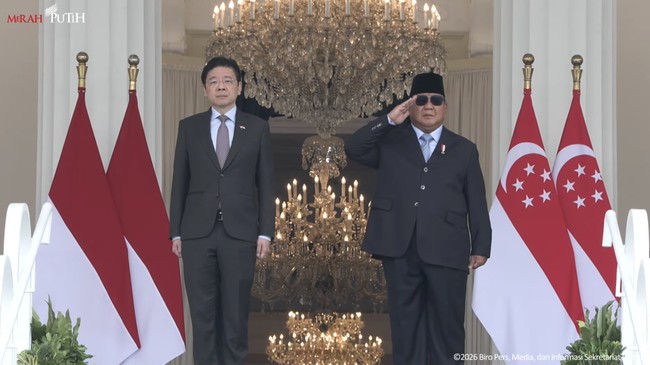
The meeting between President Prabowo Subianto and Singapore Prime Minister Lawrence Wong in Jakarta on Monday (6/7/2026) served as a momentum to reassess Singapore’s significant role in the Indonesian economy. The visit was part of the Indonesia-Singapore Leaders’ Retreat, the highest-level annual bilateral forum between the two countries. During the forum, the two leaders discussed not only political relations and regional issues but also economic cooperation, which has long been one of the main foundations of the relationship.
Singapore has long been known as one of Indonesia’s most strategic economic partners. However, the economic relationship presents two contrasting faces. In terms of goods trade, Indonesia continues to record a substantial deficit. Conversely, in the investment sector, Singapore stands as the largest source of foreign direct investment into Indonesia.
Data from the Ministry of Trade’s Satu Data portal indicates that Indonesia’s trade balance with Singapore remained in deficit during the first half of 2026. From January to June 2026, Indonesia’s exports to Singapore were recorded at US$5.07 billion, a decline of 22.57 percent compared to the same period the previous year. Meanwhile, imports from Singapore reached US$8.90 billion. Although imports also fell by 7.67 percent year-on-year, their value was still significantly higher than exports, resulting in a trade deficit of US$3.83 billion. Assuming a current exchange rate of approximately Rp17,980 per US dollar, this deficit equates to around Rp68.9 trillion.
The data shows that while both exports and imports declined, the larger value of imports kept the trade balance in deficit. The deficit also worsened compared to the same period the previous year, with the trade balance declining by 23.93 percent year-on-year, indicating persistent pressure.
In terms of commodities, Indonesia’s imports from Singapore are dominated by mineral fuels, with a value reaching US$5.13 billion, far exceeding other commodities. Minister of Energy and Mineral Resources Bahlil Lahadalia previously stated in CNBC Indonesia’s Energy Forum that the majority of Indonesia’s fuel imports originate from Southeast Asia, particularly Singapore and Malaysia. He noted that around 62 percent of Indonesia’s imported fuel supply comes from Singapore, 35 percent from Malaysia, and the remaining 3 percent from other countries. The high volume of fuel imports from Singapore is linked to Indonesia’s domestic oil production, which remains unable to meet national consumption needs. Bahlil mentioned that Indonesia’s oil lifting in 2025 was around 605,000 barrels per day, while national oil consumption reached approximately 1.5 million to 1.6 million barrels per day.
Beyond mineral fuels, Indonesia’s imports from Singapore also include significant volumes of industrial machinery and equipment. Imports under HS code 84, covering nuclear reactors, boilers, machinery, and mechanical appliances, were recorded at US$1.19 billion, marking a sharp annual increase of 43.96 percent. Additionally, imports under HS code 85, covering electrical machinery and equipment, reached US$564 million, up 3.50 percent compared to the same period the previous year.
Despite the trade deficit, Singapore exerts considerable influence over direct investment flows into the country. Data from the Ministry of Investment and Downstreaming/BKPM shows that Singapore was the largest source of foreign direct investment into Indonesia in the first quarter of 2026. Investment realisation from Singapore reached US$4.6 billion, equivalent to approximately Rp75.9 trillion using the state budget exchange rate of Rp16,500 per US dollar. Singapore far outpaced other countries, with Hong Kong in second place at US$2.7 billion, followed by China at US$2.2 billion, the United States at US$1.3 billion, and Japan at US$1.0 billion.
The substantial investment from Singapore demonstrates that the country remains a crucial gateway for foreign capital entering Indonesia. The value of Singaporean investment in the first quarter of 2026 was nearly 1.7 times that of Hong Kong, which ranked second. This reinforces Singapore’s position as a vital economic partner for Indonesia, not only as a trading partner but also as a source of funding, a base for regional companies, and a link between Indonesia and global investors.
One of the main reasons Singapore can be the largest source of investment into Indonesia is its status as a global financial centre. Numerous financial institutions, investment companies, private equity firms, venture capital entities, and regional offices of multinational corporations are headquartered in Singapore. This position allows Singapore to serve as a gathering point for global capital before it is channelled to various investment destinations, including Indonesia. Indonesia remains a primary target due to its large market, high development needs, and attractive economic growth potential.
Source: jawawa.id (https://jawawa.id/newsitem/prabowo-and-pm-wong-meet-the-two-faces-of-indonesia-singapore-economic-relations-1783324295)
Originally published by CNBC Indonesia (https://www.cnbcindonesia.com/research/20260706103736-128-748311/prabowo--pm-wong-bertemu-ini-dua-wajah-hubungan-ekonomi-ri-singapura), translated from Indonesian