
Prabowo Allocates Rp175 Billion, Andre Rosiade Confirms Gunung Nago Bridge and Sabo Dam Construction to Begin in November
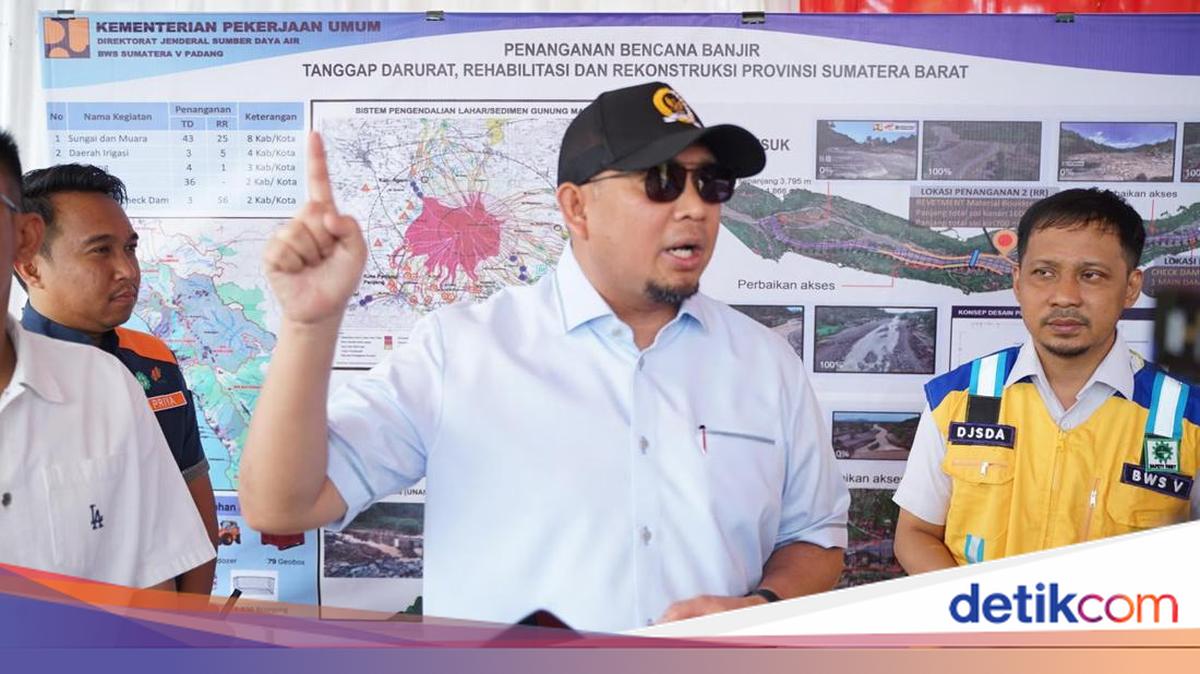
Deputy Chairman of House Commission VI from the Gerindra Party, Andre Rosiade, has confirmed that reconstruction of the Gunung Nago area in Padang, one of the worst-hit locations in the November 2025 galodo disaster, will soon commence. The government of President Prabowo Subianto, through the Ministry of Public Works, has prepared a budget of Rp175 billion for permanent handling of the area.
The confirmation was delivered by Andre during an inspection of Gunung Nago on Friday (21/8), accompanied by Head of the Sumatera V River Basin Agency (BWS) Padang Reski Wahyudi, Head of the West Sumatra National Road Implementation Agency (BPJN) Elsa Putra Friandi, and Head of the West Sumatra Cipta Karya Agency Maria Doeini Isa. During the visit, Andre held direct dialogue with community leaders and residents who have been awaiting certainty over post-disaster repairs.
Andre stressed that the government is not standing idle in the face of residents’ concerns. The tender process has been prepared and is targeted to produce a winner by October 2026, so that physical works can begin in November 2026.
“Today we are answering the public’s question about when Gunung Nago will be repaired. President Prabowo’s government, through the Ministry of Public Works, has prepared the tender. God willing, by October 2026 there will be a winner and in November 2026 work will begin,” said Andre, accompanied by Head of the Gerindra Faction in the Padang Regional House Wahyu Hidayat and Chairman of Commission II of the Padang Regional House Rachmad Wijaya.
According to Andre, permanent handling of Gunung Nago is not merely about repairing a single piece of infrastructure. The works will include construction of a check dam or sabo dam, irrigation repairs, bridge construction, river normalisation, and slope reinforcement on both sides of the river channel. “The total project is Rp175 billion and will be carried out over 24 months, or two years,” he said.
Head of BWS Sumatera V Padang Reski Wahyudi explained that Gunung Nago is one of 25 points included in the permanent post-disaster handling programme in West Sumatra. Previously, BWS had carried out emergency response handling at 43 points, targeted for completion by September 2026.
For permanent handling, Reski said, BWS is now entering the tender preparation phase. The works will be directed primarily at addressing problems in the upstream area, including construction of sediment control structures or sabo dams, while also addressing irrigation and bridges.
“This is already the preparation phase for permanent handling. God willing, this September the tender process will begin, and in October we will be under contract,” said Reski.
Reski explained that the permanent handling is part of the government’s post-disaster rehabilitation and reconstruction programme for a number of points in West Sumatra. For the Gunung Nago area, in addition to sediment control, the works also include handling of the river flow, which has been a source of concern for residents.
Andre assessed that the acceleration of handling demonstrates President Prabowo’s seriousness in rebuilding West Sumatra after the major disaster that struck the region in November 2025.
Andre said the Rp175 billion budget for Gunung Nago is part of a total of approximately Rp19 trillion in rehabilitation and reconstruction funds prepared by the government for West Sumatra. The funds are being disbursed in stages to support recovery across various sectors affected by the disaster. “This Rp175 billion is part of the Rp19 trillion prepared by President Prabowo’s government for rehabilitation and reconstruction funds for West Sumatra Province,” Andre stressed.
Andre also compared the speed of disaster handling this time with previous major disasters. In the 2012 disaster, permanent handling was only carried out in 2017, taking around five years. Meanwhile, the November 2025 disaster is said to be five times larger than the 2012 disaster, yet permanent handling is already beginning less than a year after the disaster.
“The November 2025 disaster is five times larger than 2012. But permanent handling is in October 2026, within 11 months it can already be done,” he said.
Andre said handling of the Gunung Nago area must also look at problems in the upstream area. Flood control infrastructure construction, he said, will not be sufficient if the upstream area is not also restored.
For this reason, Andre has coordinated with the Padang City Government, including Padang Mayor Fadly Amran, to carry out tree replanting in the upstream area. He has also coordinated with Head of BP BUMN and CEO of Danantara Muliaman Hadad regarding the use of state-owned enterprise social and environmental responsibility funds to support the greening programme.
“I have asked the Padang Mayor, through the Environmental Agency, to research how many trees are needed and what species they are. Later we will prepare a budget for planting trees upstream,” said Andre.
For Andre, handling of Gunung Nago must be carried out comprehensively. River normalisation, check dam construction, irrigation and bridge repairs must run in parallel with slope reinforcement and restoration of the upstream area. “So the river is repaired, the dam is installed, we get irrigation, but the area above is also replanted. This must be comprehensive,” he said.
During the dialogue, a number of residents expressed their concerns every time heavy rain falls. Residents hope that flood control works and infrastructure construction will be carried out soon because the river condition remains a source of anxiety.
Andre directly addressed these concerns by confirming that the budget is available and the tender process is underway. He asked the public to be patient because permanent works will begin in November 2026. “President Prabowo’s government is not asleep. The government is committed that the Rp19 trillion we have prepared will be disbursed in stages,” Andre stressed.