
Prabowo Aims to Build 100 GW Solar Power Plants, Requiring Approximately Rp1,800 Trillion
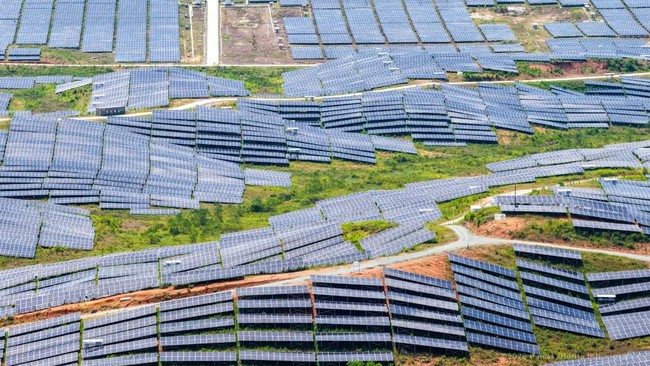
The Indonesian government is preparing a massive investment to realise the construction of Solar Power Plants (PLTS) with a capacity of 100 Gigawatts (GW) over the next three years. The Ministry of Energy and Mineral Resources (ESDM) estimates the funding requirement for this project to reach approximately US$100 billion, or the equivalent of Rp1,811 trillion (assuming an exchange rate of Rp18,112 per US dollar).
The Director General of New, Renewable Energy, and Energy Conservation (EBTKE) at the Ministry of ESDM, Eniya Listiani Dewi, explained that the government is currently aligning all national electricity planning to support this target. This massive funding will require cross-sector collaboration, particularly involving international parties and private companies. “International collaboration and the private sector are certainly essential. Private sector investment is projected to be very large, but we require more than US$100 billion in investment,” Eniya stated during The 50th IPA Convention & Exhibition (Convex) in Tangerang.
The government aims for the majority of the solar project funding to come from the Independent Power Producer (IPP) scheme. Based on calculations, private sector involvement is expected to support up to 70% of the total required investment. “I believe 70% will come from IPPs, so the private sector will join this major programme,” Eniya continued.
The primary focus of the 100 GW solar development is directed towards reducing the use of diesel power plants, which currently dominate Eastern Indonesia. This step is considered economically crucial as the cost of providing electricity from diesel fuel in remote areas is very high. “A large part of the 100 GW solar programme is how to reduce diesel usage in eastern Indonesia. If we talk about diesel usage, there are costs of more than 1 dollar per kilowatt-hour in some locations in our country,” she explained.
By transitioning to solar energy, the government is optimistic about reducing fossil fuel imports while strengthening the national energy security index, which currently stands at 6.7. The Ministry of ESDM is committed to continuously simplifying regulations to facilitate investment in the new and renewable energy sector. “We have strengthened our regulations to make investment easy, business easy, and to eliminate long regulatory and licensing processes,” she concluded.
President Prabowo Subianto is accelerating the transition to green energy, including the target for massive solar power plant construction, aiming for Indonesia to reach an installed capacity of up to 100 GW by at least 2029. Prabowo emphasised that the government will maximise the use of solar energy within the next three years. “We want to move very quickly to use electricity from solar energy. We have a plan and we are determined to move as fast as possible; within three years, we want to achieve 100 gigawatts of solar energy,” Prabowo said at the Indonesia-Japan Business Forum in Tokyo.
The plan to accelerate solar power development is deemed urgent. According to the President, escalating conflicts and growing geopolitical uncertainty, particularly in the Middle East, pose a threat to national energy supply stability. “For us, this is more urgent because the geopolitical situation in the Middle East provides strategic uncertainty for our energy security,” Prabowo asserted.
As a precaution, the government continues to strive to secure supply through the utilisation of domestic resources. In addition to solar power, Indonesia possesses great potential in the geothermal sector and is also boosting the production of biofuels, such as 50% biodiesel (B50) and bioethanol.