
Prabowo Accelerates Electric Motorcycle Conversion, Business Owners: We Are Ready!
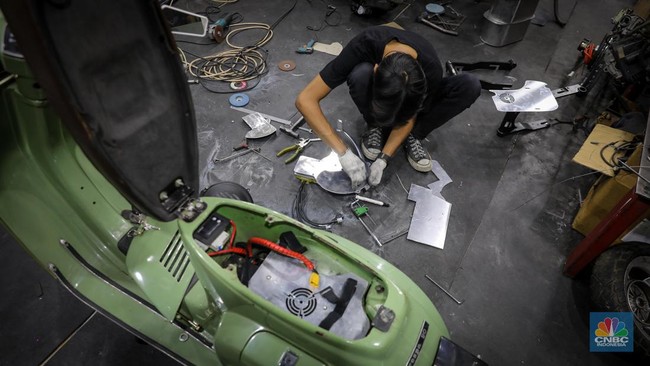
The electric motorcycle industry has stated its readiness to support the government’s programme to convert fuel-powered vehicles to electric ones. However, business actors are still awaiting clarity on targets from the government.
General Chairman of the Indonesian Electric Motorcycle Industry Association (AISMOLI), Budi Setiyadi, said that they have communicated with the government regarding the plan.
“From AISMOLI, we have prepared a letter and conveyed that we are ready to become partners with the government for the conversion programme,” Budi told CNBC Indonesia on Thursday (26/3/2026).
He explained that there are currently several companies focused on the electric motorcycle conversion business, including providers of engines and workshop networks.
“There are already several companies that have dedicated their business solely to conversions,” he said.
The conversion process involves replacing the fuel engine with an electric motor, allowing old vehicles to continue being used.
“The old motorcycle’s engine is dismantled and then replaced with an electric motor,” he clarified.
Meanwhile, the conversion workshop network is already starting to develop, even extending abroad.
“There are workshops with networks across Indonesia, even to Vietnam,” he revealed.
However, he acknowledged that some business actors still rely on imported components, especially for electric motors.
“For small-scale operations, there is still a lot of dependence on imports,” he said.
In its implementation, the conversion programme requires clear regulatory support, including workshop permits and vehicle certification. Conversion workshops must have official permits so that converted vehicles can obtain legal documentation.
“A permit from the Ministry of Transportation is required to obtain SRUT, which will serve as the basis for STNK processing,” he said.
He also emphasised the importance of the government setting targets so that the industry can adjust production capacity.
“Targets from the government are important, so we can consolidate the industry’s capabilities per year or per month,” he said.
According to him, collaboration between manufacturers and conversion actors will be key to the success of this programme.
“Manufacturers are also starting to prepare business schemes to participate in conversions,” Budi stated.