
PPIH Emphasises That Entry to Raudhah Is Free of Charge
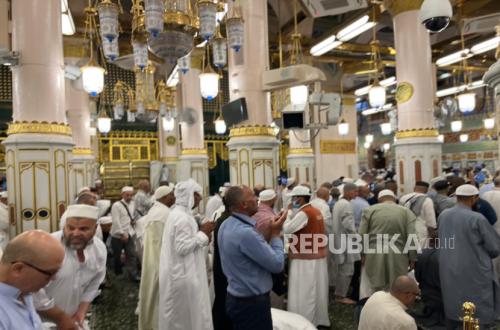
Hajj Service Officers (PPIH) have emphasised that access to Raudhah is free of charge. If any individuals claiming to be officials demand money, pilgrims are advised to report them immediately to the sector officials.
The Head of the Madinah Working Area, Khalilurrahman, explained that facilitation for pilgrims to enter Raudhah is one of the services provided to them. Therefore, every pilgrim has the right to enter Raudhah.
The procedure for group entries involves coordination by ibadah guidance or cluster leaders, forwarded to sector leaders for scheduling. “I emphasise that entry to Raudhah is free. Therefore, if any parties offer services and demand money, report it immediately to us or the Nabawi special sector,” he stated on Tuesday (28/4/2026).
According to him, there has been a rise in scams or irresponsible individuals posing as officials and demanding payment. His side will not tolerate such violations, including those by Hajj and Umrah guidance groups that charge fees for Raudhah entry.
Meanwhile, the Head of the Ibadah Guidance and Hajj and Umrah Guidance Group Section of the Madinah Working Area, Efrilen Hafiz, has asked Indonesian Hajj pilgrims not to worry about opportunities to worship in Raudhah. His team has prepared a special tasreh (permit letter) scheme designed to accommodate all pilgrims to enter the area known as the Garden of Paradise.
Hafiz explained that they are currently managing three special accounts for tasreh applications via a web-based system. Based on the latest data, these efforts have yielded significant results.
“A total of 18,682 pilgrims have already obtained tasreh. This means there are still around 10,000 pilgrims currently in the application process to soon get entry schedules,” he clarified.
To access Raudhah, Saudi Arabia enforces strict rules. Access is only possible using barcodes obtained through the group tasreh scheme or the Android-based Nusuk app for independents. There is good news regarding age regulations. Previously, Saudi policy limited Raudhah entry to pilgrims aged up to 41 years. However, through a memorandum of understanding (MoU) and intensive negotiations, this limit has been raised.
“Alhamdulillah, after the memorandum of understanding, the maximum age limit has been raised to 60 years. For pilgrims over 60, we will still accommodate them through special mechanisms,” Hafiz said.
To address quota limitations and technical challenges for the elderly, the Madinah Working Area implements a cross-subsidy scheme. The mechanism encourages pilgrims under 40 or those tech-savvy to register independently via the Nusuk app. The barcodes obtained by younger pilgrims through Nusuk are then used as a basis to transfer official tasreh applications to pilgrims over 60.
This cross-subsidy mechanism does not deprive younger pilgrims of their rights. They can still register independently via Nusuk at any time, as long as the registration is done while in the Prophet’s Mosque area.
Regarding implementation, collective tasreh barcodes are held by the Nabawi Special Sector. Ibadah guidance officers in each sector then coordinate the entering pilgrims. For example, if one tasreh covers a quota of 150 people, the sector must ensure those 150 pilgrims gather first.
“So the barcode is not distributed freely to sectors. This is done to ensure the entire quota in the tasreh is fully utilised and no quota is wasted during checks by Prophet’s Mosque officials at the Raudhah entrance,” he said.