
PPA Site BIB Increases Training Investment Alongside Manpower Growth
Jakarta, TopBusiness — PT Putra Perkasa Abadi (PPA) Site Borneo Indobara (BIB) has recorded growth in its total manpower alongside an increase in investment for employee competency development throughout 2025. The total manpower at PPA Site BIB reached 4,166 employees, an increase from 3,897 employees in 2024.
This growth in manpower has been accompanied by an expansion of competency development programmes. Total training costs rose from approximately Rp3.399 billion in 2024 to Rp6.640 billion in 2025, representing an increase of 95.35 per cent.
Group Leader HCGA of PPA Site BIB, Daniel Marhazan Putra, stated that the increase in training investment is part of the company’s efforts to balance manpower growth with enhanced employee competence.
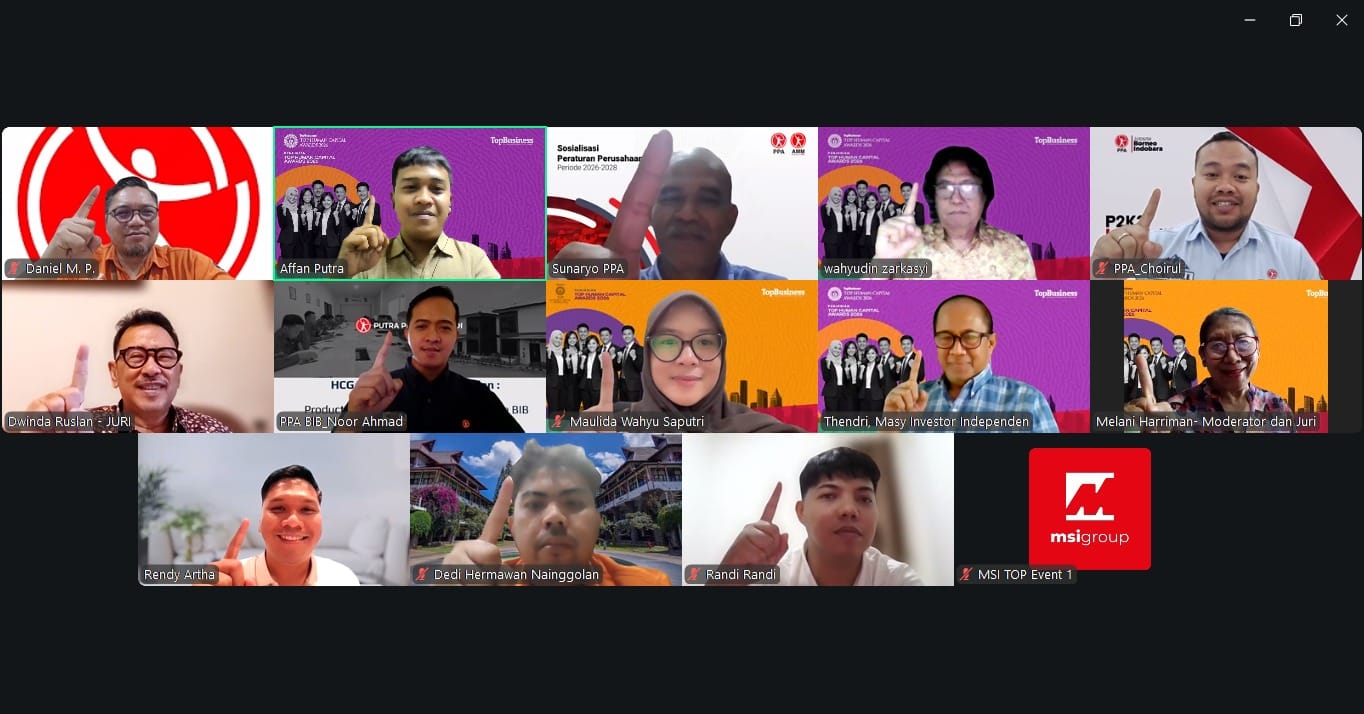
“Manpower growth certainly needs to be balanced with competency development. Therefore, increasing training is a vital part of ensuring employees receive development that meets job requirements,” Daniel told the judges of the TOP Human Capital Awards 2026 via an online session from Jakarta on Tuesday (22/09/2026).
The increase in training programmes is also evident in the average training time received by employees. Manpower training rose from 52.13 hours per person in 2024 to 60.59 hours per person in 2025, an increase of 16.21 per cent. Meanwhile, the number of employees participating in training programmes increased significantly, from 969 employees in 2024 to 1,797 employees in 2025, an increase of 85.57 per cent.
Of the total 4,166 employees, the majority are workers supporting operational activities. Specifically, 3,152 people, or 75.7 per cent, are operators and mechanics. Furthermore, 634 people (15.2 per cent) are Group Leaders, 3ly 312 people (7.5 per cent) are non-operator employees, 55 people (1.3 per cent) are Section Heads, and 13 people (0.3 per cent) are Department Heads.
In terms of workforce status, the composition of local and non-local employees remains relatively balanced. Local employees numbered 2,091 (approximately 50.2 per cent), while non-local employees numbered 2,075 (approximately 49.8 per cent). Regarding gender, the PPA Site BIB workforce is still dominated by men, accounting for 4,120 people (98.9 per cent), while female employees number 46 (1.1 per cent).
In line with organisational growth, total management costs from 2024 to 2025 increased by 0.81 per cent. Meanwhile, total compensation costs increased by 0.84 per cent, from approximately Rp15.9 billion in 2024 to Rp16.066 billion in 2025. This increase is part of the dynamics of manpower management alongside the growing number of workers and company operational needs.
Regarding employee retention, PPA Site BIB also recorded a 39.6 per cent decrease in voluntary separation in 2025 compared to the previous period. According to Daniel, the reasons for voluntary separation found among employees generally related to personal decisions, particularly family factors.
“Alhamdulillah, voluntary separation in 2025 decreased by 39.6 per cent. Generally, the reasons provided by employees were more related to personal wishes and family factors,” he explained.
With manpower growth accompanied by increased investment in competency development and a decrease in voluntary separation, PPA Site BIB continues to strengthen human resource management as part of its support for the company’s operational sustainability.
PPA BIB is strengthening people-based transformation. PPA BIB places the human aspect, or ‘people’, as a vital element in conducting activities and organisational transformation. This approach is part of the company’s strategy to ensure that every change proceeds in tandem with human resource development.
Daniel stated that the company adopts a Human Capital Strategy with the principle of “Deliver Results Through People”. He noted that people play a crucial role in every activity and transformation process within the organisation.
He explained that the role of humans is also reflected in leadership. For the company, leadership is not merely defined as a structural position or rank, but as a catalyst that drives change within the organisation.
“From a leadership perspective, we see that leadership is not just about a position. Leadership must be a catalyst for change,” said Daniel.
In addition to strengthening leadership, the company also encourages the growth of innovation and critical thinking as part of the work culture. These two aspects serve as the foundation for employees in carrying out daily activities and facing various business challenges.
Daniel noted that innovation and critical thinking abilities are expected to emerge not only when the company faces major changes but to become a habit in daily work.
“We also continue to increase the fuel for innovation and critical thinking. This is the foundation of every activity and daily task. Therefore, we always place innovation and critical thinking at the forefront,” he said.
In its implementation, this human development strategy is also supported by the use of technology. The company views technology as an enabler that can help employees perform activities more effectively.