
PP Muhammadiyah Urges President to Personally Lead Corruption Eradication
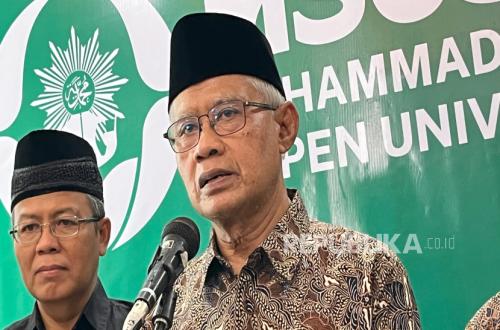
YOGYAKARTA – The recent string of alleged corruption cases has drawn attention from various quarters. From cases implicating regional governments to suspected involvement of law enforcement officials, the series of scandals is seen as increasingly eroding public trust in Indonesia’s corruption eradication efforts.
Haedar Nashir, Chairman of the Muhammadiyah Central Board, believes the situation shows that corruption has entered an alarming phase. He has even asked President Prabowo Subianto to take a direct role in coordinating all state institutions to wage an integrated war on corruption.
“Corruption has reached an emergency stage. As head of government, the President needs to personally lead the eradication of corruption through the institutions the state has established,” said Haedar on the sidelines of a meeting with the Forum of Rectors of Muhammadiyah and Aisyiyah Universities (PTMA) in Yogyakarta.
Haedar said corruption is now a major national problem on a par with poverty and limited employment opportunities. Its resolution therefore cannot be partial, but must be tackled through structured, massive and systemic measures.
He viewed the various recent alleged corruption cases—such as the discovery of 74 kilogrammes of gold bars and hundreds of billions of rupiah in cash in Sentul, as well as cases dragging in law enforcement officials—as an alarm bell for all state institutions. In his view, no institution should feel immune from the legal process.
“Nevertheless, the entire process must still respect the principle of presumption of innocence and be proven through legal mechanisms,” he said.
Haedar also applauded the courage of authorities investigating alleged corruption within law enforcement circles. For him, that boldness can become a moment to strengthen public confidence in the rule of law. He cautioned that eradicating corruption cannot rely solely on moral appeals or religious approaches.
“It is not enough just to keep urging and urging. Even the power of religion has its limits when facing a problem that has become structurally embedded in the system,” he said.
For that reason, Haedar urged all law enforcement institutions—the Police, the Attorney General’s Office, the KPK, the BPK and other oversight bodies—to work to the same rhythm. He also asked all ministries and state institutions to set aside sectoral egos for the sake of the nation. According to him, differences of view between institutions are natural, but they must not obstruct the great agenda of corruption eradication.
“This massive corruption must be tackled collectively within one strong system and orchestra. Only through a system can we eradicate corruption,” he said.
Separately, Haedar also invited civil society, community organisations and all elements of the nation to continue safeguarding the anti-corruption agenda. He described the war on corruption as long-term work that must in fact be accelerated. “Corruption eradication is long-term work. But there must be no slowing down. What is needed is acceleration, so that Indonesia truly has a clean government,” he said.