
Power, Surveillance and the Decency of Governance: Democracy’s Maturity and Love of the Republic Put to the Test
One measure of a state’s maturity is not how much power it possesses, but how strong the systems are that constrain that power.
A strong state is not one whose officials can monitor anyone without limits, but one that ensures every power is exercised in accordance with the law, for a legitimate purpose and with public accountability.
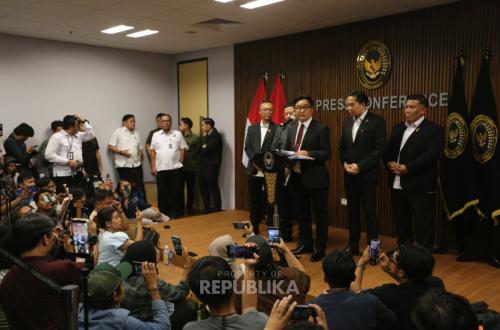
The naming of three police officials, including former National Police chief General Listyo Sigit Prabowo, as suspects in an alleged illegal-surveillance case involving the President and a number of officials, political figures, media workers, civil society organisations, NGOs and businesspeople is a serious matter.
The Criminal Investigation Department (Bareskrim) said the alleged surveillance took place in 2025–2026 and was accompanied by the alleged deletion of electronic data. The legal process is ongoing, so everyone’s right to the presumption of innocence must be respected.
This incident should not be viewed merely as a criminal case involving several individuals. It raises a more fundamental question: how could powers granted by the state to protect society and maintain security allegedly have been used outside legal procedures?
If the allegations are proven, we face serious questions about the limits of power, institutional accountability, the protection of citizens’ rights and public trust.
From the perspective of the sociology of law, the issue touches on the fundamental relationship between power, law and society. The law should be an instrument for limiting power, not merely a tool for regulating society.
Power, law and the danger of personal loyalty
Max Weber explained that the modern state rests on legal-rational authority. This means that the legitimacy of officials and bureaucracies comes not from personal influence, proximity or a leader’s wishes, but from formal powers granted and limited by law.
The consequence is clear: public office is not private property, and institutional authority is not an unlimited mandate. An official may make decisions only to the extent that the law grants them the power to do so. Even a superior’s instruction is not automatically lawful if it contravenes the law.
This is why it is important to distinguish loyalty to an individual from loyalty to the constitution. State officials need discipline and a chain of command.
But organisational discipline must not eliminate each official’s moral and legal responsibility. Obedience to a superior cannot justify actions that exceed one’s authority.
Through his idea of the separation and limitation of powers, Montesquieu warned that unchecked power can lead to arbitrariness. This principle is all the more relevant when the state has the technology to access people’s communications, data and private activities.
The greater the state’s surveillance capacity, the stronger the mechanisms for overseeing the state itself must be. No institution—let alone any private group—should wield such extensive powers without commensurate oversight.
When information becomes an instrument of power
We live in a digital society in which information is not merely a source of knowledge, but also a source of power. Control over a person’s data, communications and digital activities can affect their freedom, social standing and even political life.
Through his analysis of discipline and surveillance, Michel Foucault showed how surveillance can shape human behaviour. People who feel they are constantly being watched may restrict themselves, even when there is no direct intervention. In the digital context, the ability to gather and process information makes the relationship between the state and citizens increasingly unequal unless it is constrained by law.
Surveillance, therefore, should not be treated as a purely technical matter for law-enforcement officials. It concerns privacy, freedom of communication, security, and citizens’ right to express their thoughts without the threat of arbitrary monitoring.
Of course, surveillance can be a legitimate instrument in law enforcement and national security. But its legitimacy must be determined by a legal basis, a legitimate purpose, proportional necessity, authorisation procedures and oversight that can be scrutinised.
Political philosopher Philip Pettit describes freedom as non-domination: a condition in which a person is not subject to the threat of arbitrary interference by someone wielding power. From this perspective, the question is not only whether someone was actually monitored, but also whether the state has room to intervene in people’s lives without limits or accountability.
The state must be strong enough to protect society. But that strength must not become an instrument for subjugating it.
A test for the rule of law
The rule of law cannot be judged merely by the number of regulations or the existence of law-enforcement agencies. The more fundamental test is whether the law truly applies to everyone, including those with office, influence and access to power.
In The Morality of Law, Lon L. Fuller stressed the importance of consistency between rules as laid down and their implementation. The law loses legitimacy when it is imposed only on ordinary people while those in positions of authority can act beyond the same limits.
This case must therefore test the principle of equality before the law. Rank, office, networks of power and political connections must not be grounds for evading accountability. The law must be enforced without discrimination.
But the principle also has a converse implication: legal proceedings must not become an instrument for targeting someone for political reasons. Being named a suspect is not the same as being found guilty. Evidence must be obtained lawfully, legal rights must be guaranteed, and the final decision must be left to an independent judicial process.
We must avoid two extremes: assuming that senior officials could never commit violations, or treating someone as guilty before a court has proved it. A mature state governed by the rule of law demonstrates its strength by enforcing the law firmly and fairly at the same time.
Do not stop at blaming ‘rogue individuals’: examine the system
In institutional sociology, misconduct cannot always be explained solely by an individual’s character. Organisational factors, workplace culture, chains of command, oversight mechanisms and incentive structures can create opportunities for the abuse of authority.
Therefore, if an alleged violation is described as the act of a ‘rogue individual’, that explanation must not bring the review to an end. The questions must go further: how could it happen, who was responsible for oversight, were procedures followed, and why did control mechanisms fail to prevent or detect it earlier?
Robert K. Merton warned that bureaucracy can become dysfunctional when adherence to procedures and hierarchy becomes an end in itself. Officials may prioritise obedience to the organisational structure over the substantive purposes of the law. Robert Michels, meanwhile, used the idea of the ‘iron law of oligarchy’ to describe the tendency of large organisations to concentrate decision-making within an elite group.
These perspectives offer an important lesson: institutions cannot be built on hierarchy and authority alone. They need transparency, oversight, mechanisms for correction and meaningful accountability.
Institutional reform must therefore go beyond replacing officials or punishing individuals. There must be a comprehensive review of surveillance procedures, authorisation systems, data recording and storage, digital audits, external oversight, and protections for personnel who report misconduct.
Replacing people without fixing the system risks repeating the same problems under different names and with different perpetrators.
Meritocracy and the character of power
A developed state requires meritocracy. Public office should be filled on the basis of competence, capability, track record and integrity, not personal connections, patronage or political loyalty.
But meritocracy must not be reduced to technical ability and administrative performance. Someone may be highly intelligent, experienced and professionally skilled without necessarily having the character to exercise authority responsibly.
The state needs officials who can not only carry out instructions, but also understand the limits of their authority and have the courage to reject orders that violate the law. Competence without integrity can produce a bureaucracy that is technically sophisticated but dangerous in its use of power.
Meritocracy must therefore go hand in hand with public ethics. Recruitment, promotion and the evaluation of officials should take account of integrity, independence, professionalism and their record of respecting the law. Conflicts of interest must be monitored, and sanctions for abuse of office applied consistently.
A nation’s progress is determined not only by the quality of those in its highest offices, but also by the quality of the systems that ensure everyone performs their duties properly.
Loving the Republic does not mean endorsing power
A misconception in public life needs to be corrected: criticism of officials is often treated as criticism of the state, while oversight of the authorities is sometimes portrayed as hostility towards institutions.
But the state is not identical to the government currently in power. The government exercises a constitutional mandate within defined limits and for a specified term. The state is far broader than the individuals, offices or political groups currently in control of the government.
Loving Indonesia does not mean endorsing every action of those in power. Rather, love of country should be expressed by safeguarding the constitution, scrutinising the exercise of authority, pursuing justice and ensuring that state institutions work in accordance with their mandates.
Hannah Arendt distinguished power, which grows from people’s ability to act together, from the use of instruments of violence or coercion. Legitimate power rests not only on the ability to command and compel, but also on public trust and support.
Public trust is therefore an essential resource in the life of the state. An institution may have formal powers under the law, but its credibility depends on consistency between its legal mandate and its actual conduct.
Safeguarding the dignity of the Republic does not mean turning a blind eye to misconduct. On the contrary, a great state is one that dares to correct itself. A strong institution is not one that is never criticised, but one capable of accepting scrutiny, acting against violations and improving its governance.
Civic decency and responsibility across generations
From the perspective of the sociology of Islamic law, power must always be assessed in relation to the public good. The principle of maslahah provides a framework for judging whether policies and the exercise of authority genuinely protect life, reason, property, dignity and people’s rights. Power loses its moral meaning when it serves office-holders more than the public.
Through the concept of asabiyyah, Ibn Khaldun explained the importance of social solidarity to the survival of society and political power. But solidarity can decline when it turns into group fanaticism and elite interests take precedence over the collective good.
Indonesia must not become an arena for rival groups vying for influence. The national interest must come before personal, family, network or factional interests. But the interests of the state must not be equated with those of the government. The national interest should mean protecting sovereignty, public safety, the constitution, justice and the continuity of the nation.
This is where national character acquires its substantive meaning. Character cannot be measured solely by symbolic piety, identity or formal obedience. It is reflected in how people exercise authority, treat one another, respect the law and account for their actions.
Pancasila must function as a living public ethic in the conduct of citizens and institutions alike. Belief in God demands moral responsibility; humanity requires respect for human dignity; unity places the national interest above group interests; democracy affirms that power derives from the people; and social justice requires laws and policies that are non-discriminatory.
The responsibility for safeguarding Indonesia’s honour belongs not only to the President, ministers, officials or law-enforcement agencies. Every citizen has a responsibility towards the nation’s future. But the greater a person’s authority, the greater the responsibility they must bear.
For a nation’s quality is determined not only by who leads it, but also by the character of its people, the integrity of its public servants and the willingness of all elements of society to put the common good above personal interests.
Restoring power to its constitutional purpose
The alleged illegal-surveillance case must be resolved through an independent, transparent and reviewable legal process. If violations are proven, accountability must be enforced regardless of rank or position. If systemic weaknesses are found, they must be addressed comprehensively.
The state must also ensure that every surveillance measure has a clear legal basis and legitimate purpose, strict authorisation procedures, auditable digital records and independent oversight mechanisms in accordance with the law.
More broadly, meritocracy, professionalism, transparency and accountability must form the foundations of government. No public office should provide immunity from the law. Nor should criticism of those in power automatically be treated as a threat to the state.
Love of the Republic is not a cult of power. It is fidelity to the nation’s constitutional aspirations: a sovereign state, just laws, limited power, institutions with integrity and respect for human dignity.
The highest measure of a state’s greatness is not how extensively it can monitor its people, but how consistently it can oversee, limit and account for its own power.
From a human rights perspective, surveillance is not merely a technical matter of law enforcement or the exercise of official authority. It raises fundamental questions about respect for human rights.
The rights to privacy, personal security and freedom of communication are constitutional rights inherent to every person. Arbitrary surveillance conducted without a legal basis and proper procedures therefore violates those rights.
Source: jawawa.id (https://jawawa.id/newsitem/power-surveillance-and-the-decency-of-governance-democracys-maturity-and-love-of-the-republic-put-to-the-test-1793811102)
Originally published by Republika (https://opini.republika.co.id/berita/tnz8p2320/kekuasaan-penyadapan-dan-keadaban-bernegara-kematangan-demokrasi-dan-cinta-nkri-diuji), translated from Indonesian