
Poverty Alleviation MSF Begins Collaborative Action in Three Villages
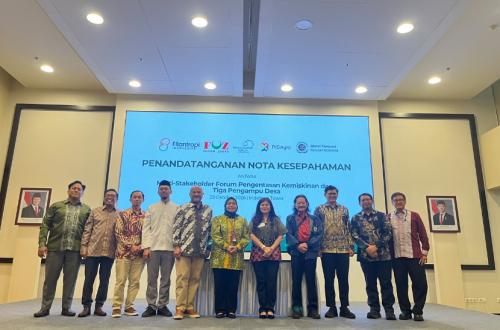
JAKARTA — Poverty alleviation programmes run by various organisations continue to face fragmentation because of differences in target groups, assessment methods and intervention models. This risks overlapping assistance, leaving service gaps and undermining the sustainability of community empowerment.
The Multi-Stakeholder Forum (MSF) for Poverty Alleviation and the Coordinating Ministry for Community Empowerment (Kemenko PM) have begun a collaborative programme in three villages to address the problem. A total of Rp8.5 billion has been allocated for three pilot projects through a blended-finance scheme, with funds disbursed in stages.
The villages selected for the programme are Ciseureuheun, Panyingkiran Kidul and Karyawangi. Human Initiative, Rumah Zakat and DT Peduli are respectively responsible for implementation in each village.
Dyah Tri Kumolosari, deputy for social welfare improvement coordination at Kemenko PM, said poverty alleviation required synergy between the government and other stakeholders. The strategy should cover reducing household expenditure burdens, increasing incomes and reducing pockets of poverty.
Dyah said Statistics Indonesia’s (BPS) March 2026 National Socio-Economic Survey (Susenas) showed that the national poverty rate had fallen. However, poverty levels, depth and severity remained higher in rural areas than in urban areas.
This makes it important to use villages as the foundation for poverty alleviation programmes. Planning and assessment are needed to ensure empowerment interventions match the needs and potential of local communities.
“Poverty alleviation is not just about reducing the poverty rate; it is also about creating opportunities for poor families to live more decent lives, develop their potential and become self-reliant. That is why we support collaboration through the MSF, so that various resources and empowerment programmes can be integrated and sustainable, and deliver tangible benefits to village communities,” Dyah said at the initial launch of the MSF programme in Jakarta on Thursday (29 October 2026).
The MSF was established in August 2025 by the Indonesia Philanthropy Association (PFI), the Zakat Forum (FOZ) and the Indonesian Humanitarian Forum (HFI). The collaboration was later strengthened through partnerships with the Partnership for Indonesia’s Sustainable Agriculture (PISAgro) and the UN Global Compact Network Indonesia (IGCN), bringing together networks of more than 700 member organisations and partners.
Rizal Algamar, chair of the Indonesia Philanthropy Association’s governing board, said poverty alleviation collaboration involved more than simply bringing together a large number of organisations. Each party needed to align its understanding of the problem, its action plan and its contribution to the community, he said.
“We do not want collaboration to stop at the number of organisations attending a forum. The MSF aims to align understanding of the problems, action plans and each party’s contribution, so that support for villages reinforces itself. The important measure is not how many activities are added, but whether communities receive better-connected support and have a greater chance of sustaining their progress,” Rizal said.
Before selecting the pilot locations, the MSF assessed hundreds of villages. Of more than 450 villages proposed, 178 were analysed, 60 were shortlisted and three were ultimately selected for the initial implementation.
The selection process involved workshops, business-model discussions, field assessments and village consultations. The Sustainable Livelihoods Framework (SLF) was used to map community needs and livelihood assets as the basis for designing the programmes.
Romi Ardiansyah, deputy chair of the MSF for Poverty Alleviation and chair of the Indonesian Humanitarian Forum, said implementation must reflect village communities’ priorities. Collaboration between organisations should complement programmes already under way, rather than create separate new activities.
“The strength of collaboration lies in connecting existing programmes with additional support that is genuinely needed. Those responsible for the villages must ensure partners’ contributions follow community priorities, rather than creating separate activities. This allows organisations’ experience, residents’ knowledge and sectoral expertise to complement one another in implementation,” Romi said.
The MSF programme covers six priority areas: poverty alleviation, health, education, economic empowerment, climate and the environment, and campaigns and communications. Each area is being developed through programme modules that partners can use as a basis for providing support according to village needs.
Wildhan Dewayana, deputy chair of the MSF for Poverty Alleviation and chair of the Zakat Forum, said empowerment programmes should strengthen communities’ economic capacity and institutions. Assistance should also support the long-term sustainability of residents’ livelihoods.
“Going beyond aid does not mean ending support that residents still need. It means connecting support with stronger capabilities, livelihoods and local institutions so that change can last. Through the programme modules, we invite partners to contribute according to their strengths, with village needs as the starting point and self-reliance as our shared goal,” Wildhan said.
The programme will be carried out in three phases: stabilisation, strengthening and self-reliance. Its targets include increasing household incomes, strengthening village-owned enterprises (BUMDes) and improving the community’s economic independence.
To measure the programme’s results, the MSF has prepared a Theory of Change framework, a Monitoring, Evaluation and Learning system, and Social Return on Investment measurement. These approaches will assess the programme’s impact on communities, not merely the number of activities completed.
The MSF aims to expand the programme to more than 100 villages by 2030. Achieving village self-reliance is a longer-term target set for 2031.