
Poultry Farmers Discard and Give Away Chicken Eggs for Free to Residents, What's Going On?
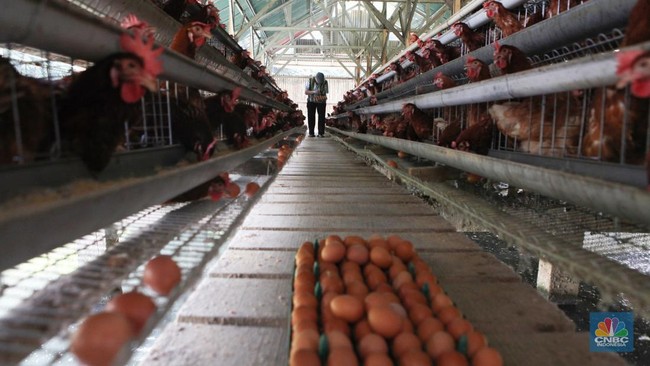
The condition of national poultry farmers is far from satisfactory. Live chicken and egg prices at the farm level continue to move below the government’s reference prices, while production costs are rising due to the high cost of feed raw materials and heavy burdens in the upstream sector.
For broiler chickens or live birds, the government’s Reference Purchase Price (HAP) is currently at Rp25,000 per kilogram. However, in the field, live chicken prices at the farm level are still around Rp16,000-Rp18,000 per kilogram. Meanwhile, the production cost (HPP) for broilers has now reached about Rp20,000-Rp21,000 per kilogram.
For layer hen eggs, the HAP is set at Rp26,500 per kilogram. However, the current selling price at the farm level is only around Rp22,000 per kilogram. On the other hand, the HPP for layer hen eggs has reached about Rp21,000-Rp22,000 per kilogram, depending on the scale of the farmer’s business.
This situation has made business margins for farmers increasingly thin, with many even incurring losses. In recent times, actions involving distributing and discarding eggs have been widely carried out by some farmers as a form of protest against the plummeting prices at the coop.
Chairman of the National Poultry Farmers Community (KPUN), Alvino Antonio, said that the action is actually intended to bring the farmers’ issues to the attention of the public and the government.
“It’s already happened several times. Actually, it’s not about wasting eggs; they would prefer to distribute them. So, discarding eggs is just to make it go viral,” Alvino said during AGRIMAT at NICE PIK 2 on Friday (8/5/2026).
According to him, the discarded eggs are only a small portion. The majority are still distributed to the community so they do not go to waste.
“But actually, they have already distributed them; they are distributing them. The discarded ones are only a little because they realise that rather than throwing them away, many people need them,” he said.
Amid the ongoing pressure, issues regarding a production strike by farmers are starting to emerge. Nevertheless, Alvino hopes that such a step does not occur, as it could directly impact food supply and prices for the public.
“As for striking, I hope it doesn’t happen. Because if farmers strike, it would be unfortunate for consumers; everything would be troublesome,” Alvino said.
He stated that farmers are currently still hoping for the government to provide permanent solutions to maintain price balance and the sustainability of smallholder farming businesses. This is because production costs continue to rise in line with the high cost of feed raw materials, which are partly influenced by US dollar movements.
“Today, all livestock feed raw material prices are rising. So, naturally, farmers’ HPP increases accordingly,” he said.
Similar complaints were voiced by the Chairman of the Prosperous Poultry Farmers Cooperative (KPUS) in Central Java and Kendal, Suwardi. He assessed that the problems in the national livestock industry are not only about low selling prices but also due to high dependence on imports of raw materials and numerous levies in the food production chain.
According to Suwardi, certain raw material distribution policies are actually contributing to a 20% increase in feed prices, which directly burdens farmers.
“Don’t let the government create legal products, for example, shifting BKK (Special Work Exchange) from private to Berdikari, resulting in feed prices rising 20% today. Is this fair and wise for us?” he said.
Suwardi believes that egg and chicken prices can actually be kept down if upstream sector governance is improved and the prices of main raw materials can be controlled by the government. Maize, soybean meal, and bran are mentioned as the largest components in forming farmers’ production costs.
“If we want egg prices at Rp25,000, is it possible? Yes. The key is to manage the upstream sector fairly and wisely,” he said.
He also asked the government to consistently implement rules on the allocation of cultivation portions between large integrators and smallholder farmers so that independent smallholder businesses still have room to survive amid industry pressures.
“If we want strong food sovereignty to become a sovereign nation, please don’t shackle our stomachs with taxes,” Suwardi stated.
Source: jawawa.id (https://jawawa.id/newsitem/poultry-farmers-discard-and-give-away-chicken-eggs-for-free-to-residents-whats-going-on-1778248453)
Originally published by CNBC Indonesia (https://www.cnbcindonesia.com/news/20260508162510-4-733546/peternak-buang-buang-telur-ayam-dan-bagikan-gratis-ke-warga-ada-apa), translated from Indonesian