
Potential for Development in Yogyakarta: Budi Mulia Dua Culinary School Re-launches Entrepreneurship Training
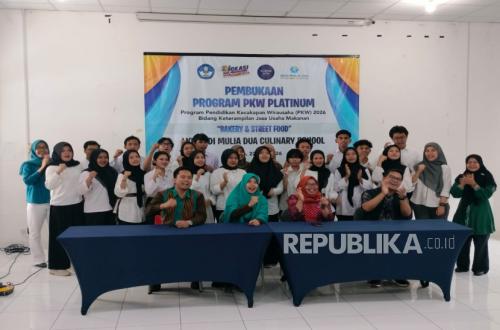
The Budi Mulia Dua Culinary School (LKP) has officially launched its 2026 Entrepreneurship Competency Programme (PKW). This free culinary training programme specifically targets the general public to produce resilient new entrepreneurs in the street food and bakery sectors.
Ani Syafaatun, head of LKP Budi Mulia Dua Culinary School, stated that the choice of the street food and bakery sectors was based on the high market demand in Yogyakarta, which continues to grow alongside the development of public spaces and changing lifestyles. “We believe that food, particularly street food and bakery products, holds great potential for development in Yogyakarta. Bakery products, in particular, are needed throughout all stages of life, presenting a massive business opportunity,” Ani said during the programme’s opening on Friday (22/5/2026).
This year, the number of participants accepted into the programme, which is sponsored by the Ministry of Primary and Secondary Education (Kemendikdasmen), has been adjusted. While previous programmes accommodated up to 40 participants, the quota is now limited to 25 people due to budget efficiencies from the central government. Despite this, LKP Budi Mulia Dua successfully maintained its programme quality, achieving a Platinum category after undergoing rigorous interviews and evaluations by the central government.
“With the platinum category, we can provide more sessions and a higher amount of assistance. We are very grateful for this mandate to help community members facing financial difficulties with training costs,” she said.
Over approximately 4s5 days, equivalent to 350 teaching hours, participants will receive intensive training ranging from cooking skills to business management, as well as assistance with business equipment upon graduation. Bakery participants will receive mixers and ovens, while street food participants will be provided with business booths, stoves, and steaming equipment as initial capital.
The programme also addresses the phenomenon of viral foods on social media. Participants are taught not only to create visually appealing products but also to implement strategies to maintain their businesses for long-term growth. “Going viral is easier now thanks to food vloggers and social media. However, we emphasise to our students that they must not just appear for three months and then disappear; they must maintain their branding,” Ani explained.
Learning materials this year have been made more adaptive to market trends, including innovations such as spicy melting doughnuts and spicy ‘cireng’ with creamy sauce. All materials have been prepared in digital video formats to facilitate the understanding of modern culinary business practices.
The success of the BKI programme is evident in its alumni. One 2024 graduate, Depri, now successfully operates a Dimsum business well-known among Yogyakarta students. Starting as a non-culinary vocational graduate and a former ride-hailing driver, his business has expanded to four strategic outlets near Unisa, UMY, and UAD campuses. “One of our alumni came from an underprivileged family. Starting with just a small table and assistance from this programme, he now employs 16 people with a monthly turnover of around Rp90 million,” Ani recalled proudly.
Reni Tri Puji Astuti, Head of Early Childhood and Community Education at the Sleman Regency Education Office, appreciated Budi Mulia Dua’s ability to maintain the central government’s trust. According to her, institutions that pass the PKW programme are those with good accreditation, transparent budget management, and clear accountability to students.
Reni added that the trend of non-formal education in Sleman is showing positive development despite central government budget efficiencies. This year, seven institutions in Sleman successfully secured training and business capital assistance from the central government, an increase from five institutions last year. The Sleman Regency Government is now focusing on strengthening institutional development to ensure training quality remains high, capable of producing new entrepreneurs who can withstand competition in the culinary industry.