
Portrait of the eFishery Scandal and Indonesia's Fisheries Ecosystem
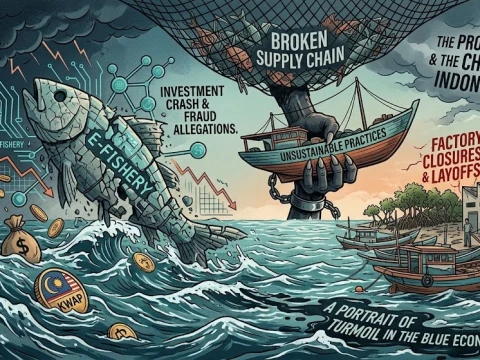
As the world’s largest archipelagic nation with the second-longest coastline, Indonesia theoretically holds the key to the future of global maritime food. This is a blessing from Allah SWT, which must be maintained and cared for as a form of gratitude, as Allah SWT says in Surah An Nahl, Verse 14: “And He it is who has subjected the sea [to His laws] so that you might eat fresh meat from it, and take from it gems which you may wear; and on that you might see the ships ploughing through the waves, so that you might go forth in quest of some of His bounty, and thus have cause to be grateful.”
The massive potential of aquaculture and capture fisheries has for years been a magnet for billions in international investment funds. The sector, initially considered traditional, experienced a surge of optimism when the wave of maritime digitalisation arrived, positioning aquaculture technology (aquatech) startups as new heroes for local fish farmers.
However, that optimism collapsed instantly when reports of alleged planned fraud surfaced, dragging eFishery, one of the national fisheries digitalisation players, into the spotlight. This scandal is no longer merely an internal corporate matter but has become a diplomatic issue that tarnishes the credibility of Indonesia’s investment climate at the regional level. Recently, Malaysian Prime Minister Anwar Ibrahim publicly revealed that the Malaysian civil service pension fund manager, Retirement Fund Inc (KWAP), was a victim of major fraud due to its investment in eFishery. From the total funding raised in 2023, the Malaysian civil service pension fund suffered a staggering loss, estimated at more than Rp850 billion. Internal investigations and legal proceedings revealed that eFishery’s former management carried out extreme financial engineering to attract capital.
The collapse of the fisheries business
The domino effect of the collapse of trust in this upstream digital sector is also being felt on the stability of the real sector domestically. The re-emergence of the eFishery scandal coincides with a worrying trend in the fisheries business, such as the collapse of various conventional fish processing industry lines and similar startups in Indonesia. Both paint a bleak picture that the national fisheries business ecosystem is in poor health. For example, in early 2025, another major fisheries startup, Aruna, officially announced mass layoffs (PHK) for up to 40 per cent of its total employees.
Meanwhile, in the downstream sector over the past several years, fish processing factories have been collapsing due to a crisis in raw material supply and soaring operational costs. In East Java, a wave of layoffs hit PT. Bahari Biru Nusantara in Lamongan and the Muncar fisheries industrial area in Banyuwangi due to a crisis in fish landings and what were described as uncertain export regulations. Not only that, PT. Cilacap Samudera Fishing Industry (PT CSFI) was also forced to furlough and lay off dozens of employees due to economic pressures in the maritime sector. This crisis has even dragged down state-owned enterprises, with PT. Perikanan Indonesia (Perindo) having to take efficiency measures in the form of mass layoffs of its workers in several regional units, such as in Subang, West Java, which triggered strong rejection from labour unions who deemed the process lacking in transparency.
Questioning sustainable fisheries
The phenomenon of faltering fisheries businesses and startups confirms a systemic vulnerability in the supply chain from upstream to downstream. This shows that Indonesia’s fisheries system is not sustainable. Referring to Anthony Charles’s view in Sustainable Fishery Systems (2023), the sustainability of a fishery system cannot be measured solely by the volume of commodities produced, but must synergise four binding main components: ecological sustainability, socio-economic sustainability, community sustainability, and institutional/governance sustainability. Charles emphasises that sustainable institutional aspects demand good governance, transparency, and financial health with integrity.
Looking at the eFishery case, it clearly fails to meet these aspects. Fraudulent practices create uncertainty that not only harms foreign investors but also damages the international reputation of Indonesia’s maritime business law. Meanwhile, the government’s inconsistent export policies also demonstrate a lack of sustainability. The mass layoffs carried out by startups and fisheries businesses clearly place the community in the most vulnerable position, as they lose access to markets through digital ecosystems and lose their jobs. This proves that the business ecosystem built so far is extremely fragile and lacks adequate community resilience buffers when shocks occur. Charles underlines that the success of the fisheries economy must be distributed fairly and guarantee long-term resilience for coastal communities and small-scale fishers and farmers to achieve a sustainable community.
Finally, reckless exploitation without regard for water carrying capacity and feed waste management ultimately damages the long-term ecosystem, leading to a decline in national harvest quality. Although the government, through the Ministry of Marine Affairs and Fisheries, has various instruments for sustainable fisheries, the fact remains that many capture fisheries businesses still use environmentally unfriendly fishing gear. This clearly poses a direct threat to ecological sustainability. The series of negative events, from investment fraud that harms the government’s image to layoffs in local fisheries businesses, must serve as an important signal for policy.
Source: jawawa.id (https://jawawa.id/newsitem/portrait-of-the-efishery-scandal-and-indonesias-fisheries-ecosystem-1785264618)
Originally published by islam.nu.or.id (https://islam.nu.or.id/opini/potret-sengkarut-efishery-dan-ekosistem-perikanan-indonesia-MOWi9), translated from Indonesian