
Portrait of Gazans Working from Displacement Tents
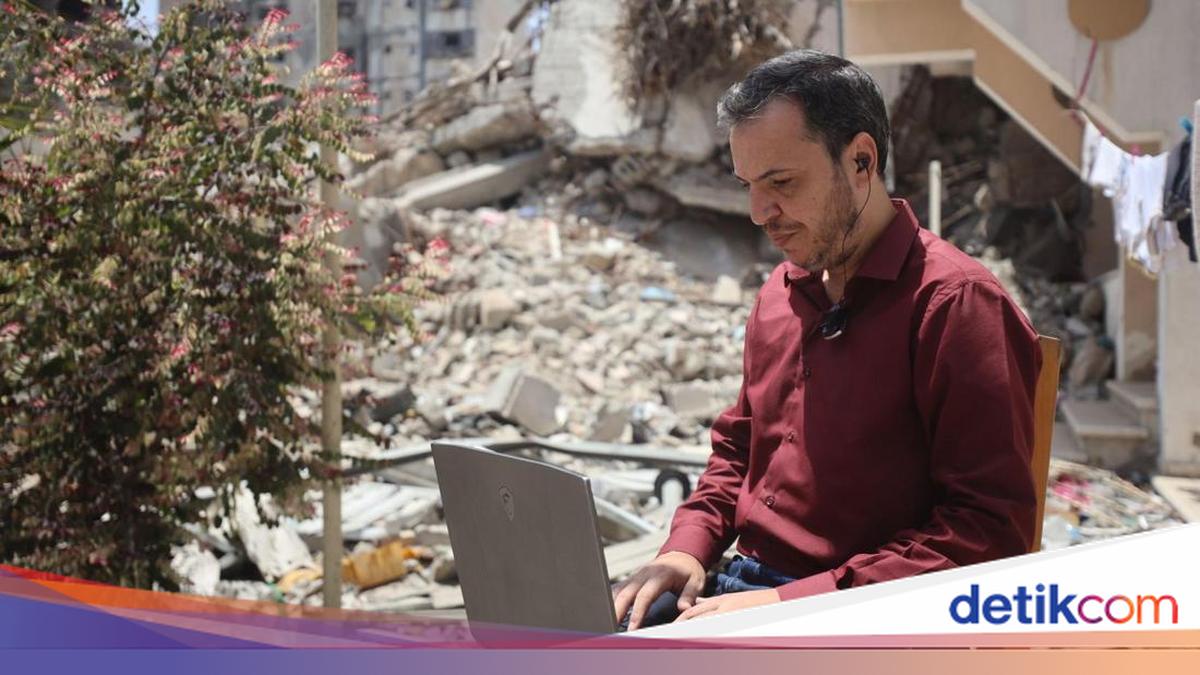
Amid the devastation of war and high unemployment, a growing number of Gazans are turning to the digital economy to survive.
For some of them, online work for clients abroad has become one of the few remaining opportunities to earn an income.
“I felt like I was sinking, drowning in uncertainty,” said Walaa Volidis, a Palestinian software engineer.
“But deep down, I made a decision: this would not be the end, no matter how difficult the situation. I would keep fighting for my dreams.”
Wearing a headset and staring at her laptop screen, Walaa joined a video call with her mentor in Silicon Valley, California, to discuss artificial intelligence (AI). The 24-year-old is determined to keep updating her skills.
However, maintaining her professional relevance is only a small part of the challenges she faces every day. Walaa now lives in a tent in central Gaza while supporting her displaced parents and four younger siblings.
“When the war began, I lost everything: my job, my university, even some of my family members. My sisters were also injured,” Walaa said from a co-working space in Deir al-Balah.
She admitted that her mental health was “completely shattered” at one point, but amid that situation she prioritised her efforts to find work.
Walaa is one of thousands of Gazans now trying to build careers in the digital economy.
“It gives me a push to keep moving,” she said.
“Every day I have a clear goal: go to work and complete my tasks. If you just stop and lament your circumstances, you won’t be able to do anything.”
Several new co-working spaces have opened across various parts of Gaza.
Amid the sprawling rubble of Gaza, most of the territory’s two million residents now depend on humanitarian aid to survive.
Opportunities to earn a decent income are extremely limited.
The United Nations says the unemployment rate in Gaza has exceeded 80%, a sharp increase from around 22% before the war.
“We now call it a kind of digital lifeline,” said Nicole Hark from the American humanitarian organisation Mercy Corps.
“The idea is simple: if you have a laptop and a working internet connection, you can still work and earn an income.
“This is crucial to help people get back to work. They don’t want to keep depending on humanitarian aid.”
Before the latest devastating war in Gaza erupted, the territory actually had a rapidly growing technology sector.
The conflict was triggered by the Hamas-led attack on Israel in October 2023.
For years, Israel and Egypt imposed a blockade on the Hamas-controlled territory on security grounds.
Under strict border restrictions, remote work such as programming, design, and software development became a way for many young Gaza graduates to break through their isolation.
Gaza Sky Geeks was founded in 2012 by Google and Mercy Corps. Initially, the organisation aimed to foster the emergence of technology start-ups.
However, its three bustling activity centres also organised coding training and provided mentoring for Gazans wanting to access international markets. Two of those centres were destroyed during the war.
Mercy Corps now supports a number of new co-working spaces that have sprung up across various parts of Gaza.
These places rely on generators and solar panels to provide better internet connections and more stable electricity supplies.
This support has become crucial because Gaza’s electricity system is almost completely paralysed, while around 75% of the telecommunications network in the territory is reported to be damaged or destroyed by the war.
“I started everything from scratch, truly from zero, to build a new career,” said Tarik Zaeem from a co-working space in Gaza City.
Before the war, the 44-year-old served as chief technology officer at a local company. Now he works as a freelance programmer.
“When I’m working in front of my laptop, I forget everything. I forget what has happened,” Tarik said.
Recently, he developed a booking application for a barbershop and a valet parking app for a client in Saudi Arabia.
Most of Tarik’s income is used to support his wife and three children, who now live in neighbouring Egypt. At the start of the war, he used all his savings to help them leave Gaza.
However, receiving payment remains a challenge in itself. Only a few bank branches have resumed operations in Gaza, while cash is extremely scarce.
Palestinians also face various restrictions in the international banking system, and Gaza residents cannot register on most digital payment platforms.
Some people can receive money through relatives living abroad. Others, however, rely on intermediaries in Gaza who charge high fees to convert electronic transfers into cash.
Tarik said these conditions often mean he receives only about half of the payment he is actually owed.
“The amount is not enough to live decently,” he said. “It’s only enough for basic needs.”
Although the US-mediated ceasefire last year, as well as the latest agreement between the Board of Peace and Hamas to promote peace, remain in effect, Israeli strikes in Gaza continue almost daily.
Israel says the strikes target Palestinian armed groups.
According to the Hamas-run Gaza Health Ministry, at least 1,250 people, including 265 children, have been killed since the ceasefire in October. The ministry’s data is considered reliable by the UN.
Tarik recalled an air strike that occurred outside the co-working space where he works in Gaza City in June.
In that incident, a Palestinian female student who was taking an online exam was killed in the street. Israel stated that the target of the strike was a Hamas member and that it had sought to avoid civilian casualties.
Amid the ever-present risks, another tech worker in Gaza said he feels the need to reassure prospective clients that his team can still complete projects for mobile applications, websites, and advertising materials.
“If we get an IT project that takes three to four months, we usually tell the client: ‘Please be aware that all the work will be done online. If we are killed, your work will still be completed and delivered to you’,” said Mahran Bayed.
Mahran lives in a tent with his wife and three young children, not far from their destroyed home near the ruins of Al-Shifa Hospital in Gaza City.
The hospital complex was repeatedly targeted by Israeli strikes during the war.
Israel accused Hamas of using the facility as a command and control centre, an allegation the group denies.
“I lost all my equipment, lost my home, lost my office,” Mahran recalled.
“At that moment I felt as if this was the end of everything in Gaza.”
Now, Mahran has found both an escape and a new purpose through freelance work creating mobile applications, websites, and advertising materials.
“From Gaza, I can collaborate with teams in different parts of the world and work with people I have never met before,” he said.
“That is one of the things I love most about technology.”
However, Mahran still faces an additional obstacle. His laptop screen was damaged by an Israeli strike, so he has to carry an external monitor wherever he works.
Repair workshops in Gaza do their best to fix computers by using spare parts from other damaged devices. But their capabilities are inevitably limited.
The Israeli defence authority, Cogat, which controls Gaza’s border crossings, categorises computers and computer components as “dual-use” items, meaning goods that can be used for both civilian and military purposes. As a result, imports of these items are banned from entering Gaza.
Despite facing numerous difficulties, many tech workers in Gaza recognise that they are still relatively more fortunate than many other residents.
Back in Deir al-Balah, Walaa received help from TAP, a Palestinian-Dutch social impact start-up, which helped her connect with mentors, career coaches, and potential employers.
Recently, she managed to secure a full-time job at a company based in Dubai.
Now, Walaa is focused on improving the daily lives of her younger siblings and finding a way for one of her sisters, who is nearly 13 years old, to be evacuated from Gaza for medical treatment.
Her sister suffers from lymphoedema, a chronic condition that causes severe swelling in the legs, after sustaining a trauma-related injury.
“My first hope is to help my family have a better life and help my sister get out of Gaza so she can receive treatment,” Walaa said.
“Beyond that, I am also working for myself, looking for scholarships so I can continue my journey and studies outside Gaza.”
While Gaza’s overall recovery remains stalled, the tech workers in the territory offer a glimpse of a brighter future that may still be achievable.
Source: jawawa.id (https://jawawa.id/newsitem/portrait-of-gazans-working-from-displacement-tents-1786103703)
Originally published by detikcom (https://news.detik.com/bbc-world/d-8608934/potret-warga-gaza-bekerja-dari-tenda-pengungsian), translated from Indonesian