
POPSI: Regulatory updates must keep pace with palm oil downstreaming
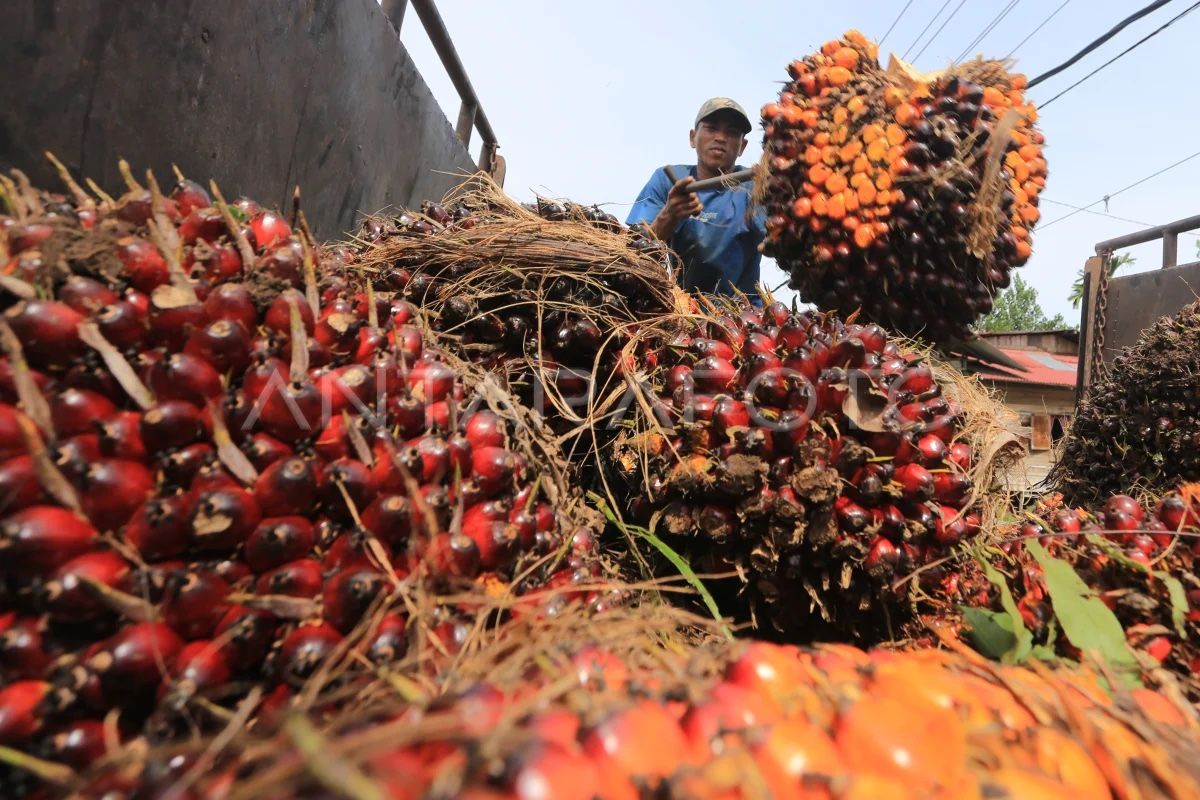
Jakarta (ANTARA) - The Indonesian Palm Oil Farmers’ Organisation Association (POPSI) believes that regulatory updates need to be encouraged alongside the rapid development of downstream palm oil product innovations.
POPSI General Chairman Mansuetus Darto, in a statement in Jakarta on Saturday, stated that one of the primary regulations requiring accelerated updates is the Ministry of Industry Regulation Number 32 of 2024 concerning the Classification of Palm Oil Derivative Commodities.
According to Darto, regulatory updates that align with the acceleration of palm oil downstreaming are expected to overcome trade barriers and potentially increase national revenue.
“Downstreaming is part of an interconnected palm oil ecosystem, starting from farmers as raw material providers, palm oil mills, refineries, oleochemical processing, trade, up to export markets,” said Dargo.
“Therefore, when an obstacle occurs in one link of the downstream chain, the impact does not stop at the downstream level. Pressure can ripple back to previous links in the chain and ultimately affect the absorption capacity of fresh fruit bunches (FFB) from farmers,” he added.
POPSI considers a significant issue to be the development of oleochemical products that are not yet listed or adequately accommodated in Ministry of Industry Regulation Number 32 of 2024. These products are by-products, residues, or the results of purification and fractionation from products that are substantively still within the palm oil-based oleochemical processing group.
On the other hand, Ministry of Industry Regulation Number 32 of 2024 has accommodated various further processed products, including methyl ester and fatty matter.
“This condition shows that product development can produce variants, fractions, intermediate products, advanced purification products, and by-products that continue to evolve,” said Darto.
He noted that Indonesia has produced approximately 200 types of downstream products in 2024. The nation’s speed in identifying, testing, classifying, and providing regulatory certainty for new products is a vital component of downstreaming competitiveness.
“Therefore, Indonesia must not allow its regulations to move slower than the development of its own products,” he said.
According to him, when a new product can technologically be produced, a market is available, and buyers exist, but the classification is not yet adequately provided, a gap emerges between innovation, regulation, and trade.
“We must not let a situation arise where a product can be made and buyers are ready, but exports are stalled simply because the nomenclature or classification has not been updated,” said Darto.