
Pope Leo XIV Diagnosed with Cancer: A Look at Popes’ Medical Histories
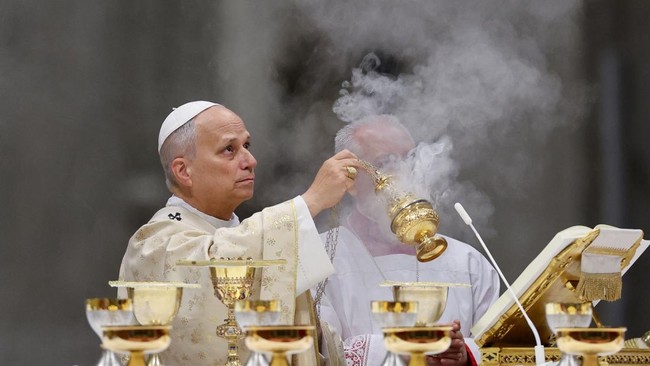
Jakarta, CNBC Indonesia — The health of the leader of the Catholic Church has once again drawn worldwide attention after the Vatican confirmed that Pope Leo XIV had been diagnosed with lung cancer and had undergone surgery to remove part of his lung.
The 71-year-old Pope underwent surgery at Gemelli Hospital in Rome, Italy, on Tuesday (13 October 2026). Doctors removed the lower lobe of his right lung after tests found cancerous tissue growth.
Reuters reported that tissue test results confirmed Pope Leo XIV had lung adenocarcinoma, one of the most common types of lung cancer. The operation lasted about 90 minutes and was declared successful, with no complications.
The latest information on Wednesday (14 October 2026) indicated that Pope Leo XIV had spent his first night after surgery calmly and was in a stable condition. However, he still requires observation and is expected to recover in hospital for about a week.
The Vatican has cancelled all the Pope’s public engagements until 20 October 2026. A trip to South America scheduled for November remains dependent on how his health develops.
The Vatican has not yet disclosed the cancer’s stage or whether it has spread to the lymph nodes. This information is needed to determine whether the Pope will require further treatment.
Pope Leo XIV’s condition has again drawn attention to earlier leaders of the Catholic Church who faced serious illnesses during their papacies. Some continued their duties until the end of their lives, while others chose to resign as their physical abilities declined.
Popes who died or resigned because of their health
Historical records show that several popes faced serious illnesses during their leadership, including kidney disorders, malaria, heart disease and cancer.
Research into historical records and medical studies indicates that at least 23 popes since the 15th century had documented medical histories, including John XXIII, who suffered from stomach cancer, and John Paul II, who had Parkinson’s disease.
Of the 23 popes on the list, 22 ended their papacies by dying in office, while only one — Benedict XVI — resigned in 2013 because of declining physical and mental strength associated with old age.
It should be noted that some of the medical conditions on the list are based on historical research and were not necessarily the direct cause of the popes’ deaths.
Why do popes rarely resign?
In the tradition of the Catholic Church, the papacy is generally held for life. However, there is no written rule requiring a pope to remain in office until his death.
According to U.S. Catholic, this tradition is linked to the view that the papacy is a spiritual calling rather than merely an administrative position. As a result, some popes have chosen to continue their duties despite serious illness.
For example, Pope John Paul II remained in office despite having Parkinson’s disease. He regarded suffering as part of his spiritual responsibility. Benedict XVI, by contrast, resigned in 2013 after concluding that he no longer had the physical and mental strength needed to lead the Catholic Church.
In law, a pope is permitted to resign. Canon Law, canon 332, paragraph 2, states that the decision must be made freely and clearly announced, and does not require anyone else’s acceptance.
Retirement rules for Catholic Church leaders also differ. Bishops are generally asked to submit their resignations at the age of 75, whereas there is no retirement age or fixed term for the Pope.
This helps explain why changes of pope occur more often because of death than resignation. Benedict XVI’s decision nevertheless showed that an inability to carry out the role may be grounds for ending a papacy.
Effects on politics and the economy
The Pope’s health is a concern not only for Catholics but also for the Vatican’s diplomatic activity. As head of the Catholic Church and head of state of Vatican City, the Pope has a role in a range of international issues, from peace to humanitarian affairs.
When a pope is unable to perform his duties, some diplomatic engagements may be postponed. The Vatican government nevertheless continues to function through relevant officials, including the Secretary of State.
The Associated Press (AP) reported that Catholic Church law does not set out in detail how power is to be transferred if a pope is alive but unable to carry out his duties. A formal change of leadership occurs only when a pope dies or resigns.
The economic effects are more apparent in Rome’s tourism and hospitality sectors, particularly during a change of leadership in the Catholic Church.
For example, the death of Pope Francis in April 2025 brought hundreds of thousands of mourners and a number of world leaders to the Vatican. According to CoStar data, hotel occupancy in Rome reached 88.8% on 25 April 2025, the day before his funeral, with an average room rate of €351.13 per night.
Ultimately, the Vatican’s influence extends beyond religious and diplomatic affairs to include an economic dimension. Changes in papal leadership show how a global religious event can drive tourist visits and local economic activity, particularly in Rome.
Source: jawawa.id (https://jawawa.id/newsitem/pope-leo-xiv-diagnosed-with-cancer-a-look-at-popes-medical-histories-1791989495)
Originally published by CNBC Indonesia (https://www.cnbcindonesia.com/research/20261014144732-128-776138/paus-leo-xiv-didiagnosis-kanker-ini-daftar-paus-riwayat-penyakitnya), translated from Indonesian