
Pontianak receives Rp157.11 billion LSDP programme for waste management
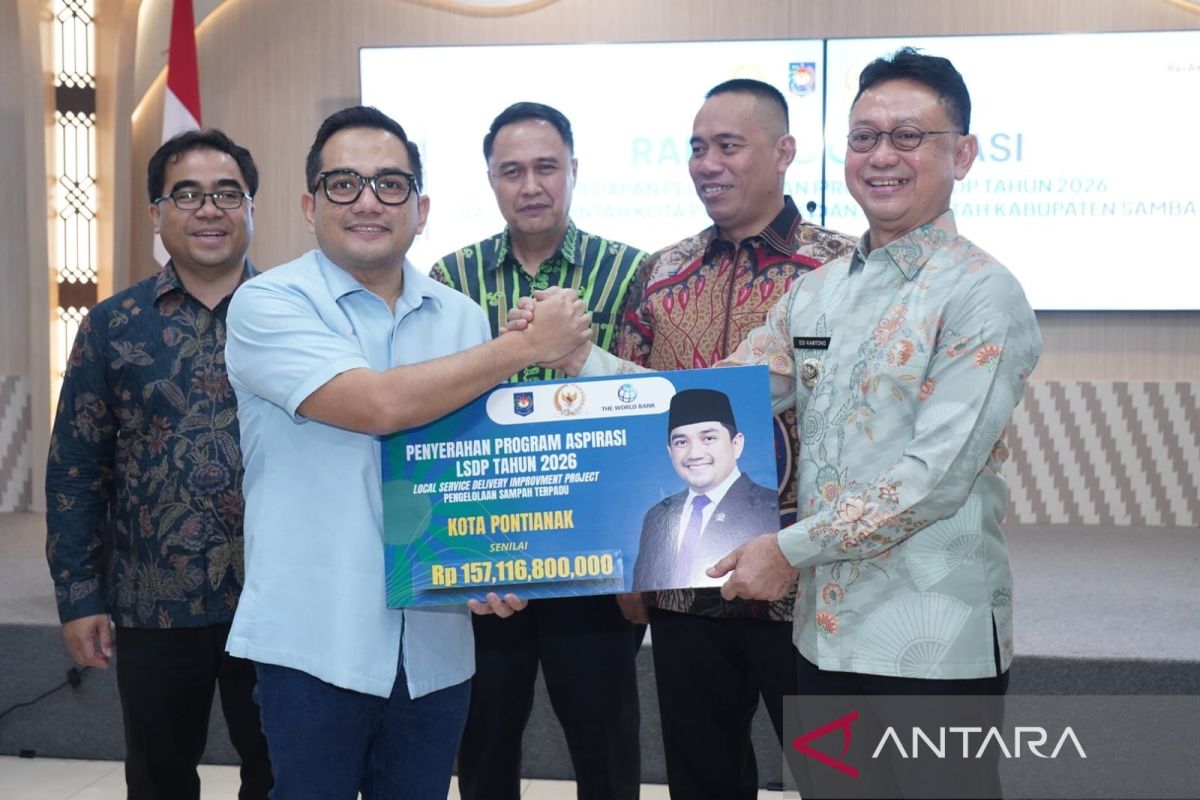
Pontianak, West Kalimantan, has received the 2026 Local Service Delivery Improvement Project (LSDP) aspiration programme worth Rp157.11 billion to support integrated waste management.
“This programme is directed at strengthening waste management from the community level up to processing facilities so that waste entering the landfill can be reduced and have economic value,” said Pontianak Mayor Edi Rusdi Kamtono in Pontianak on Saturday.
He said the support is an important momentum for the Pontianak city government to accelerate improvements to its waste management system.
“Waste management must be carried out in an integrated manner, from upstream to downstream. The community, government and businesses must all be involved,” he said.
Based on 2025 data released in 2026, Pontianak’s population reached 690,969 people. With waste generation of around 0.7 kilograms per person per day, the waste produced reaches approximately 483.68 tonnes per day or 176,542 tonnes per year.
The Pontianak city government has taken a number of waste processing steps. One of them is through the Edelweis Integrated Waste Processing Site (TPST), which processes organic waste using biodigesters, black soldier fly (BSF) or maggots, and composting.
“Plastic waste is also processed through pyrolysis to produce fuel oil,” he said.
Through LSDP support, this management will be strengthened with a more integrated system. The Pontianak city government has designed a concept of one sub-district, one 3R waste processing site (TPS 3R), landfill development, and the construction of the Batu Layang TPST with a processing capacity of around 300 tonnes per day.
Edi said infrastructure development is also accompanied by efforts to turn waste into a source of economic value. The city government has prepared cooperation for the utilisation of waste processing outputs, including compost and fuel oil.
“The hope is that waste, which has so far been a burden, can be processed into something that has economic value and can support the sustainability of waste management,” he said.
“I hope Pontianak City and Sambas Regency can provide the best example in waste management with the support of this LSDP programme,” he stressed.
According to Rifqinizamy, the programme must produce real benefits for the community. Waste management must not stop at building facilities or establishing institutions, but must produce products that have economic value.
“We want TPS 3R to grow in urban wards and villages, then TPST can be formed. The result will be products that truly provide a positive economic impact to the community,” he said.
He also revealed investment opportunities from China in urban waste management, including for the development of waste-to-energy power plants. According to him, these opportunities could become a follow-up development after strengthening the system through LSDP.
“I am ready to bring together colleagues from the Ministry of Home Affairs, Bappenas and the Ministry of Environment because they are ready to invest without using our state budget or regional budget funds at all,” he said.
Rifqinizamy also emphasised the importance of changing community behaviour. According to him, cleanliness issues require not only infrastructure but also discipline in protecting the environment.
“The land is the same. Only two things make the most difference: first, discipline, and second, cleanliness. Hopefully one of these two can be resolved gradually through the LSDP programme,” he said.
Local governments are encouraged to strengthen education, behaviour change and community groups starting from the source of waste.
“If the upstream approach, which includes education, community behaviour change and strengthening community groups, is not carried out, the programme will not run optimally,” said Iwan.
According to him, TPST will be directed to produce economically valuable products such as refuse-derived fuel (RDF), compost and other products. These outputs can be sold, support operational costs, and potentially increase regional revenue.
“TPST development is directed so that waste can be processed into economically valuable products, such as RDF, compost and other products that can be sold, increase locally generated revenue, or support operational costs,” he said.
The programme also includes support for waste transport facilities from the source to processing facilities, including dump trucks, three-wheeled vehicles and household waste transport equipment.
Iwan added that LSDP implementation will use a performance-based approach through a Performance Based Grant. Local governments will be assessed based on established indicators and targets, including planning and financial management aspects.
“During implementation, local government performance will be assessed based on established indicators, categories and targets,” he said.
“The ultimate benefits are expected to be felt directly by residents, from a cleaner environment, reduced landfill burden, increased processing capacity, to the emergence of economic opportunities from waste that has so far been an urban problem,” said Iwan.