
Poltracking Proposes 5 Strategic Policies to Support the People
NU has been urged to focus on advancing the community, particularly in the fields of economy, education, and health.
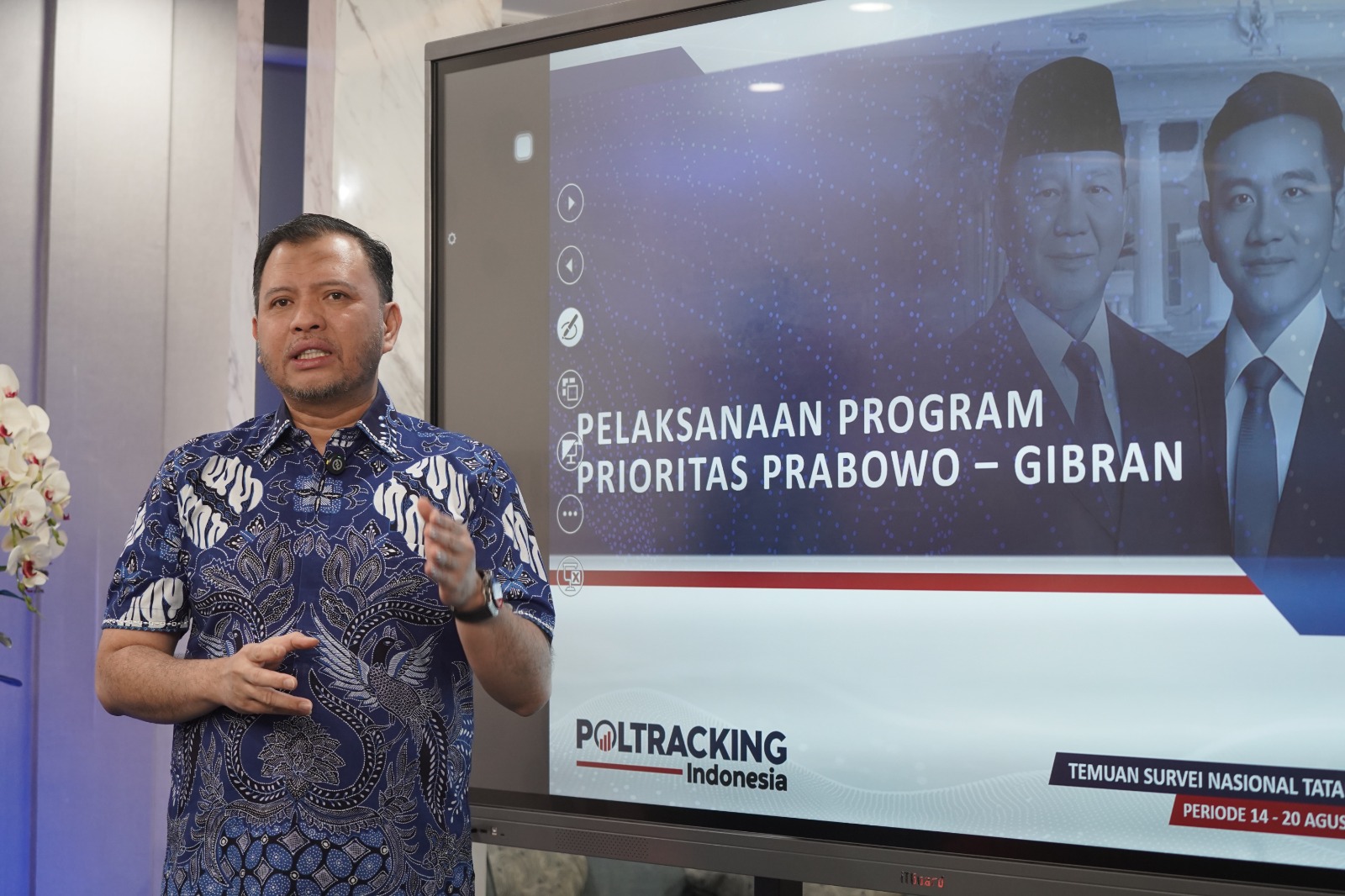
Poltracking Indonesia has offered five formulas for policy and strategic steps that favour the people in response to the downward trend in public satisfaction levels towards the Prabowo Subianto-Gibran Rakabuming Raka administration. The Executive Director of Poltracking Indonesia, Hanta Yuda, stated that this decline in approval ratings must be addressed seriously through a genuine agenda for improving government performance.
“The current downward trend in approval ratings or satisfaction with the performance of the Prabowo-Gemma administration is part of the political dynamics of the government that needs to be seriously followed up with an agenda for improving government performance,” said Hanta during a survey titled ‘Reading the Trend of Public Satisfaction towards the Prabowo Gibran Government’, broadcast on the Poltracking TV YouTube account on Monday (31/8/2026).
The survey, conducted from 14-20 August 2026 with 1,220 respondents, noted that the public satisfaction level towards the Prabowo-Gibran government stands at 55.1 per cent, while the public trust level remains at 63.2 per cent. Hanta emphasised that the first policy should be to maintain purchasing power and expand employment opportunities, following reports that 44.3 per cent of the public identified the high price of basic necessities as their primary concern, while 62.5 per cent stated that household expenditures are currently higher than last year.
“The government needs to increase social safety net programmes that specifically target vulnerable groups in dire economic conditions,” said Hanta.
He added that the government needs to restrain all forms of cost increases, such as taxes, fuel prices, and toll fees, which directly impact purchasing power and family economic pressure. The second policy is to conduct a thorough evaluation of priority programmes, particularly the Free Nutritious Meal (MBG) and the Red and White Village Cooperative (KDMP).
Hanta suggested that the MBG programme needs to be comprehensively audited from upstream to downstream and directed as a specific programme prioritised strictly in underdeveloped, frontier, and outermost (3T) regions. He also mentioned the option of converting the MBG scheme into Direct Cash Assistance (BLT) based on integrated data as a more rational approach, given the ongoing implementation issues.
The third policy is to carry out a cabinet reshuffle and strengthen government communication, considering that public satisfaction with ministerial performance is only 47.0 per cent. Approximately 51.9 per cent of the public is urging President Prabowo to reshuffle the cabinet, particularly in the economic (30.8 per cent) and legal (22.0 per cent) sectors, which are deemed to most require improvement.
“President Prabowo requires a Coordinating Minister who is firm and responsive, capable of acting as a buffer for crucial issues,” said Hanta.
He cited the strategic role of Luhut Binsar Pandjaitan during the Jokowi era in safeguarding the authority of the presidential institution. The fourth policy is to strengthen law enforcement and the eradication of corruption, which received poor ratings from the public at 46.5 per cent and 45.5 per cent, respectively. Hanta emphasised that the President must not tolerate misconduct by law enforcement officers or inter-institutional conflicts that have undermined the national legal order.
“Problematic individuals or leaders must face heavy sanctions, and even replacement must be carried out firmly if necessary, by appointing new figures with high integrity,” Hanta asserted.
The fifth policy is to strengthen checks and balances and the perception of harmony between the President and Vice President, while considering the presence of the parliamentary opposition. Hanta noted that the presence of PDIP, NasDem, and PKS, with a total of 232 seats, would revitalise healthy and democratic checks and balances, as 58.5 per cent of the public considers the existence of a critical opposition party to be important.
“This scheme for rebalancing the political landscape not only strengthens the mechanism of checks and balances but also serves as a concrete step to restore public trust and satisfaction in Indonesian democracy,” concluded Hanta.