
Polinela Research Supports Governance of Free Nutritious Meal Programme
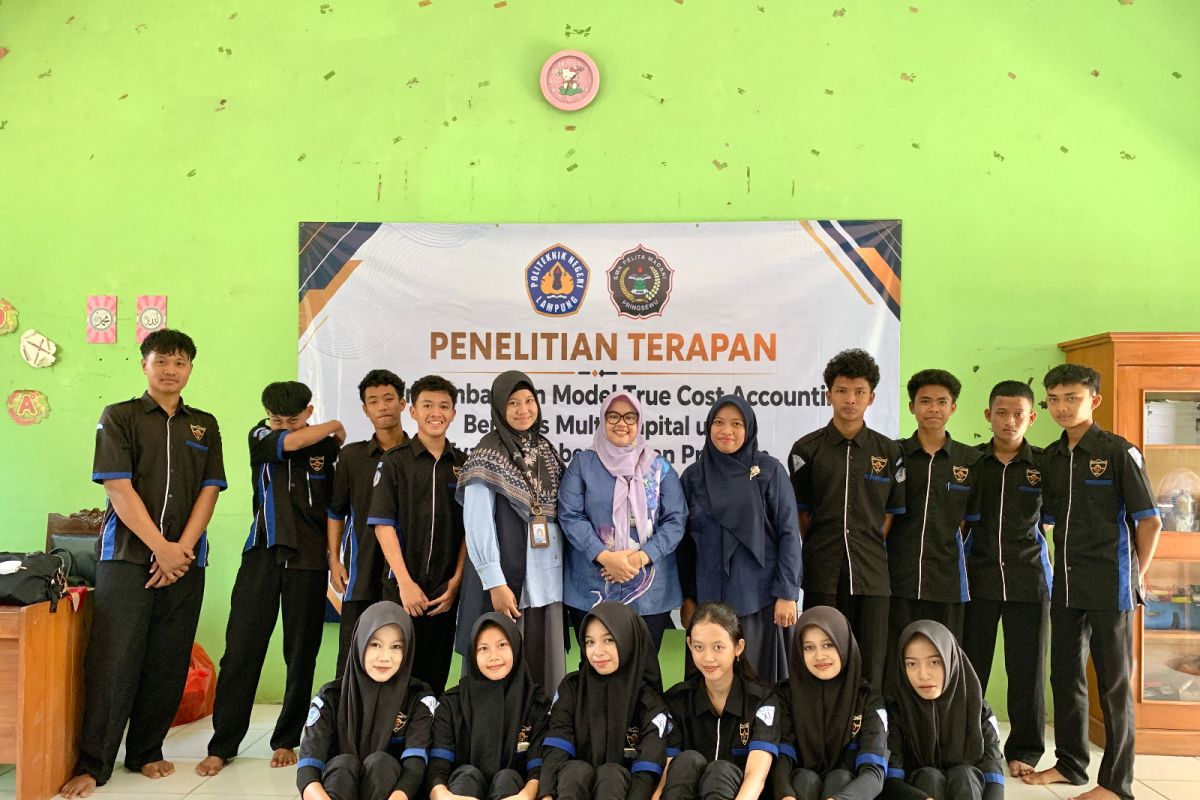
A research team from Lampung State Polytechnic (Polinela) has developed a sustainability evaluation model for the Free Nutritious Meals Programme (MBG) based on True Cost Accounting (TCA) and a multi-capital framework to support more comprehensive and sustainable programme governance.
Research team leader Endah Yuni Puspitasari said the study was carried out at SMK Pelita Madani in Pringsewu Regency, involving three sample classes: XI Software Engineering, XI Hospitality, and XI Pharmacy.
“The Free Nutritious Meals Programme is an important programme for supporting the quality of human resources. Through this research, we aim to provide an academic contribution in the form of an evaluation model that can examine cost aspects, menu acceptance, food utilisation, and programme sustainability more comprehensively,” she said.
She explained that the research assessed not only food distribution but also measured student acceptance of the menu, the efficiency of food utilisation, and the sustainability of programme implementation.
During the study, the research team observed the food distribution process, recorded portion numbers, measured sample portions, administered student questionnaires, and conducted brief interviews with school staff.
The entire series of activities was carried out on a limited and coordinated basis while maintaining student comfort and without disrupting the teaching and learning process.
In addition to field observations, the research team gathered student feedback through questionnaires to assess the menus served, portion suitability, food consumption habits, and input on the implementation of the Free Nutritious Meals Programme.
According to her, this data forms an important part of developing the evaluation model, particularly for measuring human capital and social capital aspects.
The multi-capital True Cost Accounting model integrates four main aspects: economic capital, natural capital, human capital, and social capital.
The economic aspect measures the direct costs of programme implementation, the environmental aspect assesses the efficiency of food resource utilisation, the human resources aspect measures the benefits of food for students, while the social aspect evaluates acceptance levels, preferences, and student consumption behaviour.
The research is expected to produce an evaluation instrument that can be used by schools, food providers, nutrition service units, and stakeholders to improve the effectiveness and sustainability of the programme.
Through this research, Polinela affirms the role of higher education institutions in supporting the strengthening of food programme governance in educational settings through data-based studies that can serve as a basis for more effective, efficient, and sustainable policy formulation.
Source: jawawa.id (https://jawawa.id/newsitem/polinela-research-supports-governance-of-free-nutritious-meal-programme-1786103797)
Originally published by Antara (Indonesian) (https://www.antaranews.com/berita/5684523/penelitian-polinela-dukung-tata-kelola-program-makan-bergizi-gratis), translated from Indonesian