
Police Uncover Suspected Fake Fortified Rice; Five Brands Allegedly Fail to Meet Nutritional Claims on Packaging
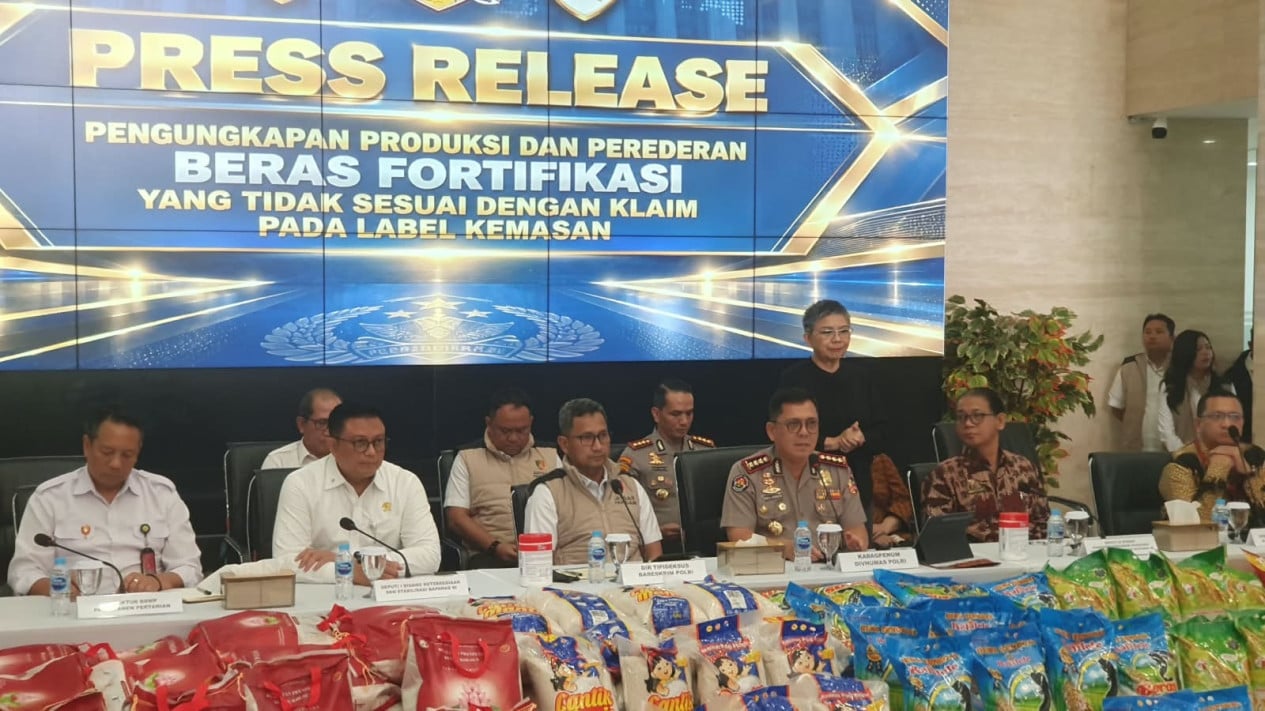
Jakarta – Indonesia’s National Police Criminal Investigation Department has uncovered suspected production and trade in counterfeit fortified rice by PT Dewa Tunggal Abadi (DTA).
The investigation found that five fortified rice brands allegedly did not meet the quality and nutritional claims stated on their packaging.
The director of the department’s special economic crimes unit, Senior Commissioner Suhasto, said the disclosure was intended to protect consumers from the distribution of fortified rice that failed to comply with the requirements.
“The special economic crimes unit of the National Police Criminal Investigation Department, through the Food Task Force and together with the National Food Agency, has investigated the production and trade of fortified rice suspected of not matching the claims on its packaging,” he said at a press conference at National Police headquarters on Wednesday, 21 October 2026.
The investigation identified five brands produced by PT DTA as the subject of the examination: Idola Hijau Fortifikasi, Idola Merah Fortifikasi, Raja Lele, Cantik Manis and Wijaya Kusuma.
“Samples of all five brands were taken by certified sampling officers from the National Food Agency and subjected to laboratory tests. The results showed that their quality and nutritional content did not match the packaging labels,” he said.
Based on the laboratory results, statements from witnesses at the National Food Agency, PT DTA’s director and head of production, and expert testimony, investigators decided to upgrade the case from an inquiry to a formal investigation.
Police have not yet named any suspects in the alleged fortified-rice fraud.
“At least two pieces of evidence have been found, and investigators have upgraded the case from the inquiry stage to the investigation stage following a formal case review,” he said.
PT DTA produces specialised fortified rice enriched with vitamins. Its production process uses finished rice as the raw material, which is then mixed with an additive called a kernel as a source of vitamins.
“The finished rice is simply mixed with the kernel, which provides the vitamins. The production process includes milling, cleaning, sieving, stone removal using a destoner, blending, weighing and sealing the packaging,” he said.