
Police to Pursue Legal Action Over Fake Fortified Rice Scandal
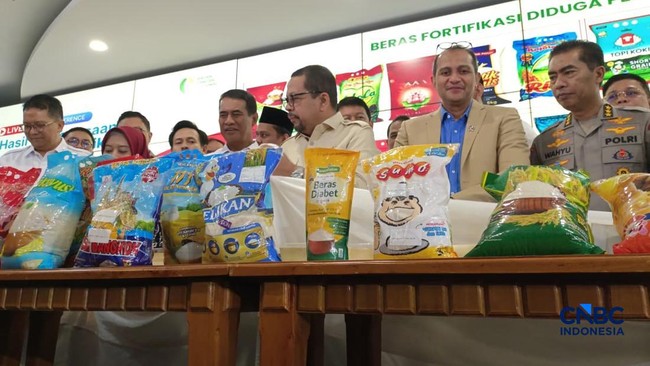
Jakarta, CNBC Indonesia - The government has revealed suspected irregularities in the circulation of rice marketed as a fortified product with added nutritional content. As well as the contents allegedly not matching the label, the product was sold at a price far above the fair price, potentially harming consumers.
Minister of Agriculture and Head of the National Food Agency (Bapanas) Amran Sulaiman said the suspected practice was a continuation of the premium rice problem previously cracked down on by the government. In this fortified rice case, the government found products that, after laboratory testing, did not match the claims on their labels.
“There is an allegation of a shift from premium to fortified rice. They claimed it was fortified. After we checked in four credible laboratories, it turned out not to match the label,” Amran said at a press conference at his office in Jakarta on Tuesday (15/9/2026).
Amran said rice that should have sold at around Rp13,500 per kilogram was found on sale for up to Rp57,000 per kg. The government estimates the suspected practice has caused losses of up to Rp89 trillion.
The matter has now entered the legal domain. Deputy Minister of Law Edward Omar Syarif Hiariej said the findings and studies by the Ministry of Agriculture together with the Food Task Force indicated suspected criminal fraud.
Edward said the alleged violations related to the mismatch between the product sold and its actual content. The criminal provisions, he said, are regulated in Chapter 27, Articles 492, 493 and 495 of the Criminal Code, and could also relate to the Consumer Protection Law.
“The essence of these articles is selling something that does not match its contents. And this certainly harms consumers, both in terms of quality and economically,” Edward said on the same occasion.
According to him, the legal issue potentially applies not only to individuals. The suspected practice could also have been carried out in an organised manner or by corporations.
“This strong suspicion is that this was not done person by person, but could have been done in an organised way and also by a corporation,” he said.
Edward explained that if the criminal act was committed by a corporation, there are special provisions in the Criminal Code. He referred to Articles 120 and 121 of the Criminal Code, which allow for fines and additional penalties.
“There are indeed special rules as set out in Articles 120 and 121 of the Criminal Code, whereby criminal offences allegedly committed by a corporation carry a penalty of a fine plus additional penalties, of which there are 12 items and which can extend to revocation of licences,” he explained.
Police Tracing the Distribution Chain
Meanwhile, the Director of Special Economic Crimes at the National Police Criminal Investigation Department and Head of the National Police Food Task Force, Brigadier General Ade Safri Simanjuntak, said his side had followed up on the findings.
The Food Task Force, together with the National Food Agency, conducted assessments on 10, 11 and 12 September. The examinations covered safety standards, nutritional content and food quality.
“We carried this out together with colleagues from the Food Agency on 10, 11 and 12 September, after these assessments were conducted. This is of course intended to verify and thoroughly and intensively examine the findings in the field,” Ade said.
Ade stressed that every finding would be verified and tested scientifically. The National Police Food Task Force would also trace the distribution chain to determine whether there were criminal elements in the case.
“All findings will be verified together, tested scientifically, and we will also trace the distribution chain and examine the criminal events in depth,” he said.
If criminal elements are found, legal proceedings will follow in accordance with applicable regulations.
“Certainly, if criminal findings emerge, we will process them in accordance with prevailing provisions,” Ade said.
He assured that the case would be handled professionally, transparently and fairly, with consumer protection remaining the priority.
“In principle, the National Police will enforce the law professionally, transparently and fairly while prioritising protection for the public and conducting scientific investigation. The public must not be harmed; we protect the public, and this is a form of the police standing together with society,” he asserted.
Government Highlights Consumer Protection
Head of the Government Communication Agency Muhammad Qodari considered the matter to be not merely about product quality, but also about protecting the public as consumers.
According to Qodari, the government’s attention in the rice supply chain has so far been largely directed at farmers and consumers. However, this finding shows there is a problem on the side of traders or processors who process, package and distribute rice to the market.
“The findings of the Ministry of Agriculture, supported by laboratory results, along with the forthcoming legal processes and legal assessments, indicate a major problem: what reaches consumers turns out not to match what has been claimed all along,” Qodari said.
He stressed that what is stated on the label must match the contents received by the public.
“What is on the label, on the packaging, must not be different from the contents, as the Deputy Minister of Law has explained,” he said.
Qodari also highlighted the impact on the very groups targeted by fortified rice.
“We must not have a situation where a product, promised to contain vitamins as a form of fortification, turns out to contain no vitamins at all,” he said.
He considered the situation could harm consumers twice over, especially if the product is consumed by people who need additional nutritional intake.
“This is a double disaster. People have bought a fake product, it was expensive, and the promised benefits never materialise,” Qodari asserted.
Nevertheless, the number of suspects will continue to be investigated over the next one to two months. The National Police Food Task Force is still carrying out scientific verification, tracing the distribution chain and conducting in-depth examination to establish whether criminal elements exist before naming those responsible.
Source: jawawa.id (https://jawawa.id/newsitem/police-to-pursue-legal-action-over-fake-fortified-rice-scandal-1789455219)
Originally published by CNBC Indonesia (https://www.cnbcindonesia.com/news/20260915132227-4-768057/polri-akan-proses-hukum-kasus-temuan-beras-fortifikasi-abal-abal), translated from Indonesian