
Police Secure MURI Record for Largest Simultaneous Garlic Planting
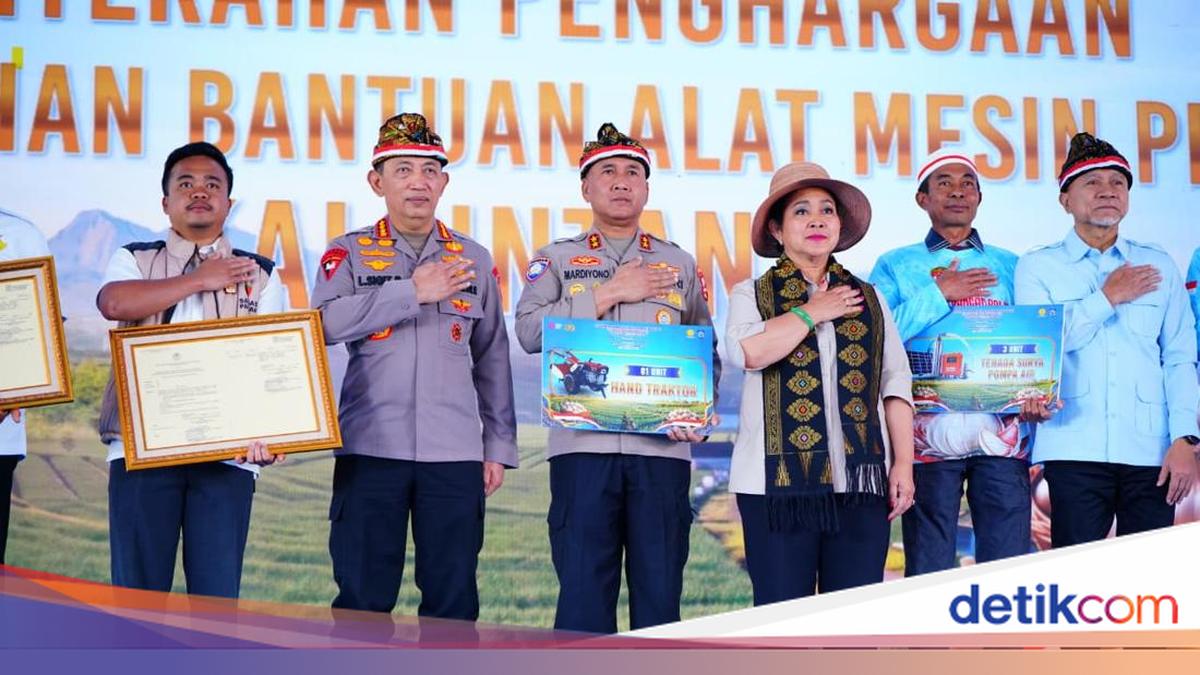
The Indonesian National Police (Polri) has secured a record from the Indonesian World Records Museum (MURI) for the ‘Largest Simultaneous Garlic Planting’. The record was awarded after Polri carried out simultaneous garlic planting across 14 regional police commands (Polda) with a total planting area of 279.53 hectares.
The simultaneous planting was led by National Police Chief General Listyo Sigit Prabowo and centred in Sembalun District, East Lombok Regency, West Nusa Tenggara, on Wednesday (19/8/2026). The event formed part of a series including the Simultaneous Garlic Planting, Garlic Grand Harvest, and the groundbreaking of the Polri Food Security Warehouse.
The activity was also attended by Chair of Commission IV of the Indonesian House of Representatives Siti Hediati Hariyadi, also known as Titiek Soeharto, Coordinating Minister for Food Zulkifli Hasan, Minister of Agriculture Amran Sulaiman, senior officials from Polri headquarters, the West Nusa Tenggara Regional Leadership Coordination Forum, farmer groups, and members of the public. General Sigit emphasised that the MURI record was not merely a recognition of achievement, but a momentum to strengthen a collective movement to increase national garlic production.
Sigit stated that 90 to 95 percent of garlic in Indonesia comes from imports. He said national garlic self-sufficiency remains a challenge.
‘Approximately 90 to 95 percent is imported, while our production is 39-40 thousand tonnes, and our need is 600 thousand tonnes per year. This is a challenge for all of us,’ said Sigit.
Sigit affirmed Polri’s commitment to supporting President Prabowo Subianto’s target of achieving garlic self-sufficiency within the next three years. He said this is being pursued through collaboration with ministries and agencies, regional governments, farmer groups, and various strategic partners.
Currently, 2,593.1 hectares have been verified across 17 Polda and 66 Polres from a target of 4,840 hectares assigned by the Ministry of Agriculture. Of that area, 927.6 hectares have been planted, involving 117 farmer groups and 2,257 farmers.
Specifically for today’s simultaneous planting, 110 farmer groups comprising 2,174 farmers were involved in cultivating 279.53 hectares. The planting has a potential production of approximately 2,795 tonnes of garlic.
In addition to the simultaneous planting, the National Police Chief also participated in a garlic grand harvest on 105 hectares involving nine farmer groups with 287 farmers in Sembalun. The harvest has a potential yield of 1,050 tonnes of garlic.
Strengthening production from the upstream side is also supported by the handover of various agricultural machinery and production inputs to farmer groups. The assistance includes 90 hand tractors, one four-wheel tractor, 24 water pumps, and 17 tonnes of Phonska Nitroku fertiliser from Polri, the Ministry of Agriculture, and PT Pupuk Indonesia.
Meanwhile, from the downstream side, a groundbreaking was held for the Polri Food Security Warehouse on a 1,013 square metre plot of land granted by the East Lombok Regency Government. The warehouse, with a building area of 250 square metres and a storage capacity of up to 300 tonnes, is supported by a construction budget of Rp 1.4 billion from the West Nusa Tenggara Provincial Government.
The warehouse is prepared to support post-harvest management and maintain garlic quality. Furthermore, the harvest will be absorbed by Bulog to meet the need for seeds to be replanted, so that increased production can go hand in hand with market certainty for farmers.
Chair of Commission IV of the House of Representatives, Titiek Soeharto, expressed appreciation to Polri and the Ministry of Agriculture for their hard work in supporting food self-sufficiency, as well as to the Coordinating Minister for Food who has coordinated various ministries and agencies so that the programme can run synergistically. According to Titiek, the momentum of the simultaneous planting must be the beginning of a consistent and sustainable movement.
She emphasised that garlic self-sufficiency is not enough with merely expanding land and increasing production, but must be followed by building a strong ecosystem, certainty of harvest absorption, healthy trading governance, and improved farmer welfare.