
Police Reveal How to Identify Counterfeit Stamps: Check with Saliva
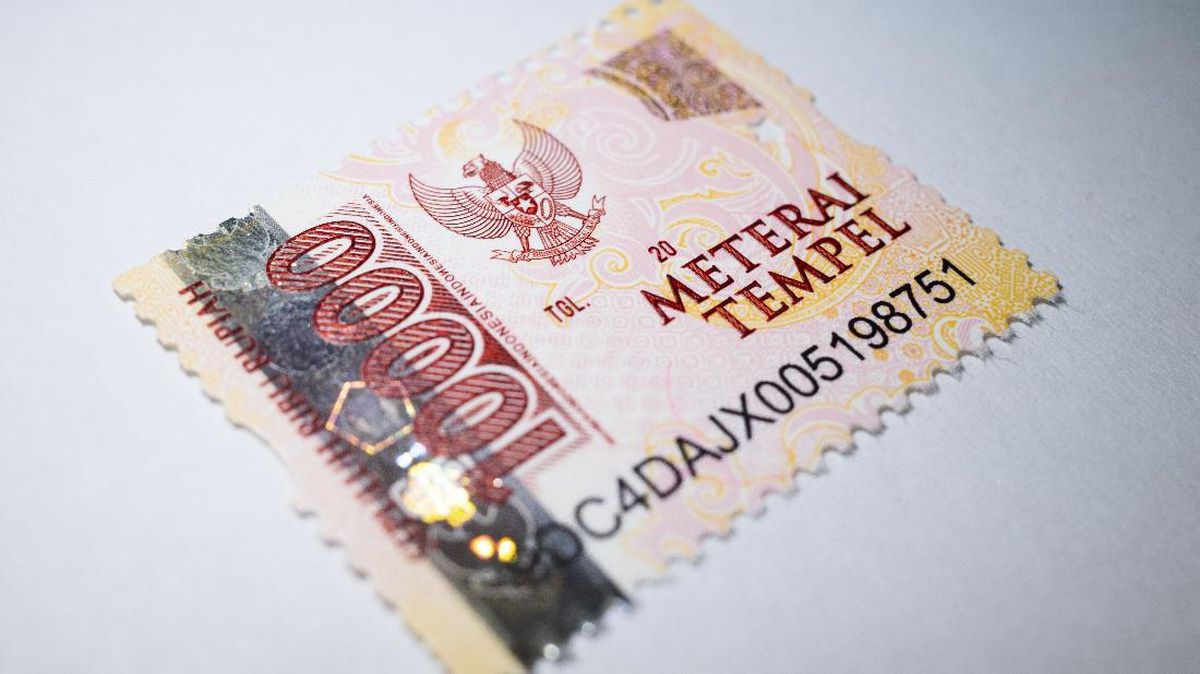
The Special Criminal Investigation Directorate of Polda Metro Jaya and the Directorate General of Taxes (DJP) of the Ministry of Finance have uncovered a syndicate producing counterfeit duty stamps. In this case, 3.4 million counterfeit stamps were seized.
Deputy Chief of Polda Metro Jaya Brigadier General Dekananto stated that the case began with public information and several police reports received by Polda Metro Jaya. “The enforcement carried out by Polda Metro together with the Directorate General of Taxes was conducted during June and early July in several regions, including Jakarta, West Java, Central Java, East Java, and North Sumatra,” said Dekananto at a press conference in Jakarta on Wednesday (19/6).
In this case, police have named 16 people as suspects. They have the initials B, RC, M, TA, RTP, IA, F, H, RH, MIF, SNM, U, FF, NSA, P, and MO. They played different roles in the operation.
Polda Metro Jaya then revealed a simple method for the public to distinguish genuine stamps from counterfeit ones produced by the professional syndicate, which had the potential to cause state losses of up to Rp1 trillion.
Head of Sub-Directorate IV for Specific Crimes at the Special Criminal Investigation Directorate of Polda Metro Jaya, AKBP Anton Hermawan, explained that the most practical test can be done simply by moistening the back of the stamp paper with water or saliva. “If it is bought and then given saliva and it does not stick, it means it is fake. It is very simple for ordinary people because the paper material is indeed different,” said Anton in Jakarta, as quoted from Antara.
He explained that the counterfeit stamps produced by the syndicate had a high level of similarity, reaching 98 percent of the original form based on the results of the tax technical team’s examination. The main perpetrator of the illegal stamp production was known to be a recidivist in a similar crime case.
To produce products that closely resembled the originals, the perpetrator used a special pressing tool to create embossed effects and gradations, a manual sewing machine to make precise perforations per sheet, and special colouring techniques resembling screen printing.
Although they looked similar to the naked eye, Anton emphasised that there was a fundamental difference in the hologram security feature when tested using an ultraviolet (UV) scanner. “There is a hologram, but when illuminated with UV light it will not fluoresce. Meanwhile, genuine stamps will definitely fluoresce,” he said.
Furthermore, Anton mentioned that all raw materials and paper sheets seized by officers during the operation had the potential to cause state losses of Rp1 trillion if they had been printed and widely circulated.
Based on the investigation, the dozen suspects in the counterfeit stamp syndicate had different roles in carrying out their actions, ranging from producers, recyclers, couriers, to sellers.
Director General of Taxes Bimo Wijayanto revealed that in this case a number of pieces of evidence were also seized, including 3.4 million counterfeit stamps. “Officers managed to secure more than 3.4 million illegal stamps, one production set machine, and three rolls of raw materials that could still be used to produce stamps in very large quantities,” he said.
“Based on the results of the joint investigation, the raw materials found are estimated to still be able to be used to produce more than 33 million stamps per roll. This means that if this activity had not been stopped, the potential loss of state revenue could have reached around Rp1 trillion,” he continued.
Bimo also mentioned that from the investigation results, the syndicate had successfully sold 4 million stamps with a value reaching tens of billions of rupiah. “We also obtained information that around 4 million stamps have been sold with a nominal value of around Rp40 billion,” he said.
For their actions, the suspects are charged under Article 24, Article 25 and Article 26 of Law Number 10 of 2020 concerning Stamp Duty and/or Article 382 of the Criminal Code and/or Article 383 of the Criminal Code.