
Police Rescue 400 Pet Cats Before They Could Be Slaughtered for Food
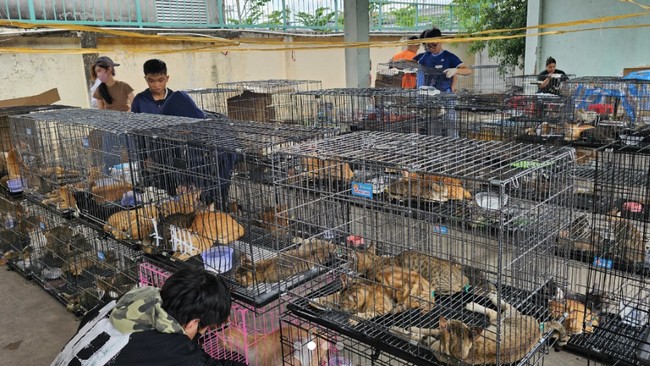
Vietnamese police have dismantled one of the largest cat meat trafficking rings in recent years. During an operation in Ho Chi Minh City last week, authorities rescued more than 400 live cats and arrested nine people suspected of involvement in a pet theft syndicate.
According to the Associated Press, at least 400 of the rescued cats have been returned and reunited with their owners. However, a number of other cats were reported dead after being found in deplorable conditions. Animal welfare groups attributed the deaths to the poor conditions the animals endured within the illegal trade network, though they did not specify the exact number of fatalities. The surviving cats are currently being cared for at a temporary shelter set up at the Ho Chi Minh City Criminal Police Division facility, where veterinarians and volunteers are working tirelessly to restore the animals’ health.
‘People who have lost their cats can come to the police station to identify their pets and assist with the investigation process,’ police official Nguyen The Bao told the state-run newspaper Tuoi Tre.
The operation stemmed from an investigation into the rampant theft of pets in Ho Chi Minh City. During the raid, police discovered 45 cages containing around 400 live cats in a storage yard. Officers also found four styrofoam boxes filled with ice containing approximately 80 cat carcasses. At a different location, police recovered about 20 more live cats. In total, more than 500 cats were secured in the operation, making it one of the largest cat rescues in Vietnam in recent years.
According to police statements, the suspects confessed to capturing and collecting cats from various regions of southern Vietnam over the past three years, operating in Ho Chi Minh City, Tay Ninh, and An Giang. The investigation revealed that one kilogram of cat meat was sold for approximately 70,000 Vietnamese dong, equivalent to US$2.70.
Phuong Pham, Director of Humane World for Animals Vietnam, stated that the cat meat trade remains a significant problem in the country. ‘The sad fact is that thousands of cats are stolen, traded, and slaughtered for consumption across the nation every month. Fortunately, these survivors were rescued,’ she said. Another surprising finding was the presence of several pregnant female cats at the time of rescue; a number of kittens were even born under police care this week.
Chris Gindelhumer, a representative of the organisation Vietnam Cat Welfare, recounted witnessing many emotional moments during the rescue process. ‘It was very touching to see so many Vietnamese families come to look for their cats. But on the other hand, it was heartbreaking because many families did not find their pets,’ he said.
Although the consumption of cat and dog meat remains legal in Vietnam, traders are required to possess permits proving the origin of the animals sold. Several cities, including Hoi An, are now beginning to cooperate with international animal welfare organisations to halt the consumption of dog and cat meat. Following South Korea’s ban on the dog meat trade in 2024, the Vietnamese government has also stated it plans to strengthen legal protections for pets and their owners. The case has sparked public attention, with cat lover An Pham from Ho Chi Minh City saying the syndicate’s exposure opened many people’s eyes to the cat meat trade. ‘This event shocked many people and raised awareness to stop consuming cat meat,’ he said.
Source: jawawa.id (https://jawawa.id/newsitem/police-rescue-400-pet-cats-before-they-could-be-slaughtered-for-food-1781754705)
Originally published by CNBC Indonesia (https://www.cnbcindonesia.com/lifestyle/20260618091353-33-743606/polisi-selamatkan-400-kucing-peliharaan-sebelum-dipotong-jadi-makanan), translated from Indonesian