
Police Name Argo Bromo Driver Suspect in Bekasi Train Crash
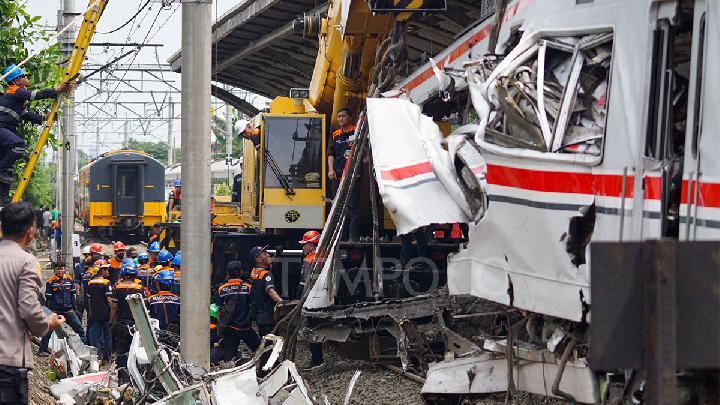
Police Name Argo Bromo Driver Suspect in Bekasi Train Crash
Reporter
September 29, 2026 | 09:56 pm
TEMPO.CO, Jakarta - The Jakarta Metropolitan Police’s Criminal Investigation Directorate has named AN (37), the driver of the Argo Bromo Anggrek train, a suspect in the fatal collision with a commuter line (KRL) at East Bekasi Station after finding that he braked too late despite fully functioning track signals.
The accident involving the Argo Bromo Anggrek train and the Cikarang-bound Commuter Line killed 16 people on April 27, 2026.
“Based on the results of the investigation and the evidence gathered, investigators have named AN, a 37-year-old male, as a suspect,” said Deputy Director of General Criminal Investigation at the Jakarta Metropolitan Police, Adj. Comr. Sr. I Dewa Putu Gede Anom Danujaya, during a press conference in Jakarta on Tuesday, September 29.
Dewa explained that the suspect, who drove the Argo Bromo Anggrek train, faces charges under Articles 323, 324, and 474 of Law No. 1/2023 on the Criminal Code, alongside Articles 198 and 206 of Law No. 23/2007 on Railways.
“The maximum sentence is five to 12 years in prison. Investigators will then summon the suspect for questioning,” he said.
The naming of the suspect followed a scientific crime investigation, with police questioning 54 witnesses and analyzing CCTV footage, communication logs, and train operation data (data loggers).
The Jakarta Metropolitan Police also involved the National Police Forensic Laboratory Center (Puslabfor), the Directorate General of Railways, and experts in forensic medicine, railway systems, signaling, telecommunications, and criminal law.
Data Logger Reveals Delayed Emergency Braking
Head of Unit 1, Sub-Directorate 1 of State Security (Kamneg) at the Jakarta Metropolitan Police, Adj. Comr. Muhammad Rizka, explained that pre-reconstruction showed the repeater signal and main signal were clearly visible from an adequate distance.
“The repeater signal was 400 meters away, for a total of 800 meters. From the previous 200 meters, the repeater signal was still visible. In total, the signal was visible for approximately one kilometer,” Rizka said.
Citing a railway expert who applied the Minden theory, Rizka stated that based on the speed recorded on the data logger, braking was fully capable of bringing the train to a complete stop within 600 meters.
“However, the facts on the ground show that the engineer only activated the brakes at a distance of 263 meters,” she said.
The engineer told investigators that he hesitated and feared that applying emergency brakes suddenly from a distance would cause the train carriages to overturn.
“That reason is refuted by the railway expert’s testimony using the Minden theory. It should have been capable of a complete stop at 600 meters,” Rizka asserted.
Violation of Standard Railway Operating Procedures
Rizka also highlighted the suspect’s violation of Standard Operating Procedures (SOP) under Service Regulation No. 19 Article 50 concerning Railways, which dictates that if a driver is unsure about a signal indication, he must make the safest, most restrictive decision.
“If he’s unsure whether the signal is red, Article 50 states: take the most severe action, namely stopping the train, and then confirm,” he said.
Police confirmed that the main signal and the repeater signal were synchronized and functioning normally to issue a stop command at the time of the incident.
Dewa added that the fatal incident comprised a sequence of two events that occurred in close succession.
Further Coordination and Safety Findings
Regarding further evaluation of the railway system, investigators continue to coordinate with experts from the Directorate General of Railways at the Ministry of Transportation, while leaving the final determination of criminal negligence to the judicial process.
“The verdict of negligence is up to the judge,” Rizka added.
Previously, the National Transportation Safety Committee (KNKT) revealed six contributing factors to the collision between the Argo Bromo Anggrek and Commuter Line trains in East Bekasi, Bekasi, West Java, based on its investigation results.
“Contributing factors are actions, conditions, events, or a combination of these that, if eliminated, avoided, or absent, would reduce the likelihood of an accident or lessen its severity,” the KNKT report stated, as quoted in Jakarta on Tuesday.
Read: KAI-INKA Merger Set for Completion Before Jan 2027
Click here to get the latest news updates from Tempo on Google News