
Police Law Challenged Again at Constitutional Court over National Police Chief's Authority over Security Guards
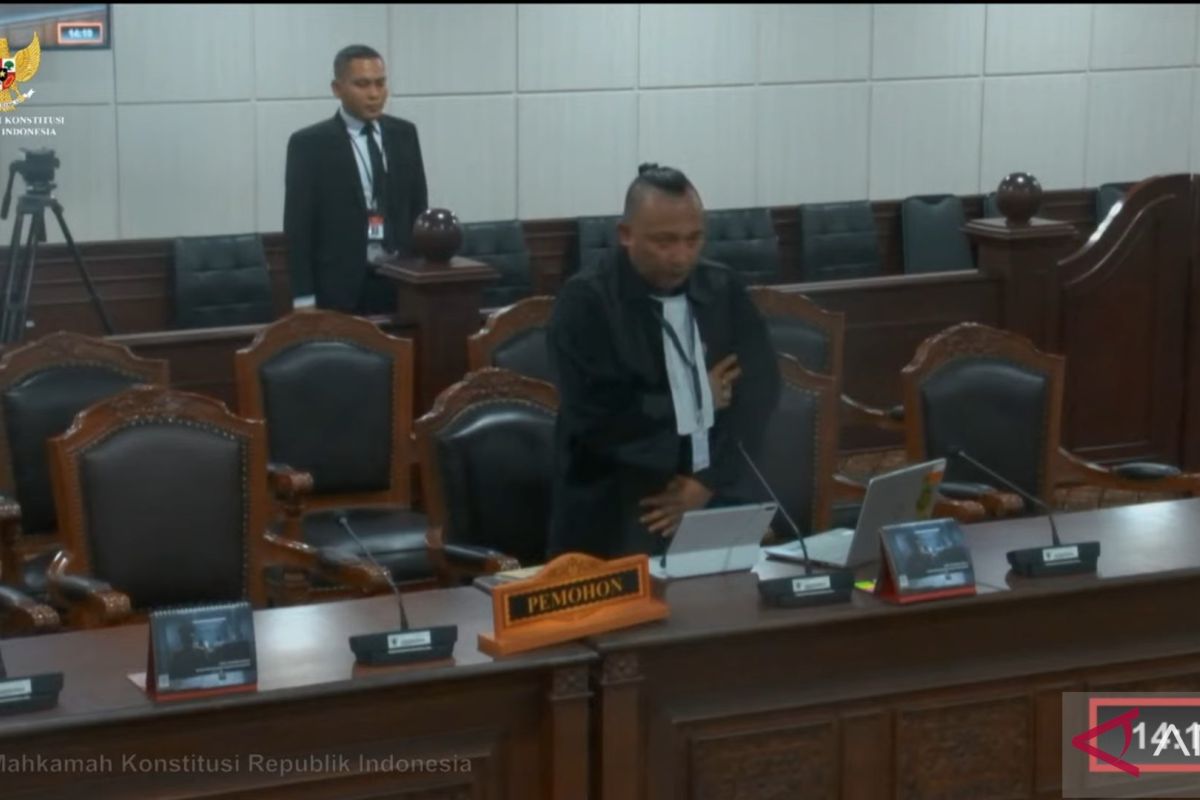
Jakarta (ANTARA) - The Constitutional Court has held a judicial review hearing on Law Number 2 of 2002 concerning the Indonesian National Police (Polri), once again challenged by Syamsul Jahidin as petitioner in case Number 324/PUU-XXIV/2026, which concerns the placement of security guards under the authority of the National Police Chief.
At the preliminary hearing held in the panel courtroom of the Constitutional Court building in Jakarta on Monday, Syamsul challenged Article 3 paragraph (1) letter C of the Police Law, which reads that “forms of self-initiated security” are a form of security established on the will, awareness and interests of the community itself, which subsequently receives endorsement from Polri, such as environmental security units and security service business entities (BUJP).
The petitioner also took issue with two phrases in the elucidation of Article 3 paragraph (1) letter c, namely “security service business entities” and “The regulation of self-initiated security is the authority of the National Police Chief”.
According to him, the enforcement of the article in question and its elucidation creates an imbalance, as it places security guards, who are in effect private workers, under the control of the police.
This is stipulated in the fact that security guards are regulated and placed under the technical guidance of the police through Polri based on Polri Regulation Number 4 of 2020.
“If we look at the phrases above, every element of the private security service business is monopolised and annulled by the Indonesian National Police, which is a form of legal uncertainty,” said Syamsul.
In his petition, he revealed that Article 3 paragraph (1) letter C of the Police Law is imperative in nature, yet the elucidation of Article 3 paragraph (1) letter c has given rise to the interpretation that security service business entities and security guards are under the full management of Polri.
In reality, everything that touches upon private security must be under Polri’s control, including security services for companies, training and education, as well as the extension of membership identity cards (KTA), which in fact serve no immunity function. The reality on the ground is that the status of security units is that of private workers who follow and are subject to the Labour Law.
According to him, the phrase “the regulation of self-initiated security is the authority of the National Police Chief” makes security guards subject to Polri Chief Regulations and Polri Regulations issued by the police, which should be internal to the police force.
“This happens because of the potential for concealed business interests being forced to be legalised, since regulation is the authority of the National Police Chief,” he said.
In fact, security guards are independent or private workers subject to the Employment Law. Another point can be seen in the change of uniforms, which can change three times within five years, and the KTA extension which must be paid by private workers at Rp75,000, as well as education and training costs reaching Rp17.5 million.
The petitioner also compared the security unit system in Indonesia with a number of countries such as Malaysia and the United States.
In Malaysia, he said, the regulator for security guards is the Ministry of Home Affairs through the private security industry association and official agencies, not under the control of the Royal Malaysia Police.
In his petitum, the petitioner stated that the elucidation of Article 3 paragraph (1) letter c of the Police Law, as supplemented in State Gazette of the Republic of Indonesia number PAS 168, contravenes the 1945 Constitution and has no binding legal force.
Deputy Chief Justice Saldi Isra, in his advice, ensured that the judicial review filed by the petitioner would not be ne bis in idem (cannot be tried twice for the same case on the same grounds), as the petitioner had already challenged the Police Law twice before.
“There are aspects that distinguish the previous petitions from this one. For instance, the basis of the review, and then the reasons for the review, so that it does not later fall into the category of ne bis in idem,” said Saldi.
In addition, Adies asked the petitioner to explain the constitutional issue being brought before the Court, which argues that the existence of BUJP in the elucidation causes Polri to become a business operator or to engage in monopoly.
“How the petitioner draws the connection from the mention of BUJP in the elucidation to the conclusion that Polri engages in monopoly or commercialisation also needs to be explained,” Adies requested.
Meanwhile, Constitutional Justice Lilie P. Adi asked the petitioner to clarify who, if the elucidation is declared contrary to the constitution, would then be authorised to regulate security guards.
“Perhaps it should be placed under the regional government, like Satpol PP, perhaps that would be better, because if under labour affairs, functionally there is no connection between the security function and the labour office,” said Liliek.
Source: jawawa.id (https://jawawa.id/newsitem/police-law-challenged-again-at-constitutional-court-over-national-police-chiefs-authority-over-security-guards-1788799968)
Originally published by Antara (Indonesian) (https://www.antaranews.com/berita/5730573/uu-polri-kembali-digugat-ke-mk-menyoal-satpam-kewenangan-kapolri), translated from Indonesian