
Police Involve ESQ Founder Ary Ginanjar in High-Ranking Officer Assessment
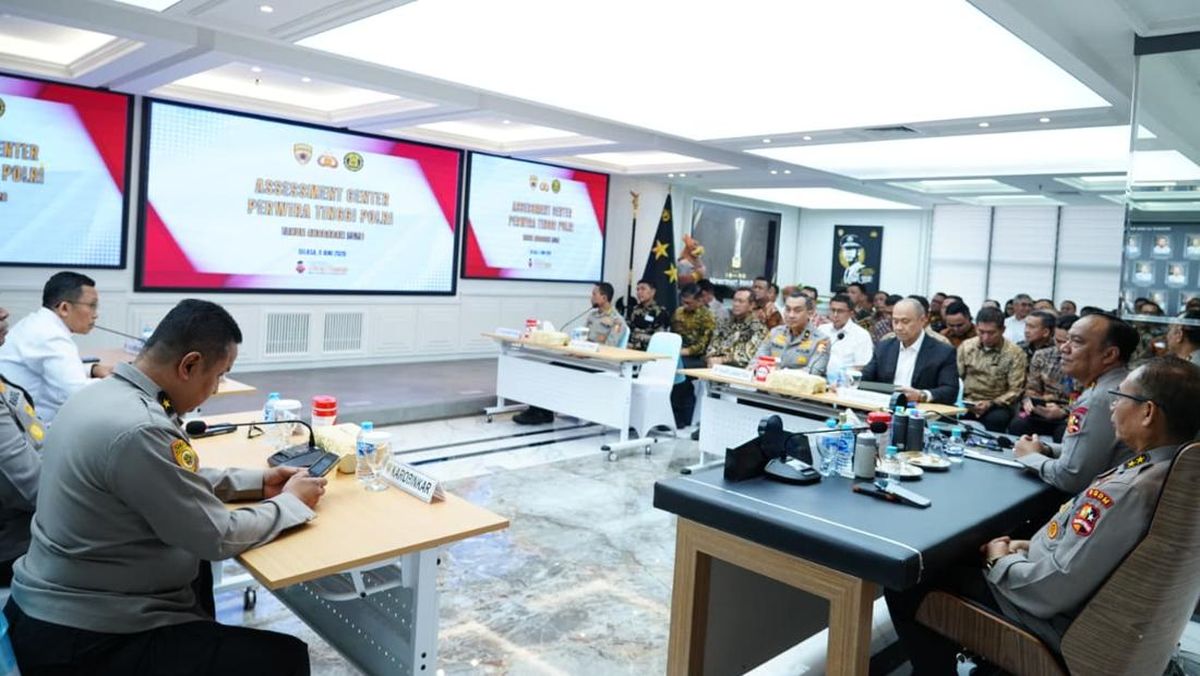
The Indonesian National Police (Polri) is continuing to strengthen internal reform through the reinforcement of meritocracy and talent management as a follow-up to the recommendations of the Police Reform Acceleration Commission (KPRP). One of the measures taken is the involvement of ESQ Corp. founder Ary Ginanjar in the implementation of the High-Ranking Officer Assessment Centre for the rank of Brigadier General for the 2026 fiscal year, which was opened by Deputy Chief of Police Commissioner General Prof. Dr. Dedi Prasetyo at Police Headquarters on Tuesday (9/6). The involvement of external parties is part of Polri’s commitment to building human resource governance that is increasingly transparent, objective, and competency-based. This step also addresses one of the KPRP’s recommendations regarding the strengthening of a merit system in cadre formation and the filling of strategic positions within Polri. In his brief, Deputy Chief of Police Commissioner General Dedi Prasetyo stressed that the challenges facing Polri are increasingly complex, ranging from global geopolitical dynamics, cyber threats, and transnational crime, to rising public expectations for the quality of public services. ‘Therefore, Polri needs leaders who are adaptive, have integrity, are humanitarian, and are capable of providing solutions for the community through an objective, transparent, and merit-based cadre system,’ said Dedi in his statement on Tuesday (9/6). Meanwhile, Assistant to the Chief of Police for Human Resources Inspector General Dr. Anwar explained that the Polri Assessment Centre is a strategic instrument for building a modern and sustainable talent management system. According to him, the development of assessment centres in various world institutions is no longer just used to assess individual competence but has evolved into an instrument for mapping leadership potential, adaptability, collaborative capacity, decision-making, and readiness to face changes triggered by technological developments and artificial intelligence. ‘The Polri Assessment Centre was built to ensure that personnel career development runs objectively and is data-based. The goal is not merely to assess whether someone is suitable for a particular position but to discover the best potential each personnel member has so it can be developed optimally,’ said Anwar. He stated that the existence of the Assessment Centre is one of the crucial foundations for implementing the merit system and talent management within Polri. ‘Through assessment, we can map the competencies, potential, readiness, and leadership character of personnel more comprehensively. The results become the basis for career development, education, job promotions, and the preparation of future Polri leadership cadres,’ he said. Anwar added that strengthening the Assessment Centre is also part of Polri’s HR transformation efforts, aligned with the Polri Grand Strategy 2025-2045 and various institutional reform recommendations that encourage more professional, transparent, and accountable HR governance. ‘We want to ensure that every personnel member has equal opportunities to develop based on their competence, integrity, and potential. This is the essence of the meritocracy that is continuously being strengthened within Polri,’ he asserted. Meanwhile, Ary Ginanjar stated that the world is currently entering the era of ‘Talentism,’ a period where an organisation’s excellence is increasingly determined by its ability to manage and develop human talent. Referring to various global studies, including those from the World Economic Forum (WEF), Ary explained that the development of artificial intelligence and robotics will change many conventional work patterns. Therefore, abilities that cannot be replaced by technology such as leadership, creativity, adaptability, social influence, integrity, and decision-making will become the main differentiating factors. ‘In the future, organisations will no longer compete based on who has the largest resources, but who is most capable of finding, developing, and correctly placing their best talents,’ said Ary. According to him, modern organisations in various countries are now starting to shift from a position-based assessment approach towards a talent and potential-based approach. Assessment is no longer seen merely as an evaluation tool but as a strategic instrument for mapping individual strengths and preparing future leadership. Ary appreciated Polri’s initiative to start building a Big Data talent system to map personnel potential more accurately as a basis for career development and job placement. ‘I see Polri as one of the pioneering institutions that has begun building Big Data talent to identify the excellence profile of each personnel member with more precision. This is an important foundation for an objective and measurable meritocracy,’ he stated. He explained that modern assessment no longer focuses on finding individual weaknesses but rather on revealing authentic potential that has not been mapped so far. ‘Assessment is not about finding who is the best, but discovering where someone can make their best contribution. When talent is placed accurately, the organisation will move more effectively, and the benefits will be felt directly by the public,’ said Ary. According to Ary, talent-based placement will produce personnel who better understand the meaning of their duties, are more independent in their work, develop their competencies more quickly, and are capable of providing a greater impact for the organisation and the community. ‘The ultimate goal is not merely to produce leaders who are individually successful but to build an organisation capable of developing sustainably through a system that operates based on competence, talent, and integrity,’ he concluded. The High-Ranking Officer Assessment Centre for the 2026 fiscal year was attended by 100 participants and is part of Polri’s concrete steps to follow up on the recommendations of the Police Reform Acceleration Commission.