
Police develop Aerosafer Pangan to support national food security
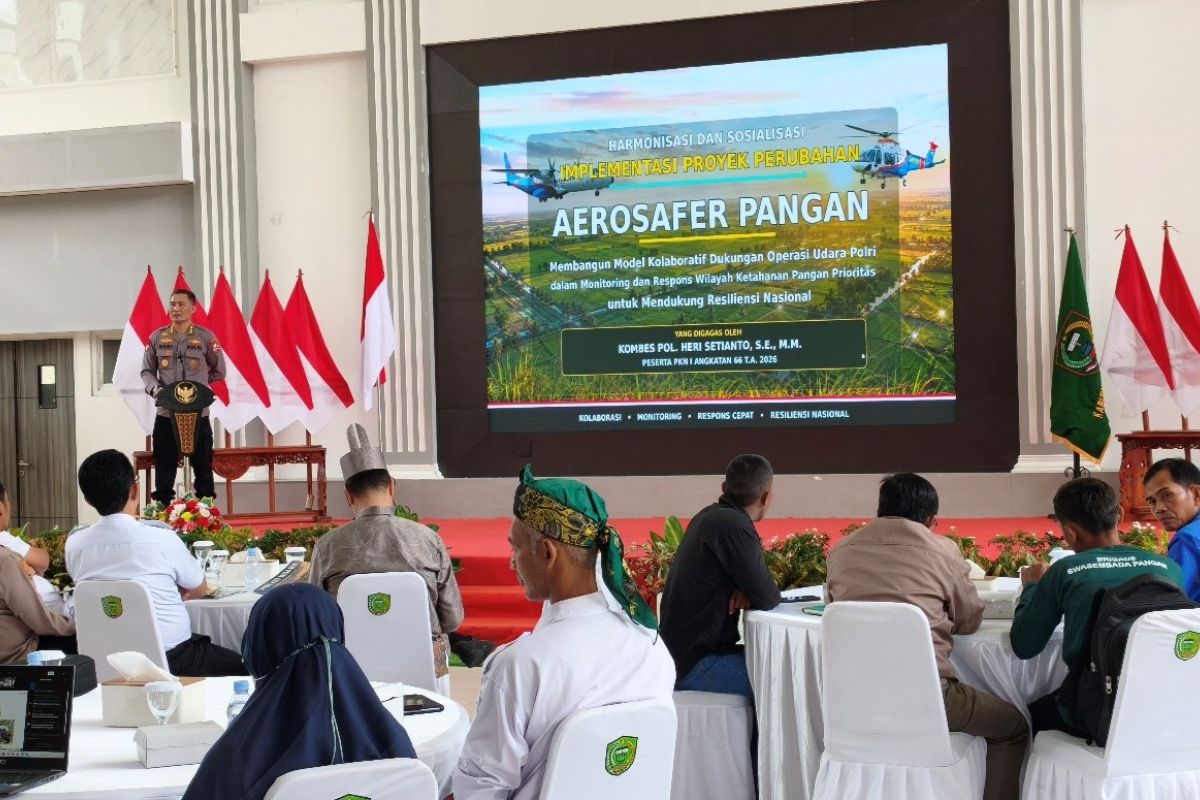
The Air Police Directorate of the Indonesian National Police’s Security Maintenance Agency (Korpolairud Baharkam Polri) has developed the Aerosafer Pangan innovation, a Collaborative Air Support Model, as a form of air operations support in strengthening national food security, particularly in priority areas with limited land access.
“This programme integrates aerial monitoring capabilities, data collection, regional mapping, cross-agency coordination, and rapid response to various potential disruptions in agricultural areas,” said Police Grand Commissioner Heri Setianto, Head of the Facilities and Services Sub-directorate of the Air Police Directorate, who initiated Aerosafer Pangan, in Jakarta on Friday.
The Aerosafer Pangan programme was conceived as a Change Project for the National Leadership Training Level I, Cohort 66, Year 2026.
Heri explained that potential disruptions include forest and land fires, natural disasters, damage to irrigation networks, distribution obstacles, and geographical conditions that are difficult to reach by land routes.
The implementation of Aerosafer Pangan is supported through the use of Indonesian National Police aircraft and the AERO Support Board system, a dashboard that provides information from aerial monitoring results as material for coordination, reporting, and rapid, measurable decision-making.
Heri Setianto explained that food security is not only related to increasing production but also requires a system of supervision, protection, and rapid response to every threat.
“Aerosafer Pangan is expected to strengthen synergy between the National Police, ministries and agencies, regional governments, farmer groups, and all stakeholders in safeguarding national food security areas,” he said.
Heri explained that the programme also encourages the preparation of standard operating procedures for air support requests so that aircraft deployment can be carried out according to needs and on target, as well as in accordance with aviation safety regulations.
In its implementation, the Air Police Directorate is collaborating with the Ministry of Agriculture, the Ministry of Public Works, regional governments, AirNav Indonesia, and other relevant elements.
“This collaboration is expected to produce an integrated, effective, and sustainable air support system,” he said.
According to him, the area of focus in the development of this programme is Pulang Pisau Regency, Central Kalimantan.
The region has significant agricultural potential but also faces challenges in the form of its vast area, limited access, swampy land conditions, and the threat of forest and land fires.
According to him, through aerial monitoring, the condition of agricultural areas can be identified more quickly and comprehensively.
The information obtained can then be used by relevant agencies to determine handling measures, infrastructure improvements, area security, and the provision of assistance to the community.
The development of Aerosafer Pangan is being carried out in stages, starting from the formation of an effective team, preparation of capability profiles, preparation of SOPs, and development of the AERO Support Board.
The next stage includes conducting trials in priority areas, strengthening cross-agency cooperation, and replicating the programme nationally.
He assessed that by optimising the National Police’s aviation capabilities and strengthening inter-agency collaboration, Aerosafer Pangan is expected to become an important part of maintaining the sustainability of production, distribution, and food security in Indonesia.
“From the sky we guard food, from food we guard the nation,” he said.