
Police Continue to Investigate Corporate Involvement in Forest and Land Fire Cases
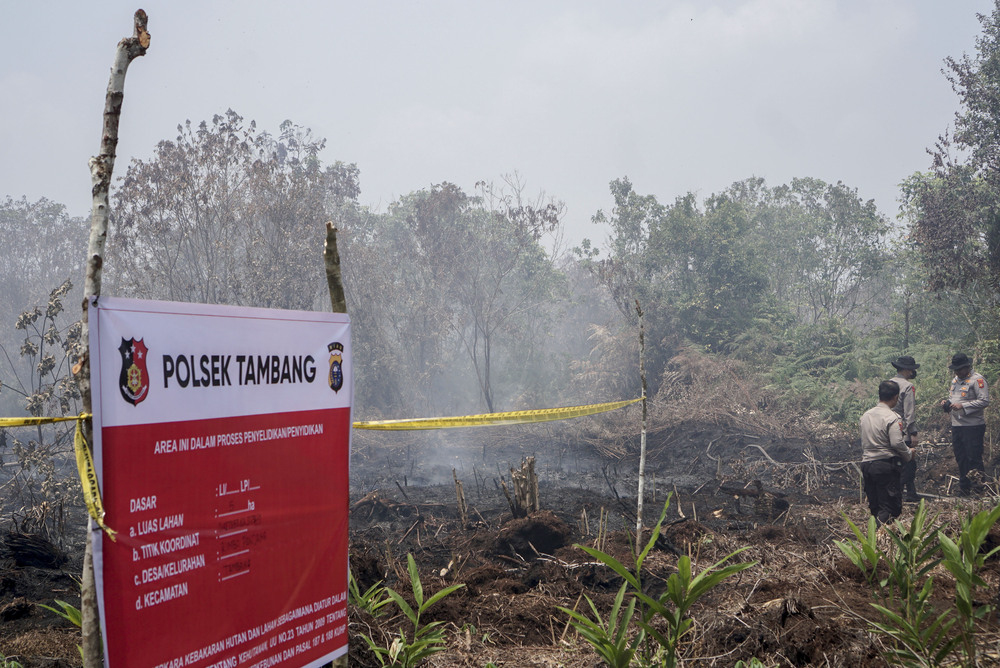
The Indonesian National Police (Polri) are continuing to investigate the possible involvement of corporations in forest and land fire (karhutla) cases being handled across nine regional police forces (Polda). Investigators are not only pursuing perpetrators who set fires on the ground but are also tracing parties suspected of ordering, funding, or profiting from these activities.
Director of Specific Crimes (Tipidter) at the National Police Criminal Investigation Agency (Bareskrim Polri) Brigadier General Mohammad Irhamni said the investigation is being deepened by tracing financial transaction flows to identify the parties behind the land burning.
To date, the police have named 72 individual suspects from 89 police reports related to forest and land fires spread across nine regional police forces.
“These nine regional police forces have carried out investigations and inquiries with approximately 72 individual suspects having been named,” Irhamni said at a press conference in Jakarta on Sunday (23/8).
Irhamni explained that investigators are not stopping at naming suspects believed to have carried out the burning directly. The police are also working to uncover whether there are other parties who gave orders or benefited from the burning.
The investigation is being conducted using various evidence, including crime scene processing results, witness statements, clues, physical evidence, and financial transaction tracing.
According to Irhamni, tracing the flow of funds is important to determine whether the burning was carried out for personal interests or in connection with the interests of other parties.
Investigators are also open to the possibility of corporate involvement in these cases.
“Both corporations and individuals will be pursued and subjected to firm law enforcement,” he said.
In handling 89 police reports across nine regional police forces, the police have named 72 people as individual suspects.
Several of these cases originated from hotspot monitoring which was then verified by officers in the field. If fire spots or burned land were found, officers first carried out extinguishing and cooling before investigators processed the crime scene.
The police found that the method of clearing land by deliberately burning dominated the cases being handled. This method is used because it is considered cheaper than other land clearing methods.
“Most of the modus operandi used by the suspects is clearing land by deliberately burning it so that the operational costs of farming activities become cheap or economical,” Irhamni revealed.
Land that has been cut down is then burned to clear remaining vegetation. The ash from burning is also considered by perpetrators to be useful for helping fertilise the soil before it is used for plantation activities.
Irhamni stressed that suspects’ confessions are not the only basis for investigators in naming someone a suspect. The police continue to prioritise evidence found during the investigation process.
A number of items of evidence have been seized, including 35 lighters, bottles and jerry cans containing fuel, 21 machetes, two axes, hoes, two chainsaw units, burned soil samples, oil palm seedlings, and burned wood logs.
The investigation into corporations and other parties suspected of involvement will continue based on evidence found by investigators.
Irhamni stressed that law enforcement is not only directed at perpetrators of burning on the ground, but also at parties who ordered the acts and parties who profited from the crime.
“We will continue to pursue all perpetrators or people who ordered the acts and all parties who obtained profits from the forest and land burning crime,” he said.
The perpetrators are charged under a number of criminal provisions, including the Forestry Law, the Plantation Law, the Environmental Protection and Management Law, and provisions in the Criminal Code.