
Police Chief: Police Must Be Smart and Neutral as Democracy's Referee
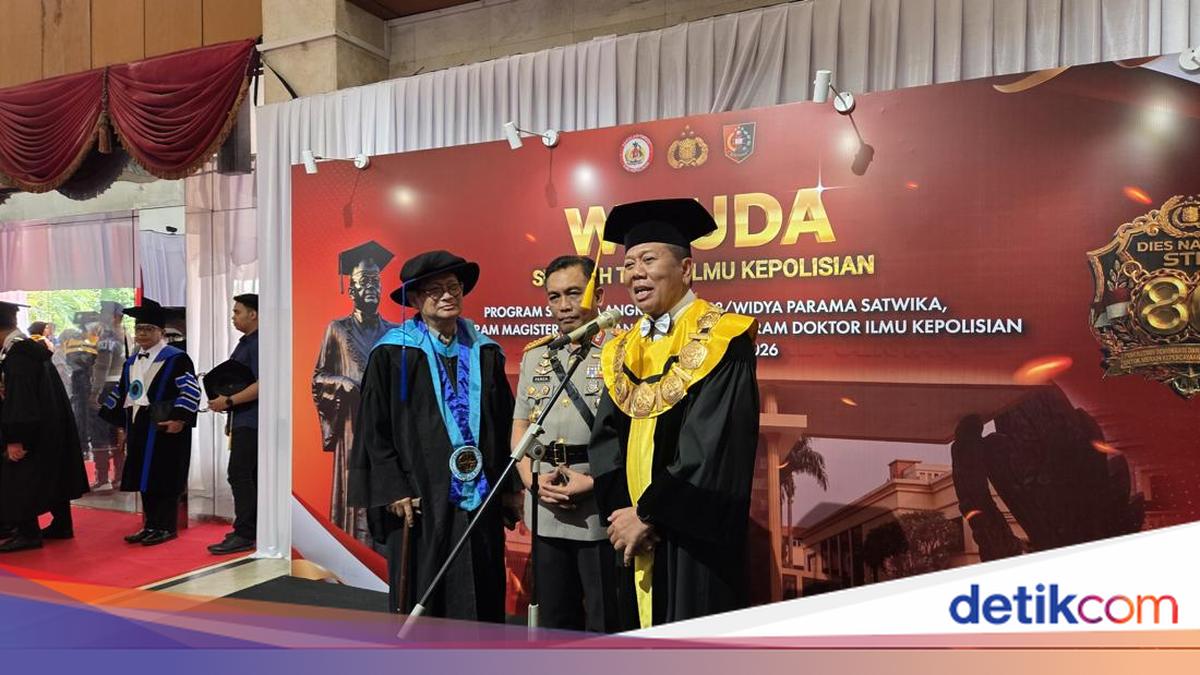
The Chairman of the Police Science College (STIK) at the Education and Training Institute (Lemdiklat), Inspector General Eko Rudi Sudarto, stated that the police serve as a referee or mediator to safeguard democracy. He emphasised that police officers must be neutral and intelligent.
“The Republic of Indonesia was formed as a democratic state. To safeguard democracy, what is needed? A referee. A referee is someone who can regulate, who is neutral. So what kind of referee? A smart referee, an intelligent referee. Who is that? It is the police organ,” Eko said after a graduation ceremony and the 80th anniversary event at STIK in South Jakarta on Wednesday (17/6/2026).
Eko noted that the concept of the police as the referee of democracy was established by the nation’s founders, including Sukarno, Mohammad Hatta, General Sudirman, and Ki Hajar Dewantara, as well as the first National Police Chief R.S. Soekanto and STIK founder Professor Djoko Soetono. He said that at that time, the police had an ideal structure to safeguard democracy in Indonesia.
“These figures saw the police structure as the referee for this nation. Guarding this nation, guardians of civilisation, keepers of human dignity. Therefore, the police must be what? They must be smart, the police must be intelligent,” he asserted.
He continued, noting that the Police Academy was founded in Mertoyudan, Magelang, Central Java, on 17 June 1946. He expressed hope that on the 80th anniversary of the National Police, the public would increasingly feel the performance of the police. He also affirmed a commitment to continuous improvement.
“Hopefully, the community can feel it. Are the police already intelligent? We, under the guidance of the Kalemdiklat Polri, STIK is part of the structure under Lemdiklat Polri, continue to try to improve. And one thing we now want to develop is a Police University,” he said.
Meanwhile, Kalemdiklat Polri Commissioner General Ridwan Zulkarnain Panca Putra Simanjuntak said the newly graduated police officers would now be deployed to the field. They will take up positions according to their rank and role.
“They will go down to the field to apply the knowledge they gained at this institution, and later it will be used as an analytical tool to solve social problems in the community related to police duties, including how to realise security and public order,” Panca said.
Furthermore, Panca stated that the graduates would later be given the opportunity to pursue higher education from undergraduate to postgraduate and doctoral levels. This is so they can test what they have learned in the field.
“So the National Police has designed a career and experience development system for them, structured in such a way that they not only study, but must go to the field and test all the knowledge they have received. That is the current programme,” he added.
He also noted that the most current challenge for these police graduates is technological advancement. According to him, technological progress not only has a positive impact on society but can also have a negative impact if not scrutinised carefully.
“Including, for example, how information is not curated. All information enters, and the challenge for them later, these officers, is that they will face conditions in the field where the social sense of the community is increasingly thinning, and community unity is also thinning, and ultimately this can cause social conflicts in the community. That is the most real challenge,” he concluded.