
Police Bill: Kompolnas term of office set to four years, renewable once
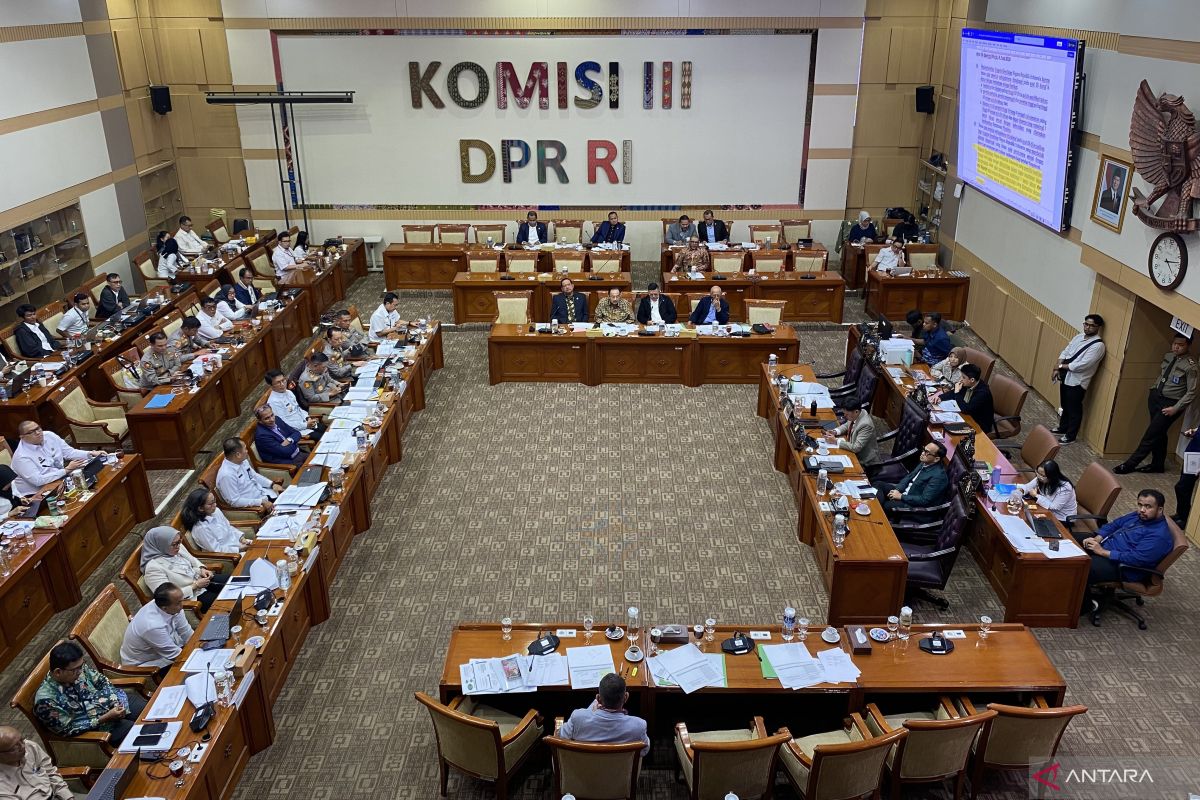
Jakarta (ANTARA) - The Working Committee (Panja) for the Draft Law on the Amendment to Law Number 2 of 2002 concerning the National Police has agreed that the term of office for members of the National Police Commission (Kompolnas) shall be four years, renewable for one additional period.
This agreement was reached during the discussion of the List of Inventarised Problems (DIM) regarding the Police Bill between Commission III of the House of Representatives (DPR RI) and government representatives at the DPR Building, Jakarta, on Monday.
“DIM 104: members of the National Police Commission shall hold office for four years and may be re-elected for only one additional term,” stated Deputy Minister of Law, Edward Omar Sharif Hiariej.
Prior to the final decision, the provisions regarding the term of office for Kompolnas members had sparked debate. Proposals were raised to limit membership to a single five-year term without the possibility of extension.
“Kompolnas is closely linked to the President. The President serves a five-year term. If the President is re-elected, then so be it, but if a different President takes office, it would be strange for the member to continue. They serve as an instrument of the President,” said the Chairman of Commission III, Habiburokhman.
The Head of the National Police Legal Division, Inspector General Agus Nugroho, explained that the extension of the Kompolnas term refers to Presidential Regulation (Perpres) Number 17 of 2011 concerning Kompolnas. He noted that while the regulation specifies four years, any changes made during this forum to align with the presidential term would not be problematic.
Meanwhile, Edward explained that the reason for setting the term at four years with one possible extension was to achieve parity with the term of office for members of the Prosecution Commission. According to the Deputy Law Minister, this is also intended to prevent perceptions of discrimination between state institutions, which could lead to challenges in the Constitutional Court once the Police Bill is enacted.
Although he acknowledged that this specific regulation is not mirrored in the Indonesian Prosecution Law, Edward emphasised that the norms regarding the terms of office for state institution members remain an open legal policy.
Responding to the debate, Habiburokhman suggested that terms for positions not directly elected by the people should be regulated to prevent state institutions from being used merely as employment opportunities for certain individuals. “We must avoid positions not decided through elections becoming places for ‘job seekers’ where people stay too long. So, should we standardise it or what?” he asked other legislators.
In response, Commission III member Adang Daradjatun suggested, “Why must we follow the Prosecution Commission’s four-year term? I suggest five years, but only for one single period.”
Ultimately, legislators agreed to the government’s proposal after the Vice Chairman of Commission III, Moh. Ranold Alfath, stated that a four-year term renewable once does not present a problem. “There is no issue here; the principle is four years and it is ‘may’ be re-elected. If performance is good and they are deemed capable, they can be re-elected. If not, they are not,” he remarked.
Furthermore, the meeting also agreed that the membership of Kompolnas shall be appointed and dismissed by the President.