
Police Bill: Hinca Pandjaitan Questions Minimum High School Requirement for Police Recruitment
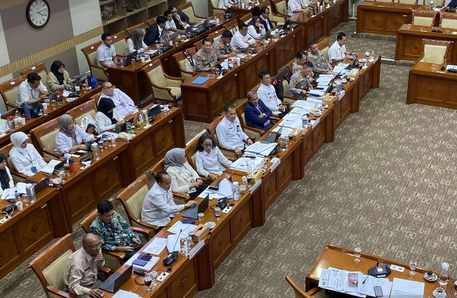
The Working Committee (Panja) for the Draft Law on the Amendment of Law Number 2 of 2002 concerning the National Police (Polri) has officially agreed on regulations regarding the minimum educational requirements for prospective police members. Under this agreement, the minimum educational requirement will remain at the Senior High School (SMA) level or its equivalent.
This decision was reached during a meeting of the Police Bill Working Committee, bringing together Commission III of the Indonesian House of Representatives (DPR RI) and the government at the DPR RI Building, Jakarta, on Monday (8/6). Deputy Minister of Law, Edward Omar Sharif Hiariej, explained that the provision is stipulated in the proposed Article 21, paragraph (1), point d.
“To be appointed as a member of the National Police, a candidate must meet the requirement of having at least a high school education or its equivalent,” Edward stated while reading the draft regulation.
The decision to maintain the high school requirement was questioned by Commission III Member, Hinca Pandjiti, who highlighted public aspirations to raise the educational standard for police officers to a minimum of a Bachelor’s degree (S-1) to improve service quality.
“There is a desire for the education level of our colleagues in the police force to be at least an S-1 level. Is there an explanation from the government as to why the minimum remains at high school level?” Hinca asked during the meeting.
Responding to this, the Head of the National Police Legal Division, Inspector General Agus Nugroho, explained that the high school requirement is maintained based on internal analysis, specifically for the Non-Commissioned Officer (Bintara) recruitment track. However, the National Police will continue to accommodate university graduates through specialised pathways.
“The formation of Bintara is sourced from high school graduates, whereas the formation of Officers (Perwira) is sourced from graduates via the Police Inspector School for Bachelor Graduates (SIPSS). Therefore, both educational levels are accommodated,” Agus clarified.
In addition to education, the latest Police Bill brings progressive news for inclusive groups. The government and the DPR have agreed that Indonesian citizens with disabilities can now be appointed as members of the National Police, provided they possess the specific competencies required by the police organisation. This move is expected to expand the spectrum of service within the Bhayangkara Corps.
With the agreement reached at the Working Committee level, the draft Police Bill will soon proceed to the next decision-making stage before being ratified in a plenary session of the DPR RI. The affirmation of the high school minimum requirement also addresses public speculation regarding the standardisation of police personnel competence, which continues to balance technical field roles with managerial officer tracks.