
Police Begin to Be Replaced, New Phenomenon in China Causes a Stir
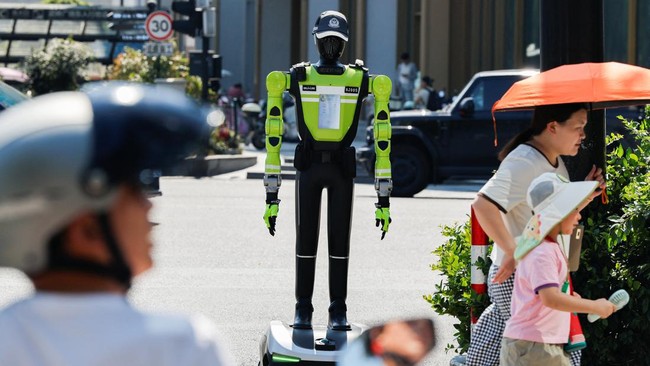
The Chinese government has begun testing the use of autonomous robots to take over a number of traffic police duties. The technology is being deployed to handle routine and repetitive tasks, from monitoring violations to issuing direct warnings to motorists.
The trial is taking place in Hangzhou, in eastern China. At a busy intersection, the 1.88-metre-tall robot is able to detect electric bicycle riders not wearing helmets and automatically voice a warning.
The robot can also move both arms in time with traffic light rhythms, mimicking the standard Traffic Control Hand Signals normally performed by police officers, according to Reuters.
The robot, named T2, was developed by local technology company SUPCON Information. Weighing around 98 kilograms, T2 is part of a pilot project to shift some repetitive traffic management duties to intelligent machines.
Cao Hui, head of SUPCON’s Unmanned Systems Innovation Centre, explained that the robot is equipped with high-precision cameras, radar sensors and an on-board computer to detect various types of violations in real time.
The robot is capable of recognising riders not wearing helmets, electric bicycles carrying more passengers than permitted, vehicles stopping beyond the stop line, and pedestrians crossing against a red light.
In addition to addressing violations, the T2 robot also functions as a public information centre. Members of the public can ask for directions, parking locations and local traffic rules. In emergency situations, the robot provides a direct call feature connected to the nearest police headquarters.
SUPCON has deployed 15 T2 units in Hangzhou since May 2026. The company claims the robots have issued more than 170,000 warnings and succeeded in reducing helmetless riding and stop-line violations by more than 40% within just one month.
However, Reuters has not been able to independently verify those figures. Hangzhou traffic police have also not provided an official response regarding the operation of the robots.
SUPCON has tested T2’s reliability for thousands of hours across various landscapes, from tourist areas, school zones and business districts to congested roads during rush hour and in extreme weather conditions.
Even so, the technology is acknowledged to still have technical limitations. The performance of its cameras and radar sensors can still be affected by overly bright sunlight, heavy rainfall and extreme temperatures.
Nevertheless, SUPCON states that the robot system’s accuracy in recognising violations has exceeded 95%.
Cao stressed that the main philosophy behind the technology’s development is not simply to make it easier to impose sanctions or fines. The robot is designed as a preventive measure to provide early warnings so that traffic violations do not become bad habits in society.
“Robots never get tired,” Cao asserted, highlighting the advantage of autonomous machines that can work consistently without time limits.
The robot can operate independently from 07.00 to 18.00 local time. It moves between patrol points at intersections automatically according to a predetermined mapping without requiring remote control.
On the other hand, an integrated control centre allows police teams to monitor the robot’s movements and deploy the devices flexibly when needed.
SUPCON revealed that nearly 50 similar robots are currently operating in eight cities across three Chinese provinces. The company targets a population of nearly 200 units by the end of this year.