
Police Accelerate Food Self-Sufficiency with Garlic Planting in 14 West Java Regions
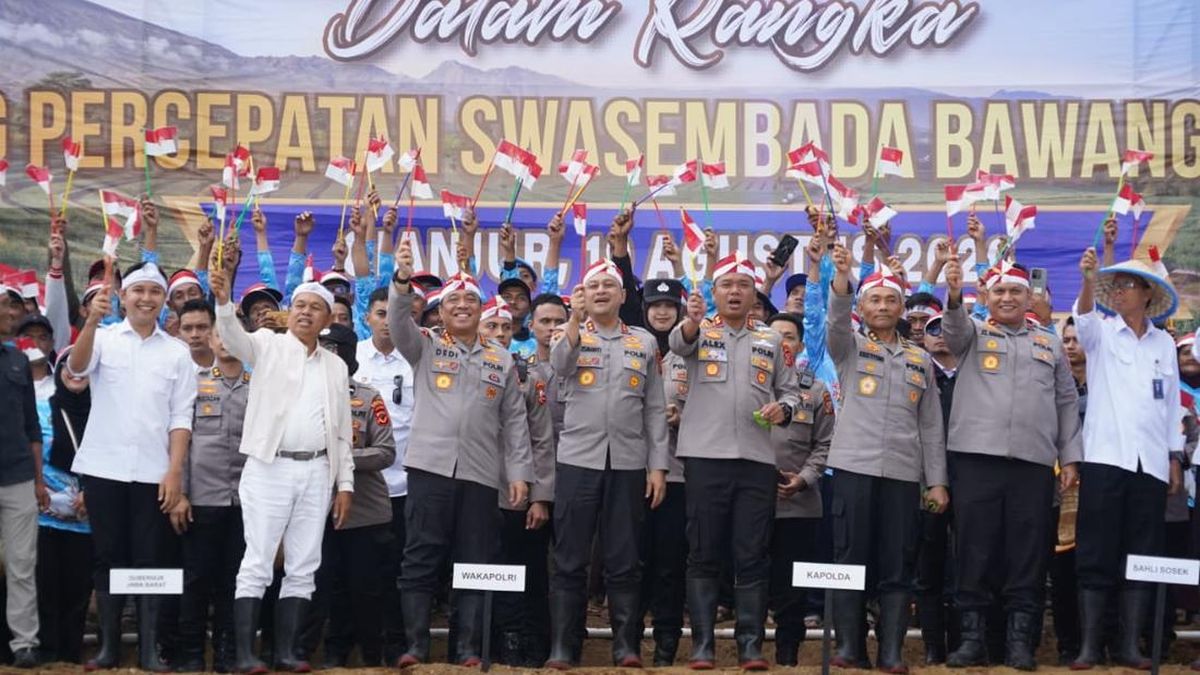
Polri has carried out simultaneous garlic planting in 14 regions of West Java. The activity forms part of the Asta Cita programme, which places food security as one of the main pillars of national self-reliance.
The activity also forms part of a series of events welcoming the 81st anniversary of the independence of the Republic of Indonesia.
The garlic planting was carried out by utilising the potential of agricultural land in various regions, including Cianjur Regency. Farmers in the North Cianjur area were involved in the implementation of the programme as an effort to encourage increased garlic production while strengthening national food security.
The programme also formed part of a series of garlic planting activities, a mass harvest, and the groundbreaking of the Polri Food Security Warehouse. Nationally, the demand for garlic reaches more than 600,000 tonnes each year, while around 95 percent of that demand still depends on imports.
Deputy Chief of the Indonesian National Police, Commissioner General Dedi Prasetyo, said Polri continues to take concrete steps to support the direction of President Prabowo Subianto in realising national food security and self-sufficiency.
“As President Prabowo Subianto has always said, food security is the key to national self-reliance. With self-sufficiency, we are not only meeting the needs of the people, but also strengthening Indonesia’s dignity. Therefore, Polri is moving to make the Asta Cita self-sufficiency programme a success, one of which is through the garlic commodity,” he said on Wednesday (19/8).
According to him, the garlic development effort has been underway since 2025 through cooperation with farmer groups. By 2026, the cooperation has reached a total land area of 948 hectares with a wet harvest yield of 9,480 tonnes.
“A total of 14 regional police commands with 59 district police commands have actively participated in this programme. The total land area planted has reached 279.53 hectares with an estimated harvest yield of 2,795.4 tonnes,” he said.
The Deputy Chief of Police explained that the activity carried out in Sembalun, East Lombok, was one of the main series of the programme. At that location, garlic planting was carried out on 120 hectares of land, a mass harvest on 105 hectares, as well as the groundbreaking of the Polri Food Security Warehouse.
The warehouse will later be used as a storage and drying facility for garlic to maintain the quality of the harvest while supporting supply stability.
Meanwhile, in the West Java Regional Police area, simultaneous garlic planting was carried out on 44.58 hectares of land with a potential harvest yield of 445.8 tonnes.
West Java Regional Police Chief, Inspector General Pipit Rismanto, said that in the implementation of garlic cultivation there are a number of aspects that need attention, including limited human resources, seed availability, and water availability.
To overcome the limited human resources, Polri has prepared 25 people in a collaborative research team involving Agricultural Specialist Non-Commissioned Officers, Polri personnel, farmer groups, students, and agricultural experts.
“This team will study seeds, land characteristics, and cultivation patterns, the results of which will be transferred to farmer groups and partners in West Java,” he said.
In terms of seed availability, Polri has also received support of 1 tonne of seeds from PTPN as well as through self-help efforts. Going forward, collaboration with agricultural agencies and strategic partners will continue to be strengthened, including through the development of a seedling greenhouse concept to improve the availability and self-sufficiency of seeds sustainably.
Meanwhile, to overcome water availability constraints, especially during the dry season, piping will be carried out as well as the preparation of irrigation facilities at a number of cultivation locations.
“With the facilities and infrastructure that are also being built, it is hoped that this garlic cultivation can continue optimally in a sustainable manner,” he concluded.
Through this programme, Polri together with regional governments, farmer groups, and various strategic partners continues to encourage increased domestic garlic production. The step is expected to reduce dependence on imports while supporting the realisation of garlic self-sufficiency as part of strengthening national food security.