
PNM Promotes Women's Empowerment to Strengthen Family Economy and Children's Education
YOGYAKARTA — Empowering women micro-entrepreneurs is considered to have a broader impact than merely increasing family income. When women’s economic capacity strengthens, a family’s ability to meet basic needs, including ensuring the continuity of children’s education, also has the opportunity to improve.
This condition is reflected in the journey of Sulastri, a bamboo craftswoman and mother from Dlingo, Bantul, Yogyakarta. Since 2021, Sulastri has been a client of PNM Mekaar and has obtained access to financing and mentoring to develop a business that has become one of the pillars of her family’s economy.
For Sulastri, the business she runs is not only a source of income to meet daily needs. Behind her activities as a micro-entrepreneur lies the hope that her child can continue schooling and have the opportunity to achieve a better future.
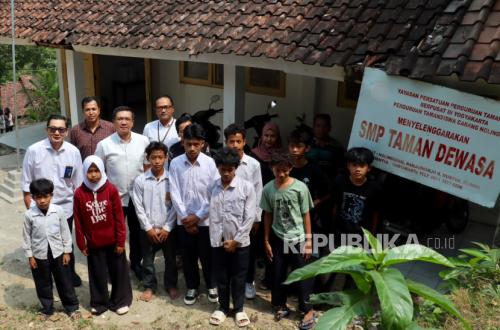
Sulastri’s child currently attends SMP Taman Dewasa 2 Dlingo in Mangunan, Dlingo District, Bantul Regency. The school is an important part of her child’s educational journey.
However, a number of school facilities still require improvement. For families with limited economic conditions, these needs are not always easy to meet independently. This situation also illustrates that family economic issues and access to a proper educational environment are interconnected.
Strengthening the family economy, especially through empowering women micro-entrepreneurs, is one effort that can open greater space for families to maintain the continuity of their children’s education.
Seeing this need, PT Permodalan Nasional Madani (PNM) provided assistance for the improvement of educational facilities at the school where Sulastri’s child studies. The assistance was intended to support a number of repair needs so that the school environment can become more proper and support student learning activities.
PNM Director of Operations and Institutional Relations Lalu Dodot Patria Ary said that client empowerment cannot be separated from the condition of the family and the social environment around them.
“We see Ibu Sulastri’s struggle not only as about how she runs her business, but also how a mother strives to ensure her child still receives a proper education. Therefore, when PNM accompanies clients, attention does not stop at their business. We want to help maintain the environment where their families grow and their children learn,” said Dodot.
According to him, education is an important part of building family welfare sustainably. Client business growth is expected not only to have an impact on increasing economic capacity, but also to provide benefits for family life.
“We help their businesses grow, we pay attention to their families, and their children’s future must also have room to grow. Perhaps this assistance is simple, but we hope it can provide a sense that their struggle is not being carried out alone,” he said.
For Sulastri, the support holds special meaning amid her efforts to run a business while meeting family needs.
“I am grateful that my child can continue schooling. This assistance makes me feel that someone is also paying attention to our struggle. I want my child to keep learning and have the opportunity to achieve their dreams in a good place,” she said.
Sulastri’s story shows that the impact of women’s economic empowerment does not always stop at increased capital or business growth. When women have stronger economic capacity, the benefits can spread to various aspects of family life, including opening opportunities for children to obtain a better education.
This is relevant amid the position of women micro-entrepreneurs who often play a dual role as drivers of the family economy as well as child caregivers. Strengthening their businesses can become one of the foundations for families to face ever-growing household needs.
Ultimately, economic empowerment and education do not stand as two separate issues. Behind a mother’s efforts to maintain family income lies a longer-term investment, namely ensuring the next generation still has room to learn, develop, and pursue their aspirations.
Sulastri’s journey is one illustration of how strengthening women’s economic capacity can bring impacts to the family environment and children’s education. Support for micro-enterprises is therefore not merely a matter of financing, but also part of efforts to expand family opportunities to build a better future.