
PMK Coordinating Ministry: 2006 Yogyakarta Earthquake Must Not Merely Be Remembered as a Tragedy But as a Lesson
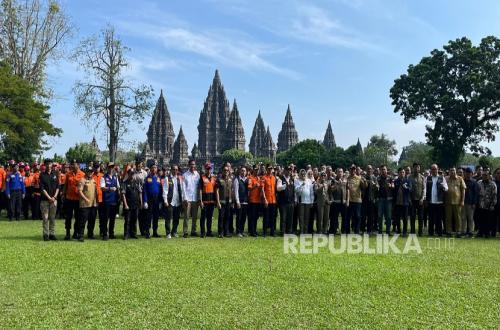
The 20th anniversary of the earthquake that struck Yogyakarta and Central Java serves as a moment for all parties to reflect and enhance disaster preparedness. Lilik Kurniawan, Deputy for Coordination of Disaster Management and Social Conflict at the PMK Coordinating Ministry, stressed that the 2006 disaster should not merely be remembered as a tragedy but as a lesson to build community resilience against future risks.
He reminded that the event left widespread social and economic impacts on communities, making the two-decade commemoration a crucial opportunity to reinforce national collective memory on the importance of disaster readiness.
“Twenty years ago, a magnitude 5.9 Richter scale earthquake shook Yogyakarta and Central Java. The 57-second shaking resulted in over 5,700 deaths, more than 200,000 damaged homes and infrastructure, and estimated losses of over Rp29 trillion at the time,” Lilik said during a disaster preparedness drill and equipment demonstration marking the 20th anniversary of the Yogyakarta and Central Java earthquake at Prambanan Temple on Saturday (23/5/2026).
“The 20th anniversary of the Yogyakarta and Central Java earthquake is not merely a moment to remember past events. This commemoration must serve as a collective reflection to strengthen the nation’s collective memory that disaster preparedness is a vital investment in reducing disaster risks,” he added.
Lilik noted that Indonesia, situated in the Ring of Fire, faces high disaster risks including earthquakes, tsunamis, volcanic eruptions, and hydro-meteorological threats such as floods and droughts. Therefore, mitigation and preparedness efforts must be planned and sustained.
He also stressed the importance of synergy among all pentahelix elements—government, business, academia, media, and communities—to strengthen disaster management systems.
“No single entity can tackle disasters alone. Experiences from various disasters show that cross-sector collaboration and community solidarity are the main strengths in managing disaster impacts,” he said.
During the event, the deputy called for strengthening human resources, equipment readiness, and faster, adaptive early warning systems. He stated that future disaster management approaches must shift from emergency response to more anticipatory risk governance. Besides earthquake threats, the government also warned of potential El Niño impacts causing droughts, clean water crises, and forest and land fires.
Meanwhile, the Yogyakarta Special Region Governor’s speech, read by the Regional Secretary Ni Made Dwipanti Indrayanti, stated that Yogyakarta residents coexist with various disaster threats, including earthquakes, Merapi eruptions, floods, landslides, and tsunamis in the southern region.
“Disasters are part of our living reality,” she said.
Reflecting on the 2006 earthquake, safety can only be built through preparedness long before disasters strike. She noted that BNPB and BPBD did not yet exist then, so initial responses relied heavily on community solidarity. “Amid these limitations, we learned that citizen solidarity is a crucial asset in aiding, evacuating, and supporting recovery efforts,” she added.
Ni Made also agreed that preparedness must be built as an ecosystem encompassing safe infrastructure, early warning systems, disaster education, disaster-resilient villages, regular simulations, and clear evacuation routes.
“Yogyakarta earthquake memories must translate into policy. Let us make preparedness a daily living culture,” she said.
On another front, IDM Operations Director Indung Purwita Jati said her organisation is strengthening disaster education through emergency response training at 10 schools in Yogyakarta, involving around 1,000 students. She noted that senior high school students were chosen as they are deemed sufficiently informed to act as educators within their families and communities.
“We hope these students become ambassadors in their communities, highlighting that Yogyakarta is a cultural city but also highly vulnerable to disasters,” she added.
She added that PT Taman Wisata Candi Borobudur, Prambanan, and Ratu Boko has a special team called Gorila or Gunung Rimba Laut deployed to assist disaster victims nationwide. Regarding temple areas, Indung noted that post-2006 earthquake damage was promptly repaired. Current management has tightened oversight and restricted visitor activities to preserve structural safety.
“Visits are strictly filtered and limited not to discourage tourism, but to ensure safety measures such as no littering or graffiti are followed, given the fragile nature of the temple structures,” she said.
Source: jawawa.id (https://jawawa.id/newsitem/pmk-coordinating-ministry-2006-yogyakarta-earthquake-must-not-merely-be-remembered-as-a-tragedy-but-as-a-1780343283)
Originally published by Republika (https://rejogja.republika.co.id/berita/tfjkk1282/kemenko-pmk-gempa-yogya-2006-jangan-hanya-dikenang-sebagai-tragedi-tapi-harus-jadi-pelajaran), translated from Indonesian