
Plot Twist in Libya: Former Arch-Enemies Khalifa Haftar and Erdogan Meet — What’s Behind It?
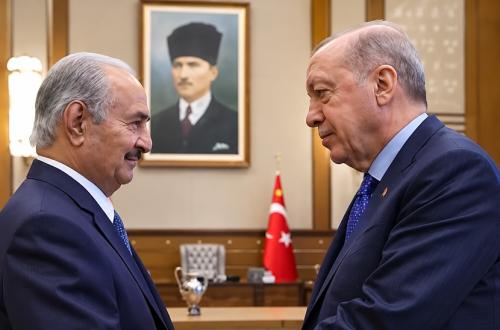
ANKARA — Khalifa Haftar, commander of eastern Libya’s forces, met Turkish President Recep Tayyip Erdogan at the Presidential Complex in Ankara on Wednesday (25 November 2026). The closed-door meeting marked a new chapter in relations between two figures who once stood on opposing sides of Libya’s civil war.
Haftar arrived in Ankara on Tuesday evening (24 November) and was welcomed by General Selcuk Bayraktaroglu, Chief of the Turkish General Staff. The visit was Haftar’s first official trip to Turkey.
The Turkish presidency confirmed that Erdogan met Haftar, with Foreign Minister Hakan Fidan and Defence Minister Yasar Guler also in attendance. Ankara did not disclose the details of their discussions.
Before meeting Erdogan, Haftar and his delegation held talks with several senior Turkish officials: Fidan; Guler; Energy and Natural Resources Minister Alparslan Bayraktar; General Bayraktaroglu; and Ibrahim Kalin, head of Turkey’s National Intelligence Organisation (MIT).
Haftar was accompanied by three sons who hold key positions in eastern Libya: Saddam Haftar, deputy commander of the Libyan National Army (LNA); Khaled Haftar, the LNA’s chief of staff; and Belqasim Haftar, director-general of the Libya Development and Reconstruction Fund.
According to AFP, in a report published by Independent Arabia, Saddam Haftar said the Ankara talks opened a new phase in relations between the two sides, covering political, military, security and economic cooperation.
The meeting is significant given Turkey’s major role in thwarting Haftar’s forces’ attempt to capture Tripoli around six years ago.
From the battlefield to the negotiating table
Relations between Erdogan and Haftar were once at their lowest point. In April 2019, Haftar’s forces launched an offensive to seize Tripoli, Libya’s seat of government at the time, where the UN-recognised Government of National Accord (GNA) was based.
Turkey subsequently provided military support to the Tripoli government. Ankara’s intervention helped shift the balance of power in Libya and ultimately thwarted Haftar’s offensive in 2020.
The two sides also clashed diplomatically. Erdogan once described Haftar as a mercenary, while eastern Libya’s authorities opposed Turkey’s military involvement in the North African country.
Six years later, Erdogan received Haftar at Turkey’s Presidential Complex. Haftar’s sons sat down with officials overseeing Ankara’s foreign policy, defence, intelligence and energy portfolios.
The shift illustrates how geopolitical interests can create room for dialogue between two powers that were previously in military opposition.
Ankara pursues a two-track diplomatic approach
Since the fall of Muammar Gaddafi’s government in 2011, Libya has endured prolonged political turmoil. Armed conflict spread again in 2014, producing two rival centres of power competing for political legitimacy, control of government and management of the country’s resources.
Western Libya is now governed by the Tripoli-based Government of National Unity (GNU), led by Prime Minister Abdulhamid Dbeibah. Eastern Libya, meanwhile, has a rival administration backed by Haftar’s military forces.
A ceasefire agreement in October 2020 brought large-scale fighting to an end. However, political and institutional divisions have persisted, particularly after elections planned for December 2021 failed to take place.
Turkey has recently stepped up contacts with both centres of power. Ankara is seeking to broaden its ties with eastern Libya without abandoning the strategic partnership it has built with the Tripoli government.
On 23 October 2026, Ankara brought together Abdulsalam al-Zoubi, deputy defence minister in the Tripoli government, and Saddam Haftar to discuss unifying Libya’s military institutions.
According to Hurriyet Daily News, one proposal under discussion was the establishment of a joint military command in Sirte, a strategically located city between the centres of power in western and eastern Libya.
Erdogan also met Dbeibah on 12 November 2026 on the sidelines of a climate conference in Antalya. Nine days later, Fidan and Kalin held further talks with Dbeibah in Istanbul.
The series of meetings shows Ankara building lines of communication with both Libyan camps simultaneously. The approach could broaden Turkey’s diplomatic influence in efforts to resolve the country’s political conflict.
Source: jawawa.id (https://jawawa.id/newsitem/plot-twist-in-libya-former-arch-enemies-khalifa-haftar-and-erdogan-meet-whats-behind-it-1795668677)
Originally published by Republika (https://news.republika.co.id/berita/tp3cj0451/plot-twist-libya-dulu-musuh-bebuyutan-jenderal-khalifa-haftar-kini-temui-erdogan-ada-apa), translated from Indonesian