
PLN to Emulate UAE, US, and Saudi Arabia in Aggressive Solar Power Expansion
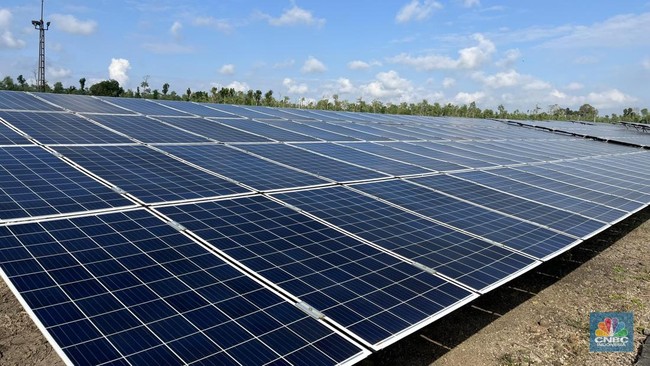
PT PLN (Persero) has identified several countries, including the United Arab Emirates, the United States, and Saudi Arabia, as benchmarks for accelerating the development of large-scale solar power plants (PLTS) within the country. This move aims to adopt land management and technological strategies to achieve national energy sovereignty targets.
PLN President Director Darmawan Prasodjo explained that these nations have successfully optimised landscapes, such as deserts, to produce low-cost energy. He emphasised that PLN is now striving to replicate this efficiency in Indonesia through government-supported land assignments to ensure electricity production costs remain competitive.
“We are certainly conducting benchmarking, particularly in the United Arab Emirates, the United States (specifically California), and Saudi Arabia. They have access to vast desert areas, so land availability is not a challenge in their conditions,” he stated during a Hearing with Commission XII of the Indonesian House of Representatives (DPR RI) on Thursday (2/7/2026).
This initiative aligns with the target to develop 100 Gigawatts (GW) of solar power as directed by President Prabowo Subianto. However, due to Indonesia’s different geographical characteristics, PLN is addressing land challenges by utilising reservoir surfaces and areas along state-owned toll road corridors.
“The government has issued assignments so that this 100 GW solar programme can strengthen the electricity system across Indonesia, transforming energy from imports to domestic, from fossil fuels to renewable energy, and from expensive to cheaper energy,” he added.
To emulate the success of developed nations in providing cheap energy, PLN is collaborating with the Ministry of ATR/BPN to secure 28,000 hectares of land. Furthermore, the utilisation of 10,000 hectares of reservoir surfaces is projected to contribute up to 10.3 Gigawatt peak (GWp) without competing with land needs for residential or industrial use.
“This is because the land is very inexpensive, provided by the state through cooperation between state-owned enterprises, including ATR/BPN. The main challenge for solar programmes using Battery Energy Storage Systems (BESS) has been land,” he noted.
For the first phase of the 100 GW solar mega-project, PLN targets a capacity of 27.4 GWp combined with battery storage of 82.5 GWh. This capacity increase is planned to be realised gradually, with 4.6 GW in 2027, 4.4 GW in 2028, and a target cumulative addition of 19.1 GW by 2030. By 2028, the company plans to build BESS + floating solar projects utilising state reservoirs up to 3.1 GW.
In PLN’s presentation, the company will utilise 1.3 GW of BESS from excess system energy in 2027. Additionally, the BESS + solar programme under the Electricity Supply Business Plan (RUPTL) for the Java system is 2.8 GW, while the BESS + solar programme for fuel elimination in the Bali system is 0.3 GW, and the Madura system is 0.2 GW.
Furthermore, the ‘Fat Burning’ programme launched in Bali aims to reduce dependence on fuel oil (BBM) for power plants by 586,000 kilolitres. This is achievable through the installation of 3,000 MWh of BESS and 1,400 MWp of solar power, requiring up to 1.4 hectares of land.