
PLN Strengthens Governance by Promoting a Culture of Compliance
PT PLN (Persero) is strengthening its corporate governance through improvements in legal capacity and employee compliance. This effort is aimed at ensuring that every business decision operates accountably, prudently, and in line with national regulatory developments.
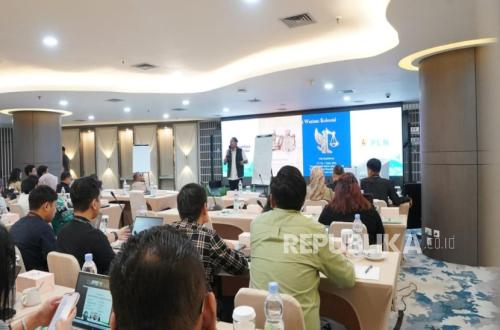
The governance strengthening was carried out through a workshop on litigation skills themed around developments in corporate criminal acts following the new KUHP and KUHAP, held at the end of April. This activity represents PLN’s step to align governance practices with changes in Law No. 1 of 2023 on the KUHP and Law No. 20 of 2025 on the KUHAP.
The workshop was opened by EVP of Litigation and Advocacy at PT PLN (Persero), Chorinus Eric Nerokou, and attended by SEVP of Law, Policy, and Compliance, Nurlely Aman. Eric stated that strengthening the legal function is crucial to ensure corporate governance operates from the policy planning and operational stages.
“The changes to the KUHP and KUHAP fundamentally urge us to alter our perspective and approach towards subjects and objects of criminal acts that can be criminalised, including corporations, from accountability to the expansion of legal risks to directors and decision-makers in corporations. Additionally, it is necessary to ensure that the legal function does not only play a role when disputes occur, but also serves as an instrument for risk mitigation and strengthening corporate governance,” said Eric.
Through this activity, PLN positions the legal function as part of the company’s internal control system to maintain transparency, accountability, and the quality of business decision-making.
The workshop featured advocate and criminal justice system expert Julius Ibrani as the main speaker. In his presentation, Julius explained that reforms in the new KUHP strengthen corporate compliance standards through demands for administration, documentation, and stricter internal oversight.
According to Julius, strong governance is a key factor in preventing legal risks in the corporate environment, especially for state-owned enterprises implementing government strategic programmes.
He assessed that many legal issues arise due to weak documentation and administrative processes, not merely intentional violations. “For example, in the implementation of construction projects, even if permits have been obtained, they may not be well socialised; even if socialised, compensation for losses (if any) may not be completed, and so on regarding environmental impacts and others. Without strong documentation and strict compliance, routine operational actions (corporate actions of SOEs) can risk being drawn into the criminal realm,” he said.
In addition to discussing compliance aspects, the workshop also reviewed important changes in the new KUHAP, including strengthening the principle of rights protection, oversight through Preliminary Examination Judges, and the digitalisation of the criminal justice system. In this system, the company’s digital footprint holds increasing importance as evidence, making data management and corporate administration key elements of modern governance.
Participants also gained understanding of alternative dispute resolution mechanisms such as restorative justice, Deferred Prosecution Agreement, guilty pleas, and peaceful fines, which emphasise proportional dispute resolution before entering the criminal realm.
“Law must be reasoned logically. Material truth must be simple and free from doubt (beyond reasonable doubt),” Julius emphasised.
The workshop was conducted in a hybrid format and attended by PLN employees from across Indonesia. This activity strengthens the culture of compliance while ensuring the consistent implementation of Good Corporate Governance throughout the company.