
PLN Outlines Several Challenges in Developing Solar Power Plants in Indonesia
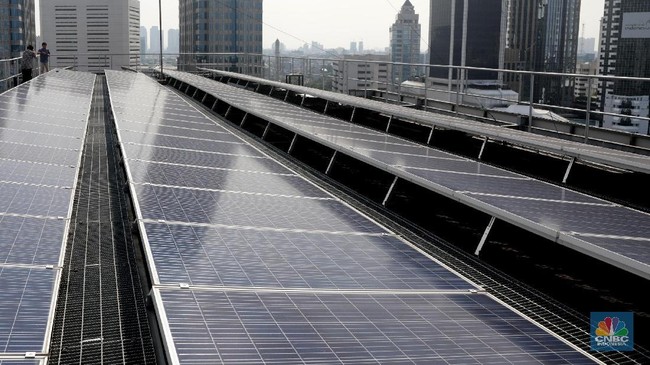
PT PLN (Persero) has outlined various challenges in accelerating the development of domestic solar power plants (PLTS). The obstacles range from mismatches between energy source locations and demand centres, land availability constraints, to uncertainties in long-term electricity absorption by industries.
EVP of Power System Planning at PLN, Arief Sugiyanto, stated that the development of renewable energy sources (EBT), including PLTS, currently faces location-related challenges. He mentioned that much of the green energy potential is located in remote areas far from major industrial zones that represent the main electricity demand.
“The main challenge mentioned earlier is the mismatch between the locations of renewable energy potential and the industrial demand. Most of these locations are quite far from the demand,” he said during the Public Discussion on Renewable Energy Zones (REZ) as an Enabling Instrument by INDEF, in Jakarta on Tuesday (28/4/2026).
To mitigate this, the construction of long and expensive transmission networks is required to evacuate power from the energy sources to consumers. In addition, the process of providing these transmission networks is often hindered by land acquisition issues as well as competition for land use with other economic sectors.
“Another challenge, if we talk about PLTS, if we build it in an industrial area and there is also a PLTS. Well, from the developer’s perspective, whether this land is more profitable to build a PLTS or more profitable to build another factory or perhaps housing,” Arief explained.
Besides that, there needs to be certainty of sustainable electricity demand. His side emphasised the need for investment security guarantees because the operational period of the power plant reaches at least 25 years, whereas the profile of certain industrial contracts is sometimes shorter.
“Industrial zones require a reliable electricity supply. A reliable supply certainly, if the industrial zone only relies on PLTS, it might be a bit risky. Of course, it must be balanced and certainly connected to the PLN electricity system or using batteries,” he stressed.