
PLN optimises Bali solar power plants to reduce dependence on imported fuel
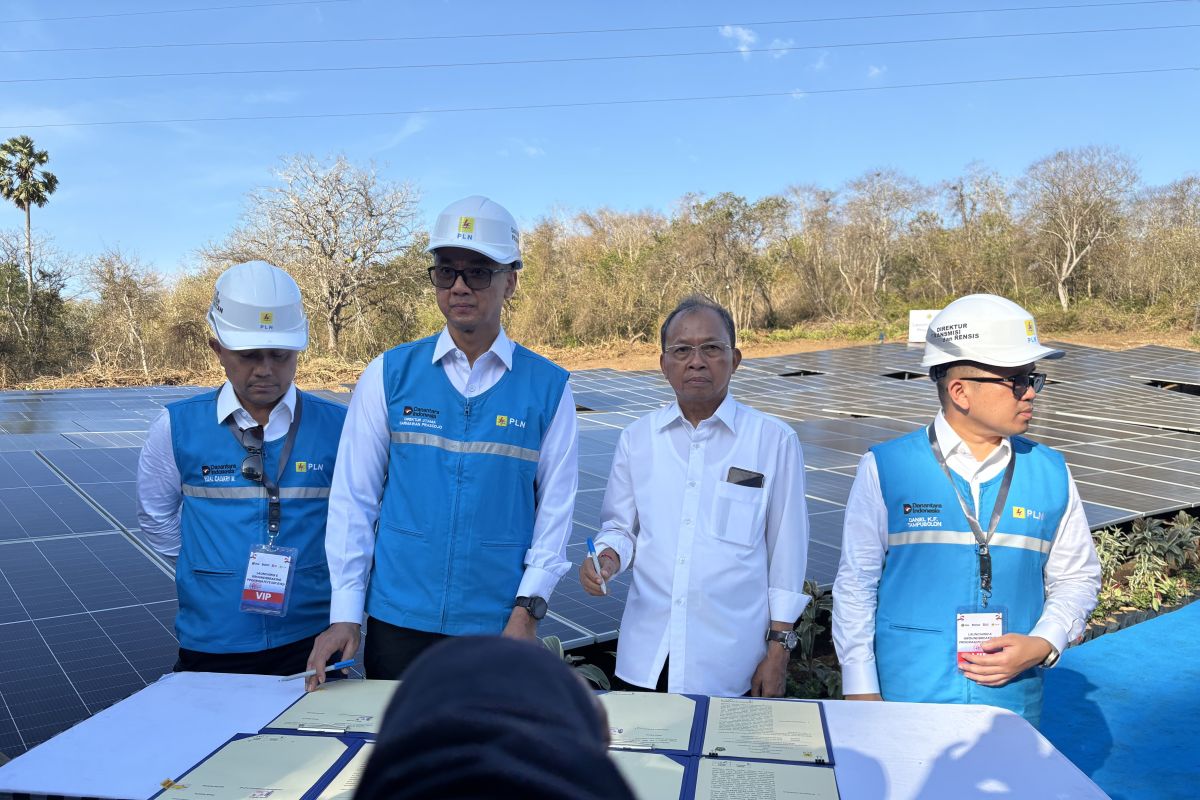
State electricity firm PT PLN (Persero) is optimising the development of solar power plants (PLTS) with capacity of up to 1,000 megawatt peak (MWp), equipped with a 3.3 gigawatt hour (GWh) Battery Energy Storage System (BESS), to reduce the use of imported fuel oil (BBM) in Bali. “With this PLTS programme, Bali’s electricity system is shifting; the previous use of imported BBM is being replaced with domestic energy,” said PLN President Director Darmawan Prasodjo at the launch of the Gilimanuk PLTS development in Jembrana, Bali, on Tuesday. “Later, expensive energy will become cheap energy, and fossil energy will become new renewable energy,” he added.
Darmawan explained that the project’s main advantage over conventional solar plants lies in the integration of a large-scale battery storage system with advanced technology. Through the BESS, solar energy produced abundantly during the day, especially between 10.00 and 14.00 Central Indonesia Time, can be stored for use as a power source from evening until morning. “The large BBM consumption that occurs from late afternoon to evening can be replaced by PLTS energy stored in the Battery Energy Storage System,” Darmawan said.
He explained that all electricity generated by the plant in western Bali will be transmitted through the 150 kilovolt (kV) high-voltage transmission network to reach various areas across the island. “This PLTS is directly connected to the 150 kV high-voltage transmission system, which then evacuates power directly to Denpasar, Nusa Dua, Kuta and Sanur. Although the Gilimanuk PLTS is located in Jembrana, it will supply electricity to the entire island of Bali,” he said.
PLN estimates that the Gilimanuk PLTS potential is not yet maximised because the project is still in its early stages. However, when its capacity reaches 300 MWp, the 320-hectare site has the potential to create jobs for the community.
PLN believes the acceleration of the national solar energy development target of 100 gigawatt peak (GWp) announced by President Prabowo Subianto can proceed more quickly thanks to cross-agency collaboration, involving the Ministry of Energy and Mineral Resources (ESDM), the Ministry of Forestry, and the Ministry of Agrarian Affairs and Spatial Planning/National Land Agency (ATR/BPN) as a solid team. “In this process, we will accelerate economic growth, create jobs, combat poverty, and in the process our nation will become more advanced. We are ready to carry out the programme directed by President Prabowo Subianto,” he said.
Meanwhile, Bali Governor Wayan Koster appreciated the steps taken by PLN and the central government, which he said are in line with Bali Provincial Regulation Number 45 of 2019 on Bali Energy Independence with Clean Energy. Echoing PLN, Koster believes the presence of the solar plants can reduce BBM use in large quantities while enhancing Bali’s tourism image internationally.
“The benefits of this PLTS are not only for meeting energy needs, but also for improving Bali’s tourism image. It will also stop the use of fuel oil, which in Bali reaches 500,000 kilolitres, so there will be no more BBM imports and the cost will be much cheaper,” Koster said.
Koster affirmed that the Bali provincial government is ready to support the use of unproductive state land to optimise PLTS development. In addition to the initial 300 MWp project in Gilimanuk, surveys of dry land are also being conducted in Buleleng and Karangasem to support future expansion of PLTS capacity.