
PLN Merges Two Subsidiaries to Establish PLN Services Subholding
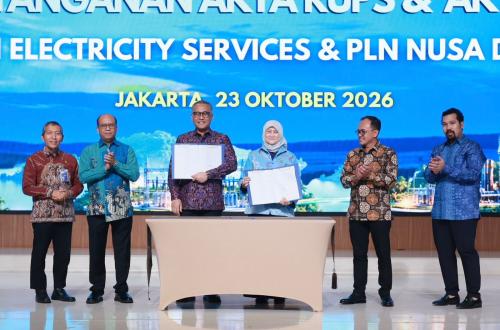
JAKARTA — State electricity company PT PLN (Persero) officially merged two of its subsidiaries, PT PLN Electricity Services (PLN ES) and PT PLN Nusa Daya (PLN ND), to form the PLN Services subholding on Friday (23 October) at PLN’s headquarters in Jakarta. The move is part of efforts to streamline the PLN Group’s portfolio in line with directions from the President of Indonesia through Danantara Asset Management (DAM), simplifying the business structure to make it more effective and efficient and strengthen services to the public.
The merger brings together the two entities’ operation and maintenance (O&M) businesses, combining the experience, expertise, resources and service networks built up by each company. Through this integration, the PLN Group is expected to improve service quality while supporting the operational reliability of electricity generation, transmission and distribution. PLN Services will be PLN’s frontline provider of services to the public.
Bhimo Aryanto, DAM’s Senior Director of Business Performance and Asset Optimisation, said Danantara Asset Management was promoting transformation and streamlining across state-owned enterprises (SOEs), in line with Presidential Instruction No. 7 of 2026 on accelerating the restructuring programme for SOEs and/or their subsidiaries. The restructuring is intended to clarify the role and focus of each entity and create a more coherent SOE structure.
“Today’s merger is the first foundation towards PLN’s supporting O&M services. But I want to stress one thing from the outset: a merger is not an end in itself. It is an instrument for creating greater value. The success of transformation is not measured by a reduction in the number of entities. That is the means, the method, based on careful calculations, which PLN is expected to sustain. We understand that PLN is required to deliver not only profitability, but also reliability,” Bhimo said.
Bhimo added that the programme to restructure SOEs and/or their subsidiaries has four main objectives. First, to simplify corporate structures, reduce duplication of functions and business processes, and create a more efficient organisation. Second, to improve operational efficiency by optimising costs and resource use, and standardising processes, systems and governance. Third, to increase competitiveness through greater economies of scale and the adoption of more competitive professional and commercial standards. Fourth, to optimise capital allocation by prioritising high-value investments, avoiding overlapping capital expenditure, and ensuring that each investment is backed by a sound feasibility case and returns commensurate with its risks.
“Ultimately, SOE reform must deliver benefits beyond the companies themselves. Through effective streamlining, disciplined capital allocation and sustainable value creation, we want to build a stronger, more cohesive SOE ecosystem that not only manages state assets, but also optimises them to generate long-term economic benefits for Indonesia,” he said.