
PLN EPI Strengthens Workforce Competency to Navigate LNG Market Dynamics
Jakarta (ANTARA) - PT PLN Energi Primer Indonesia (PLN EPI) continues to strengthen the competencies and strategic insight of its human resources in facing the dynamics of the global LNG market.
Acting President Director of PLN EPI, Rakhmad Dewanto, said in Jakarta on Wednesday that energy issues have now developed far beyond the question of balancing supply and demand.
According to him, geopolitical shifts, global supply chain disruptions, the accelerating energy transition and changing world consumption patterns have created new challenges requiring companies to read market directions more adaptively and strategically.
Rakhmad added that, as a subholding of PT PLN (Persero) responsible for safeguarding the reliability of national primary energy supply, PLN EPI needs to continuously strengthen its human resource capacity so it can anticipate various potential disruptions while understanding market responses to global changes.
“An understanding of global market developments, including potential disruption and market response, is essential so that we can make decisions that are accurate, swift and sustainable,” he explained.
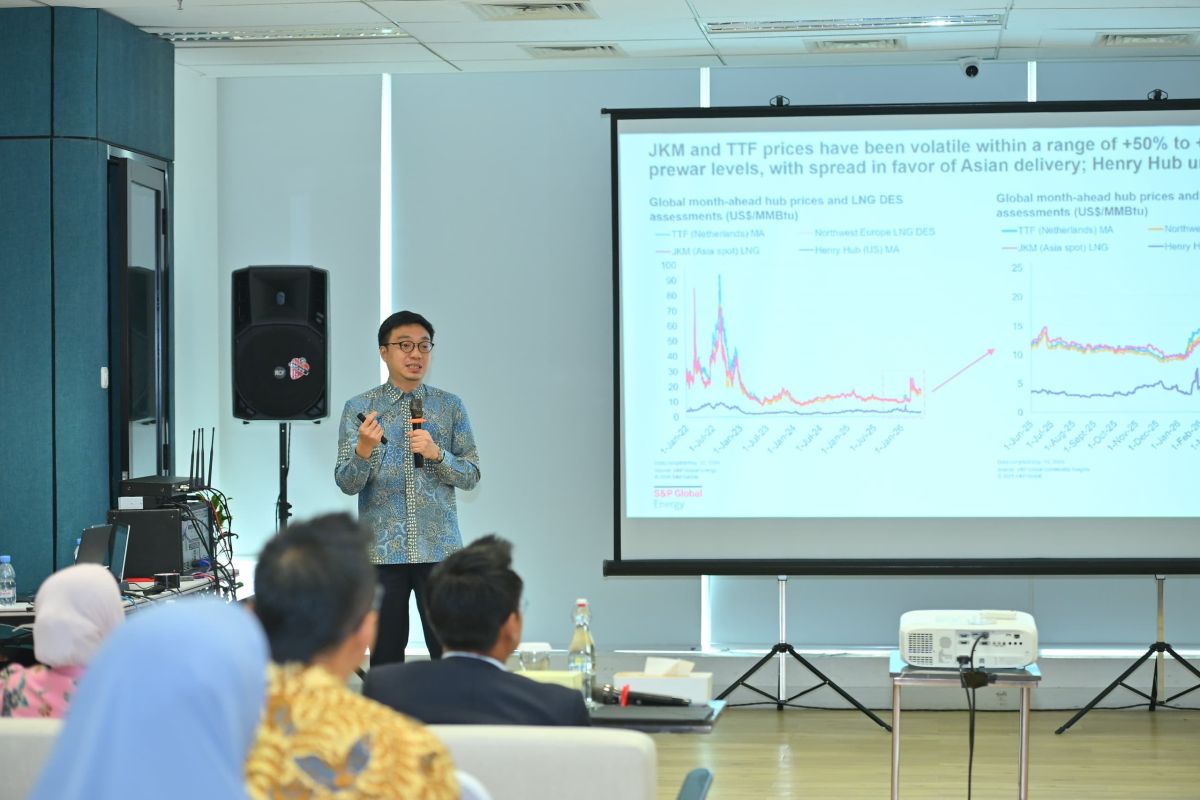
Regarding this strengthening of human resources, PLN EPI Corporate Secretary Mamit Setiawan said the company organised a training session, the “Exclusive LNG Market Briefing”, titled “Global LNG Disruption, Market Response & Indonesia Outlook”.
The event, held by PLN EPI’s Gas and Fuel Oil Directorate, forms part of the company’s efforts to build staff capability so they can understand developments in the LNG and natural gas markets as a basis for strategic decision-making in safeguarding the reliability of the national primary energy supply.
Johan Utama, Senior Principal Analyst for Gas and LNG South and Southeast Asia at S&P Global Commodity Insights, explained in his presentation during the training that global geopolitical dynamics, particularly in the Middle East and the potential disruption of distribution through the Strait of Hormuz, remain one of the main factors influencing volatility in the world LNG market.
“In addition, demand curtailment mechanisms, fuel switching and the balance of global LNG supply and demand will largely determine the direction of the energy market in the years ahead,” he said.
On the other hand, according to Johan, Indonesia has significant prospects for rising natural gas demand in line with growing electricity needs and the transition towards a cleaner energy mix.
Rakhmad expressed hope that the session would not only serve as a knowledge-sharing forum but also strengthen strategic thinking among PLN EPI staff in facing an increasingly complex energy future.