
PLN EPI Strengthens Coastal Community Resilience in Operational Areas
PT PLN Energi Primer Indonesia (PLN EPI) continues to strengthen its commitment to supporting climate change mitigation and the resilience of coastal communities around its operational areas. Muhammad Aminuddin, Vice President of Occupational Health, Safety, Security and Environment (K3KL) at PLN EPI, stated in Jakarta on Wednesday that climate justice is not only about reducing emissions, but also ensuring that communities most vulnerable to the impacts of climate change receive protection and benefits from environmental programmes. ‘We continue to promote various decarbonisation initiatives and nature-based solutions as part of our corporate sustainability strategy,’ he said.
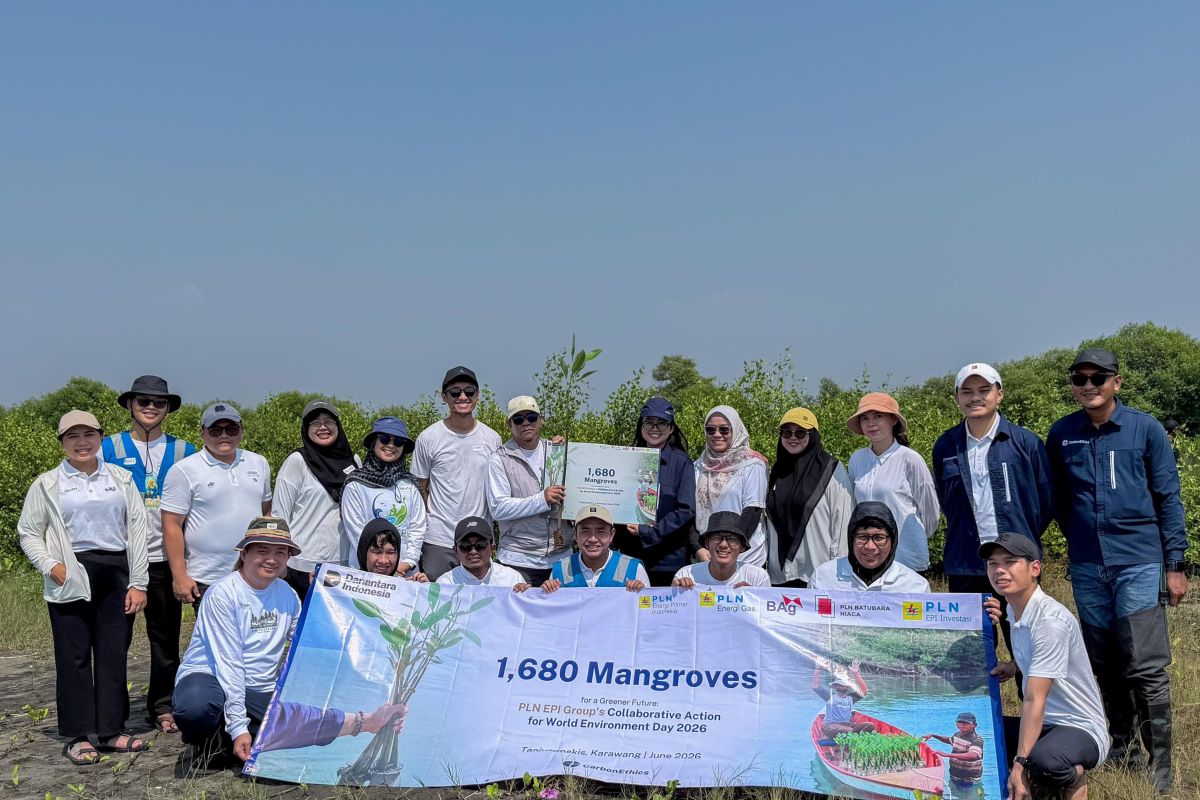
As part of these efforts, PLN EPI, together with its subsidiaries, planted 1,680 mangrove seedlings at Tanjung Pakis Beach, Pakisjaya District, Karawang Regency, West Java. The action, commemorating World Environment Day 2026, was carried out in collaboration with CarbonEthics as an environmental partner supporting the planting, maintenance, and continuous monitoring of mangrove growth to ensure optimal long-term environmental benefits. Aminuddin explained that the mangrove planting at Tanjung Pakis is a concrete step by PLN EPI to strengthen coastal area resilience, restore ecosystems, and contribute to carbon sequestration. ‘Through this action, we want to ensure that environmental benefits can be directly felt by the community,’ he said.
Tanjung Pakis Beach was chosen because of its important role as a coastal buffer zone facing challenges from abrasion and pressure on the mangrove ecosystem. The presence of mangroves serves as a natural fortress capable of protecting coastlines from waves, abrasion, and the impacts of rising sea levels. Beyond protecting coastal areas, mangroves are also part of the blue carbon ecosystem, which is effective in absorbing and storing carbon. This ecosystem supports water quality, provides a habitat for various marine biota, and maintains the sustainability of coastal community livelihoods. Aminuddin added that through this planting, PLN EPI not only seeks to increase coastal vegetation cover but also supports the restoration of the ecological functions of the beach area. The activity involved PLN EPI management, representatives of subsidiaries, local community groups, and various stakeholders concerned with environmental preservation. ‘As part of a measured sustainability approach, this programme does not stop at planting activities,’ he continued. Together with CarbonEthics, PLN EPI will carry out periodic maintenance, monitoring, and evaluation to ensure the plant survival rate and measure the resulting environmental benefits. ‘This approach is expected to create long-term impacts for the coastal ecosystem and the surrounding community,’ Aminuddin stated. The planting of 1,680 mangroves at Tanjung Pakis serves as evidence that collaboration between businesses, communities, and environmental partners can produce tangible results for coastal ecosystem preservation. ‘Through these simple yet sustainable steps, PLN EPI hopes to contribute to creating a more resilient, low-carbon, and sustainable environment for future generations,’ Aminuddin concluded.