
PLN EPI Drives Biomass Standardisation and Supply Chain Efficiency for Energy Transition
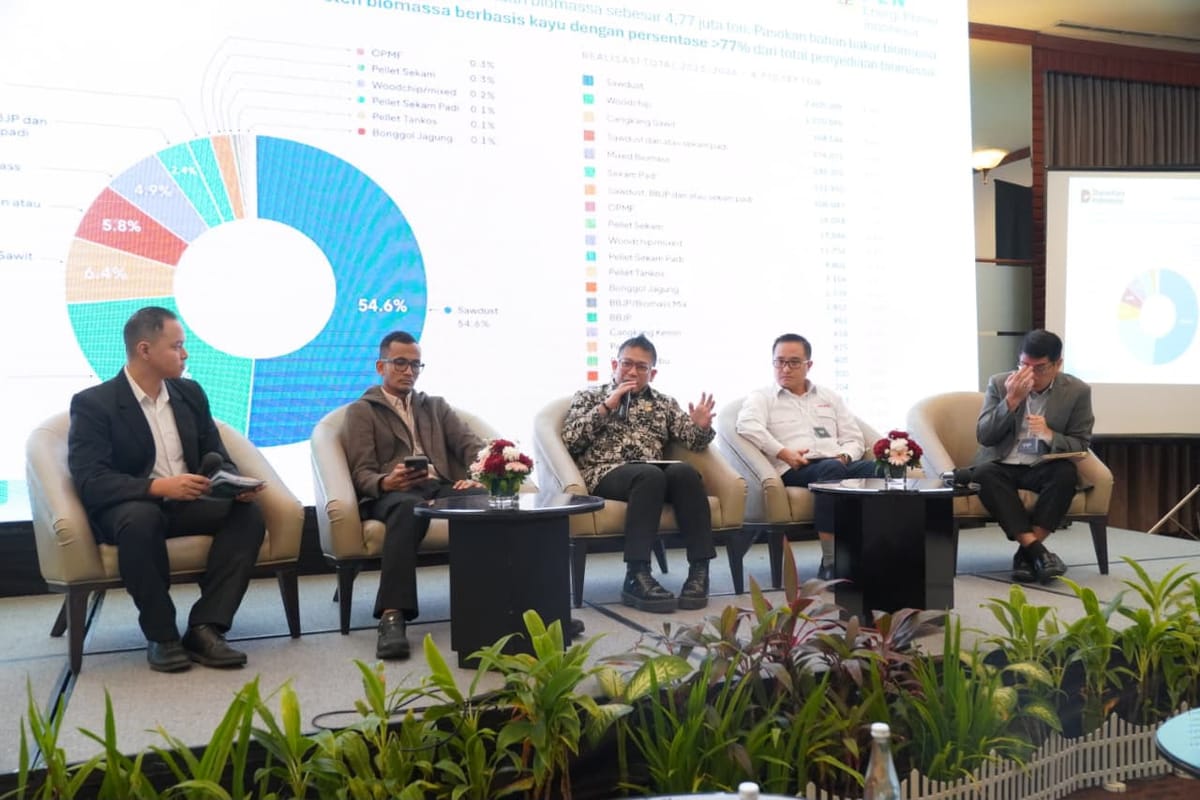
Jakarta, TAMBANG — PT PLN Energi Primer Indonesia (PLN EPI) continues to promote the use of biomass as an energy source. The company recognises that the success of its biomass co-firing programme at coal-fired power plants (PLTU) depends not only on the scale of national biomass potential, but also on other equally important factors: an efficient supply chain, consistent fuel quality standards, and reliable processing infrastructure.
This was conveyed by PLN EPI Biomass Director Hokkop Situngkir at the Material Handling Innovation for Wood-Based Industries: Engineering and Innovation for Sustainable Industrial Growth Symposium 2026, organised by the Indonesia Research Institute at the Millennium Hotel Sirih, Jakarta.
The forum brought together stakeholders from the forestry, industrial and energy sectors, as well as academics and research institutions. Speakers included Satrio Wicaksono, Head of the Undergraduate and Master’s Programmes in Mechanical Engineering at the Bandung Institute of Technology (ITB); Hariyanto, Head of the General Division and Research and Development at the Indonesian Wood Panel Association (APKINDO); and Edwin Kristianto Sijabat, Vice Chairman for Research, Cooperation and Capacity Development at the Indonesian Pulp and Paper Association (APKI).
Hokkop explained that PLN EPI was established to guarantee primary energy supply for around 200 PLTU units at 52 locations, some 200 gas-fired power plants (PLTG/PLTGU/PLTMG), and nearly 800 diesel power plants (PLTD) across Indonesia. To date, most of the nation’s power plants still rely on coal, oil and gas, making biomass one of the strategic solutions for gradually reducing fossil energy consumption.
“Around 90 per cent of power plants in Indonesia still use fossil energy. That is why we continue to expand the use of biomass to partially substitute coal in support of the decarbonisation agenda and the achievement of Net Zero Emissions,” said Hokkop.
According to Hokkop, all the biomass used by PLN EPI comes from residues of the forestry, plantation and agricultural industries, and therefore does not stem from logging activity or deforestation. This approach ensures that biomass development remains aligned with the principles of sustainability and the circular economy.
“We utilise residues that previously had no economic value. In this way, biomass is not only an alternative energy source, but also creates added value for the forestry and plantation sectors without sacrificing forest conservation,” he explained.
He added that through proper processing and quality control, biomass can meet the technical specifications of power plants, allowing it to replace part of coal consumption without compromising the operational reliability of the PLTU.
The implementation of PLN EPI’s co-firing programme continues to show progress. Throughout 2025, the company supplied around 2.35 million tonnes of biomass, contributing to an emissions reduction of approximately 2.72 million tonnes of CO2e. This figure is targeted to rise to 3.65 million tonnes in 2026 and 4.07 million tonnes in 2027 to support co-firing implementation at 52 PLTU across various regions of Indonesia.
Cumulatively, over the 2023–2026 period, PLN EPI has realised biomass provision of 4.77 million tonnes. The supply has been dominated by wood-based biomass, primarily sawdust at 54.6 per cent and woodchip at 22.4 per cent, which have met power plants’ fuel specification requirements.
According to Hokkop, the increase in supply volume must be accompanied by a comprehensive strengthening of the biomass ecosystem. The main challenge lies not only in the availability of raw materials, but also in processing capacity, quality standardisation, storage, and an efficient distribution system.
To address these challenges, PLN EPI is developing the Spoke–Hub model, which integrates raw material collection points (sub hubs), production facilities (hubs), and main hubs as centres for processing, blending, storage and biomass quality control before distribution to power plants. The model is further reinforced by the Biomass Marketplace, a digital platform connecting suppliers with the biomass needs of each power plant.
PLN EPI currently operates biomass processing facilities in Tasikmalaya and Ciamis, each with a capacity of 10 tonnes per hour. Going forward, the company will also expand its biomass hub network in Lebak, Lamongan, Blora, Cilegon and Suralaya as part of strengthening the national biomass supply chain.
By 2028, PLN EPI targets the construction of 15 Main Hubs/Biomass Hubs across various regions of Indonesia, through both company investment and collaboration with strategic partners. This infrastructure is expected to guarantee quality and continuity of supply whilst improving biomass logistics efficiency for power plants throughout Indonesia.
Through strengthened standardisation, infrastructure development and digitalisation of the biomass supply chain, PLN EPI continues to build an integrated bioenergy ecosystem from upstream to downstream. These steps will improve the reliability of primary energy supply and the operational efficiency of power plants.
Furthermore, this will help accelerate the decarbonisation of the power sector, strengthen the use of domestic resources, and serve as an important foundation in supporting the energy transition towards the Net Zero Emissions (NZE) target by 2060 or sooner.