
PLN Develops Integrated Electricity Solutions for Households and Businesses
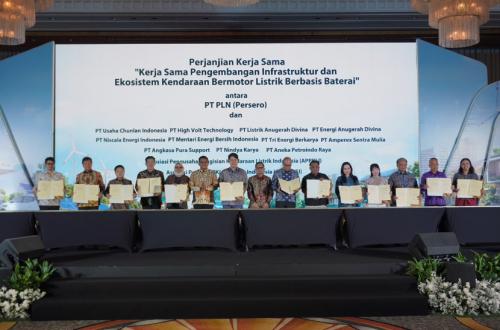
JAKARTA — State electricity company PT PLN (Persero) is expanding collaboration to develop electricity products and services for the public, signing several memorandums of understanding (MoUs) and cooperation agreements with more than 40 entities across sectors at the Green Energy Partnership Summit 2026 in Jakarta on 22 October 2026. Through the partnerships, PLN will strengthen the development of home electrification, electric-vehicle charging and green-energy use, making it easier for customers to access efficient and environmentally friendly electricity.
The agreements involved government bodies, housing developer associations, electrical equipment manufacturers, public electric-vehicle charging station (SPKLU) partners, solar power plant (PLTS) developers and other strategic customers. The initiative also supports government efforts to strengthen national energy resilience and self-sufficiency by making use of domestic energy.
Eniya Listiani Dewi, Director General of New, Renewable Energy and Energy Conservation at the Ministry of Energy and Mineral Resources, welcomed PLN’s collaboration with its partners to promote more efficient energy use.
“I really appreciate what the PLN team has created, because a great deal of new and renewable energy has already been incorporated into future planning,” Eniya said.
She added that energy should be managed intelligently, including by choosing energy-efficient and environmentally friendly technology and electrical equipment in homes. Eniya cited electric stoves as one way to reduce reliance on imported energy, particularly in the non-subsidised household sector.
“Using electric stoves would be very beneficial for households. We still depend on LPG [liquefied petroleum gas], and around 80 per cent of our LPG is imported. So, for non-subsidised consumption, we want to encourage a shift to electric stoves,” Eniya said.
PLN Deputy President Director Yusuf Didi Setiarto said collaboration with a range of stakeholders was an important step towards expanding the use of environmentally friendly electricity across sectors. The initiative also forms part of PLN’s support for the government’s Asta Cita agenda, particularly its aims of achieving energy self-sufficiency and reducing dependence on imported energy.
“Asta Cita places energy self-sufficiency among the foundations of national independence. PLN is translating that direction into concrete action by encouraging households to switch to electricity, expanding the electric-vehicle ecosystem and opening access to green energy for industry. Each step reduces our dependence on imported energy,” Didi said.
He added that the effort required the involvement of many parties, including the government, housing developers, electrical equipment manufacturers, SPKLU partners and photovoltaic (PV) developers.
“This collaboration cannot be carried out by PLN alone. Developers build the homes, manufacturers supply the equipment, SPKLU partners expand the charging network, and PV developers work together to provide solar power plants. PLN’s role is to ensure that this entire ecosystem is connected to a reliable grid,” he said.
PLN Retail and Commerce Director M. Fahrur Rozy said the company was transforming from an electricity provider into an energy-solutions partner offering integrated services. These solutions address customer needs across housing, transport, commercial buildings and industrial estates.
“PLN is transforming from an electricity provider into an energy-solutions partner. We are not just selling kilowatt-hours; we are providing integrated energy solutions, from homes and roads to building rooftops and industrial estates,” Rozy said.
At the Green Energy Partnership Summit 2026, PLN promoted the development of an integrated energy ecosystem so that household and industrial customers can access solutions suited to their needs. The company introduced four main solutions developed with strategic partners.
The first, Eco Grid Living, is a full-electric housing ecosystem with three package options. Eco Cooking is for customers who want to use an electric stove; Eco Charging prepares homes for the installation of home-charging services for electric vehicles; and Eco Living combines both facilities.
The second, My eStove, is a bundled service for new electricity connections or increased capacity that includes an electric stove. Customers can apply through the PLN Mobile app from 27 October 2026.
The third is the development of the electric-vehicle ecosystem by expanding charging infrastructure integrated with PLN Mobile. As of September 2026, PLN had provided 5,120 public charging stations and 103,116 home chargers to support electric-vehicle charging needs.
The fourth, Solar as a Total Solution, offers rooftop solar through the PLN for Business platform. Customers can choose a Solar as a Service arrangement with no upfront investment or make a direct purchase, depending on their needs and investment capacity.
“What we sign today must soon deliver tangible benefits on the ground—in customers’ homes, on the roads and on building rooftops. PLN will continue to open the door to collaboration as widely as possible, because energy self-sufficiency is a shared effort for the whole nation. We are delivering all of this with our partners to provide customers with complete solutions,” Rozy said.