
PLN Details Sumatra Blackout Caused by Power Swing Phenomenon
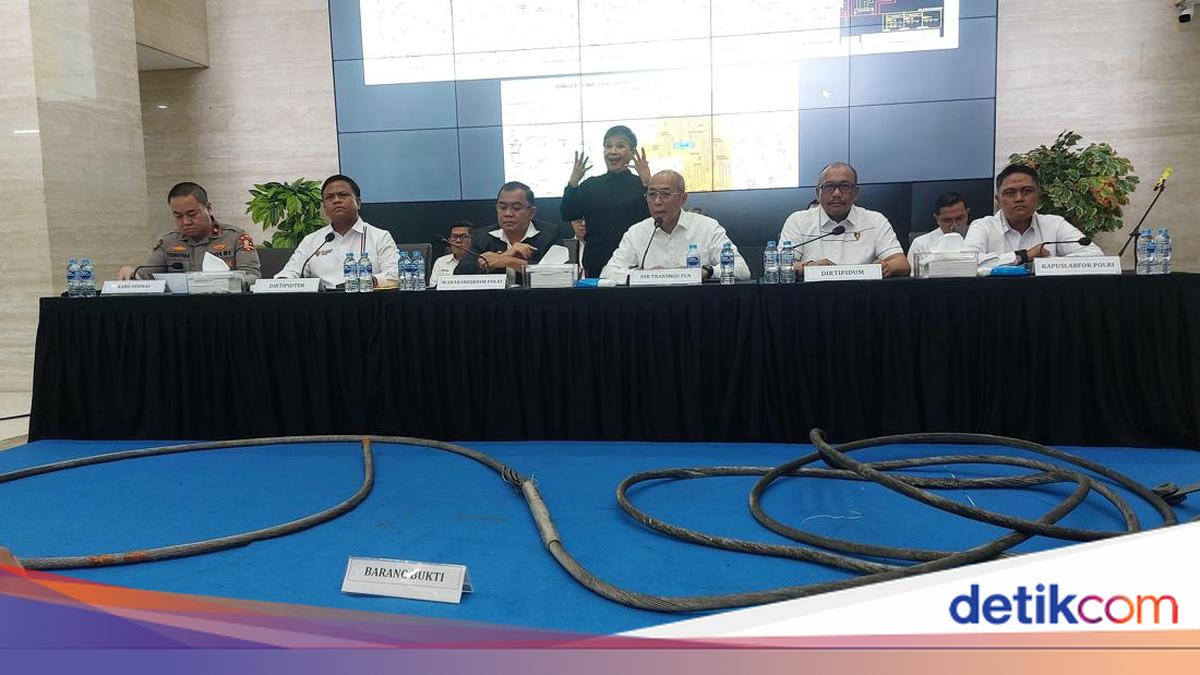
PT PLN (Persero) Transmission Director Edwin Nugraha Putra detailed the timeline of the total power outage, or blackout, in Sumatra. Edwin stated that the power swing phenomenon, or high-voltage oscillation, was the primary cause of the interconnected system’s collapse.
Edwin made the remarks during a press conference at the Bareskrim headquarters in South Jakarta on Monday, 25 May 2026. Edwin first apologised to affected communities across Jambi, Riau, West Sumatra, North Sumatra, and Aceh.
“PT PLN (Persero) extends its deepest apologies, particularly to residents in Riau, Jambi, West Sumatra, North Sumatra, and Aceh, for the power outage that occurred last Friday,” Edwin said.
Edwin explained that Sumatra’s electricity system relies on two main lines: the East Line (500 kV) and West Line (275 kV). The disruption began when extreme weather struck Jambi.
“A fault occurred on the 275 kV transmission line from New Aur Duri to South Sumatra 5, which feeds into the eastern 500 kV line. Heavy rain and strong winds caused both circuits to trip, disconnecting the 500 kV line from the system,” Edwin said.
The disconnection of the eastern line caused electricity flow from the south (Palembang-Lampung) to reverse direction and suddenly shift to the western 275 kV line. Edwin added that this massive current shift triggered the technical phenomenon known as power swing.
“This current shift caused the phenomenon we call power swing, or voltage and frequency oscillation. Both voltage and frequency experienced significant oscillations due to the shift to the 275 kV line,” Edwin explained.
“When the oscillation reached a certain technical threshold, the western 275 kV line had to isolate itself to prevent the power swing from causing wider disruptions. At the Muara Bungo to Sungai Rumbai section, both circuits also tripped,” he added.
Edwin explained that the disconnection split Sumatra’s grid into two sections. The southern regions (Lampung and Palembang) remained stable due to sufficient generation capacity, but the northern areas (Jambi to Aceh) faced severe power shortages.
“In the north, power generation shortages caused low frequency. As frequency dropped, generators tripped one by one in a domino effect,” he explained.
“Other generators saw further frequency declines, leading to all northern plants tripping, resulting in outages for customers in Jambi, Riau, West Sumatra, North Sumatra, and Aceh,” Edwin added.
Edwin noted that recovery times varied by region due to different generator types. Diesel and gas plants (black start units) could restart in 3-5 hours, while steam-powered plants (PLTU) required 20-30 hours to synchronise with the grid.
“We hope that today, major plants such as Pangkalan Susu and others have resumed operation. We expect no further outages in Sumatra’s system today and this evening,” Edwin said.
To prevent recurrence, Edwin added that PLN will strengthen transmission infrastructure monitoring, conducting dual inspections at vulnerable cable connection points.
“We are conducting double inspections using infrared technology to detect abnormal heating in cable connections. If temperatures rise 10-15 degrees above normal, immediate maintenance will be carried out,” he added.