
PLN Commits to Net Zero Emissions by 2060: Here Is Its Plan
Jakarta, CNBC Indonesia — State electricity company PT PLN (Persero) has reaffirmed its commitment to achieving net-zero carbon emissions by 2060. Among the plans it has prepared is accelerating the use of new and renewable energy (NRE).
The commitment was outlined by PLN Director of Technology, Engineering and Sustainability Edwin Nugraha Putra at the 31st meeting of the Conference of the Parties to the UN Framework Convention on Climate Change (UNFCCC), or COP31.
Edwin said the commitment was first announced at COP26 in Glasgow, where PLN became one of the first companies in the world to pledge to achieve net-zero carbon emissions by 2060.
In 2020, coal-fired power plants accounted for 51% of PLN’s generation mix and gas-fired plants for 30%. At the time, renewable energy sources made up just 12%.
From 2021, PLN began incorporating its net-zero commitment into its Electricity Supply Business Plan (RUPTL), targeting a 51% share for renewable power generation, or around 21 gigawatts (GW).
In 2025, PLN revised the RUPTL again and reiterated its commitment to accelerating renewable energy use, setting a target for renewables to account for 76% of additional generating capacity.
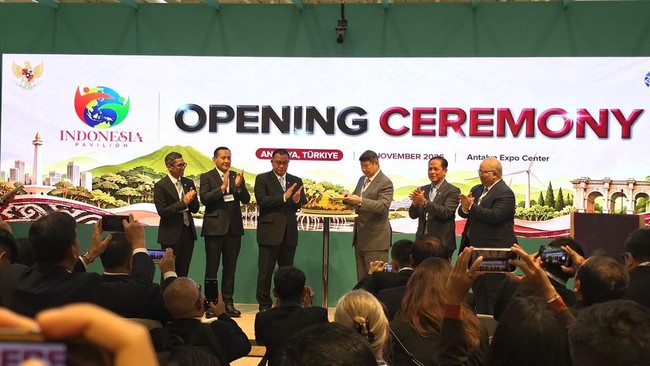
“We have prepared a scenario that we call accelerating renewable energy development. We hope that by doing this, we can reduce emissions to zero by 2060,” Edwin said at a CEO Talks event at the Indonesian Pavilion at COP31 in Antalya, Türkiye, as quoted on Wednesday (11 November 2026).
Edwin added that between 2021 and 2025 PLN had added about 2.1 GW of renewable energy to the national electricity system. This included around 500 megawatts (MW) from hydropower, 346 MW from solar power, 188 MW from bioenergy and about 1.2 GW from other renewable sources.
This year, PLN is ready to launch around 10.23 GW of renewable power projects for contracting. They include the 1.72 GW Mentari Nusantara 1 solar project, the 1.9 GW Nusantara 2 solar project, 1.2 GW of wind power, 1 GW of hydropower in Sumatra, 1 GW of hydropower in Kalimantan and 3 GW of hydropower in Sumatra.
“All of them are ready to be launched, adding a total of 10.23 GW of new renewable energy to the system,” Edwin stressed.
PLN has also secured about US$2.94 billion in funding to speed up renewable power development. The financing comes from international financial institutions, including the World Bank, KfW, ADB, EFD, Finance Australia and JICA.
Edwin said PLN would also sign an agreement with the Norwegian government at COP31 on a Mitigation Outcome Purchase Agreement (MOPA). Under the agreement, PLN will be able to sell carbon credits to Norway, representing up to five million tonnes of CO2 equivalent in emissions reductions by 2040.
100 GW solar ambition
Edwin said the 2060 net-zero target is also supported by President Prabowo Subianto’s priority programme to develop 100 gigawatt-peak (GWp) of solar power.
He said the planned solar installations would be paired with Battery Energy Storage Systems (BESS), allowing the electricity generated to be stored and used at night.
“With BESS available and its price continuing to fall, we can put all the energy from 100 GW of solar into BESS. We can then operate BESS not only during the day, but for 24 hours. This would allow us to feed all 100 GW of solar power into the system and store it in BESS,” he said.
He said the 100 GWp solar programme was also designed to replace diesel power plants still operating across around 741 islands in Indonesia.
If implemented, the measures would strengthen PLN’s position in Environmental, Social and Governance (ESG) ratings. The company’s ESG rating is projected to reach the low-risk category by 2039 through implementation of all RUPTL plans, and could reach that level by 2034 if the 100 GWp solar programme is also implemented.
Edwin said that to achieve the target by 2030, PLN would need to reduce emissions at all its coal-fired power plants, which currently account for around 50% of its generation mix, through biomass co-firing.
“We currently use 5% biomass co-firing. If we increase this to 15%, we could reach the low-risk category not in 2039 or 2034, but as early as 2030,” Edwin said.