
PLN Clears Water Hyacinth Overgrowth in Saguling Reservoir
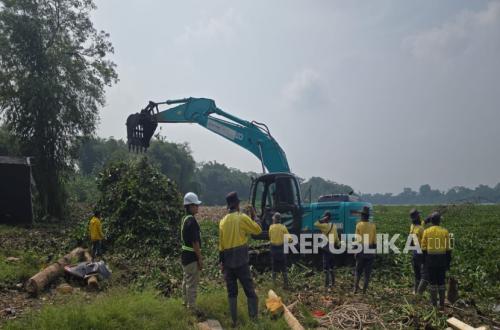
PLN Indonesia Power (IP) UBP Saguling has addressed the issue of water hyacinth flourishing in the waters of the Saguling Reservoir. The presence of water hyacinth is polluting the environment and is suspected to be triggering the breeding of mosquito populations in Rancapanggung Village, Cililin Subdistrict, West Bandung Regency (KBB), West Java. Senior Manager of PLN Indonesia Power UBP Saguling, Doni Bakar, stated that his team, along with relevant stakeholders such as the Citarum Harum Task Force, Kodim 0609 Cimahi, Perum Jasa Tirta (PJT) II, local government (pemda), environmental communities, and residents, routinely clean the water hyacinth in the Saguling Reservoir. “In the last year, approximately 8.5 hectares of water hyacinth area have been cleared through collaborative activities involving multiple agencies and the community. The handling uses heavy equipment as well as manual transport by field personnel,” said Doni when contacted on Wednesday (13/5/2026). He explained that the accumulation of water hyacinth in the Saguling Reservoir has the potential to disrupt electricity production from the Hydroelectric Power Plant (PLTA), which is known as a renewable energy plant that functions to support peak loads in the Java-Bali system and acts as a frequency regulator in the system by implementing load frequency control (LFC). The massive growth of water hyacinth and increasing sedimentation due to waste will affect the capacity and resilience of the power plant’s production equipment. “Regarding the impact of waste on electricity production, there is certainly an influence. It does not happen quickly, but gradually it will have an impact. Accumulated waste will trigger the growth of water hyacinth,” Doni clarified. Therefore, his team continues to carry out ongoing handling and support from various parties so that the efforts can run optimally. In addition to cleaning, the utilisation of water hyacinth into economically valuable products is also being promoted as part of sustainable management. PLN Indonesia Power UBP Saguling also continues to coordinate with local government and related agencies in maintaining the quality of the reservoir and river water environment in the area. “Through strengthened collaboration, PLN Indonesia Power hopes that the handling of water hyacinth can provide benefits to the environment while supporting the sustainability of the Saguling Reservoir’s function for the community and the electricity system,” said Doni. Chairman of RW 10 in Rancapanggung Village, Rohmat, stated that swarms of mosquitoes invading settlements and residents’ homes usually appear from evening until morning. The mosquitoes then disappear when the sun’s heat begins to shine on the area. “From morning until 8 a.m., there are many mosquitoes; when it gets hot, they disappear, then they come again from 5 p.m., entering the houses. So when it starts to get dark, at night there are many,” said Rohmat. So far, residents have only relied on burning mosquito repellent to ward off the swarms of mosquitoes. Because, the fogging carried out some time ago was apparently not effective, and according to Rohmat, it even made the mosquito population increase. “Fogging was done yesterday, but the mosquitoes increased even more. So now we just use burning mosquito repellent; one pack can be finished in a day,” said Rohmat. He emphasised that the swarms of mosquitoes terrorising residents do not cause dangerous diseases like dengue fever (DBD) and chikungunya like the Aedes aegypti type. However, their presence still disrupts activities and causes residents to experience itching. “The mosquitoes have been entering the settlements for three months, causing anxiety and disruption. The mosquitoes bite, causing itching and red welts immediately,” Rohmat said. According to him, the breeding of mosquito populations in his area is due to the massive growth of water hyacinth in the Saguling Reservoir waters. Therefore, residents hope that the relevant parties will soon clean the water hyacinth that fills the waters. “The Saguling water usually recedes every eight months, but last time it didn’t recede, so the hyacinth increased a lot. Now the hyacinth is even fuller and spreading, and the mosquitoes are many now,” said Rohmat.