
PLN Chief Explains How Solar Power Can Supply Electricity 24 Hours a Day
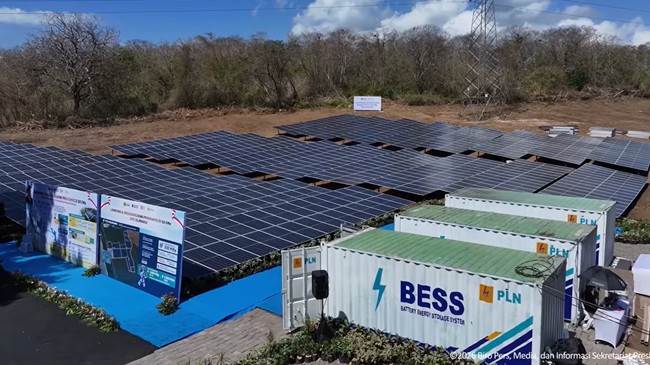
Jakarta, CNBC Indonesia – State electricity company PT PLN (Persero) has said that a planned 100 gigawatt-peak (GWp) of solar power capacity will be usable around the clock, despite solar plants being most effective at generating electricity during daylight hours.
PLN will use battery energy storage system (BESS) technology, combining the development of the 100 GWp of solar capacity with battery storage.
PLN Director of Technology, Engineering and Sustainability Edwin Nugraha Putra said current BESS supply was sufficient to support the programme, and the company would use the technology across all of its 100 GWp solar projects.
“We operate BESS not only during the day, but for 24 hours. This makes it possible for us to feed all 100 GW of solar power into the system and store it in BESS,” Edwin said at CEO Talks at the Indonesia Pavilion at COP31 in Antalya, Turkey, according to a report on Wednesday (11 November 2026).
Edwin said the use of 100 GWp of solar power and BESS could also reduce dependence on fuel oil, lower electricity costs and strengthen the reliability of the national power system.
One objective of the programme is to end the use of fuel at diesel power plants on 741 Indonesian islands. Edwin estimated that the priority programme launched by President Prabowo Subianto could eliminate the need for about 4 million kilolitres of oil for diesel power plants within the next three years.
“By using BESS, it is possible for us to reduce the need for 4 million kilolitres of oil to zero over the next three years,” Edwin said.
Tender process
In an earlier report, Energy and Mineral Resources Minister Bahlil Lahadalia said the government was preparing regulatory adjustments to speed up tenders for the 100 GWp solar project.
He said the government would simplify tender procedures for companies considered competitive and technologically capable, in order to accelerate delivery of the project, which is targeted for completion within three years.
“I am currently making regulatory adjustments for companies that are competitive and have strong technological capabilities. We are considering making the tender process less lengthy,” Bahlil said at the 2026 MKI Electricity Connect event at ICE BSD in Tangerang regency on Tuesday (22 September 2026).
Bahlil said the government would cut bureaucratic processes that could impede implementation. Procurement would be expedited if a company and its proposed project met economic viability requirements.
He said he was confident the 100 GWp solar project could be delivered within three years. The government launched about 5.5 GW in the first phase this year, while tenders for a further 25–30 GW of projects are expected to begin.
“For the 100-gigawatt solar project, we plan to complete it in three years. This year we have launched around 5.5 gigawatts in the first phase, and the tender process for around 25 to 30 gigawatts should begin,” Bahlil said.
Launched by Prabowo
President Prabowo Subianto inaugurated the start of construction of the 100 GWp solar power project in Jembrana regency, Bali, on Tuesday (25 August 2026).
Prabowo said the massive solar project was expected to provide a key solution for ending imports of crude oil and LPG, which have weighed on the country’s foreign exchange reserves.
“The essence is that with 100 gigawatts, we will truly become a nation standing on our own feet. We will not fear developments anywhere in the world. With 100 gigawatts, our geothermal resources, the gas fields we have found and rising oil production, we must not import even a single barrel of oil. God willing, as soon as possible, we must not import even a single LPG cylinder,” Prabowo said at the launch in Bali.
He said the 100 GWp target needed to be completed quickly to reduce reliance on fuel imports for power generation. He challenged Bahlil to deliver the project sooner than originally planned, setting a target of less than three years.
“I believe we may reach 100 gigawatts in less than three years,” Prabowo said, adding that he wanted the energy team to complete the project in two years. He said the team would receive a further honour if it met that target.
In the initial phase, construction was launched for 5.3 GW of capacity. Bali was allocated 1,000 megawatts (1 GW), equipped with a battery system. The project there will use state-owned land to speed up implementation and enable a shift away from diesel power plants.
The electricity generated by the solar plants is expected to cost around US$0.05–0.06 per kilowatt-hour, excluding battery costs.
According to the Energy and Mineral Resources Ministry, the mega-project requires total investment of US$73 billion, equivalent to more than Rp1,140 trillion. The government estimates that operating 100 GW of solar capacity could save Rp73.9 trillion a year in energy subsidies and create around 5.52 million jobs.
The government will prioritise partnerships with private companies, or independent power producers (IPPs), through a tender process.
Source: jawawa.id (https://jawawa.id/newsitem/pln-chief-explains-how-solar-power-can-supply-electricity-24-hours-a-day-1794397898)
Originally published by CNBC Indonesia (https://www.cnbcindonesia.com/news/20261111150242-4-784308/listrik-plts-bisa-dipakai-24-jam-bos-pln-blak-blakan-caranya), translated from Indonesian