
PLN builds green energy ecosystem technopark on Rengit Island
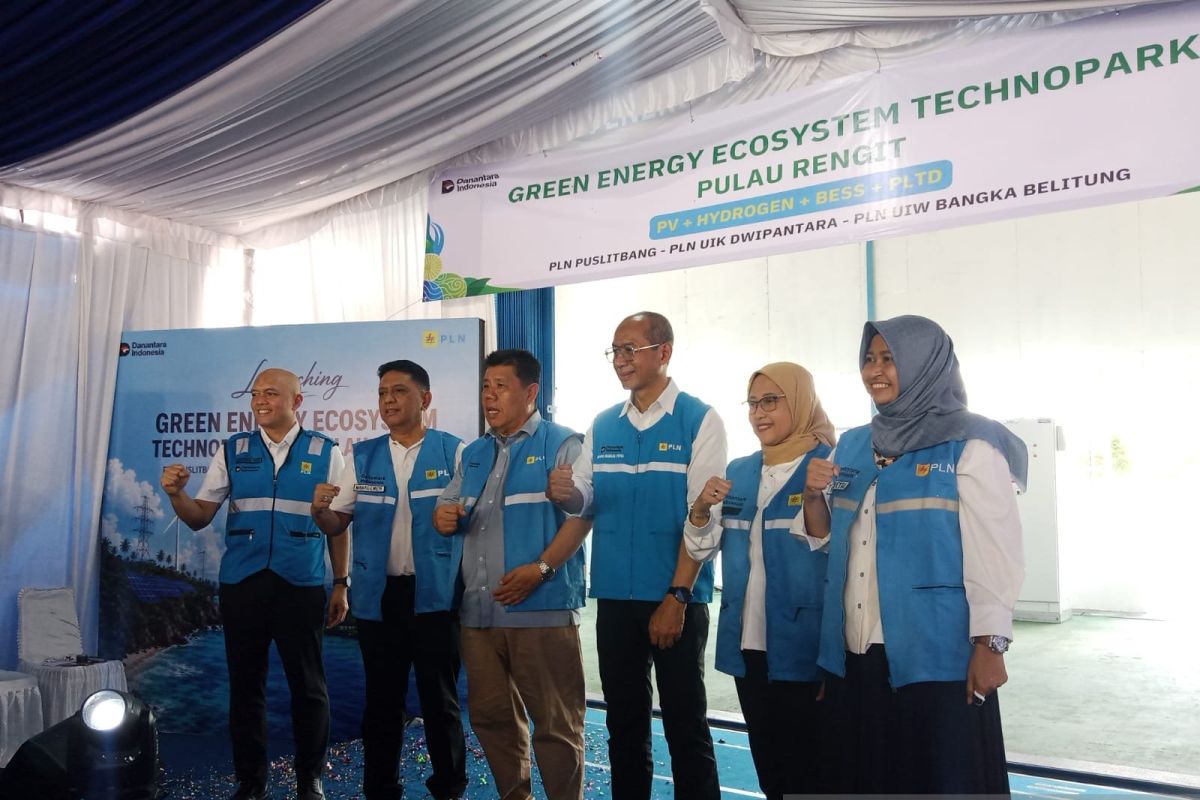
PT PLN (Persero) has officially introduced a clean energy ecosystem based on a Green Energy Ecosystem Technopark on Rengit Island, Pegantungan Village, Badau District, Belitung Regency.
PLN’s Director of Technology, Engineering, and Sustainability, Edwin Nugraha Putra, said in Tanjungpandan on Saturday that the launch of this electricity innovation was a historic step in supporting the government’s commitment to achieving national electricity self-sufficiency and energy security.
“Today is a truly historic moment. We are here to witness first-hand the operation of a renewable energy-based electricity system, PLN’s first pilot project, which is tangible proof of our shared commitment to answering the great challenge from the President,” he said at the inauguration of the Green Energy Ecosystem Technopark on Rengit Island, Pegantungan Village, Belitung.
The pilot project has succeeded in reducing dependence on diesel power plants while delivering environmentally friendly electricity supply around the clock to communities in the 3T regions.
Before this pilot project, Rengit Island, inhabited by around 44 households or 150 people, could only enjoy electricity for 12 hours at night.
The village’s electricity previously relied on two diesel generator sets with a capacity of 100 kilowatts each.
“The very high operational cost of fuel forced restrictions on operating hours,” he said.
He said the limited conditions had hampered the area’s economic potential.
“Local fishermen could not operate cold storage facilities,” he said.
Now, through the operation of the Green Energy Ecosystem Technopark, electricity supply on Rengit Island has been operating around the clock.
“Residents’ electricity consumption has surged significantly from 70 kWh to 172 kWh, which has directly boosted the fishermen’s economy and spurred economic growth,” he said.
Edwin explained that the technology applied on Rengit Island integrates several modern renewable energy sources in a sophisticated manner, one of which is an 80 kWp agrivoltaic solar power plant.
“The solar panels are built elevated above an area of around 800 to 1,000 square metres. The space beneath is used for cultivating food crops suited to the shade of the panels, in cooperation with the University of Bangka Belitung to support food security,” he said.
In addition, a modern battery system stores surplus solar energy produced during the day in an advanced battery system with a capacity of 2x100 kWh for distribution at night.
“It is also equipped with vertical and horizontal wind turbines that can rotate at low wind speeds,” he said.
Edwin stressed that the integration of renewable energy technology on Rengit Island is not only a concrete solution for remote areas in Indonesia, but also has the potential to become a model of green energy technology for the world.
“This system is proof that communities in remote areas also have the right and the ability to enjoy clean, independent, and reliable electricity around the clock. Hopefully this facility can be maintained together and become a spark for the local community’s economy,” he said.